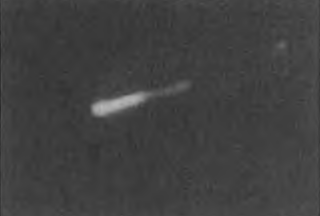
It started on a beach in Malaysia
In Batu Ferringhi, on the northern coast of Penang Island, a father and son began looking up with equipment they had built themselves. Annamalai Muthu and his son Arav were amateur astronomers, but their project was not a conventional backyard telescope. They assembled an ultraviolet/infrared imaging system around a modified smartphone and tablet, trying to see more than the naked eye could see.
Between late 2021 and mid-2022, they began recording objects they could not explain. The images were not presented as a finished scientific study. They were observations: small lights, elongated forms and points in the sky, captured through a homemade setup and then labelled by the observers according to what they thought they might show.
A contemporaneous Malaysian report provides context for the project. It records the observers’ interest and method, but it does not identify the pictured objects. That distinction matters from the beginning.

What they had was a collection of photographs and a question: if the objects were not ordinary aircraft, stars, satellites or debris, would anyone with better instruments be willing to look at them?
The search for someone who would listen
The pair began sending the material outward. Their correspondence reached public bodies and political contacts in different countries, but the replies were cautious and uneven. The UK Ministry of Defence correspondence, released in the surrounding record, says the department no longer investigated UAP or UFO reports. The route through government did not produce an identification.
Other approaches were framed less as requests for an answer than as requests for attention. The released dossier records contact with Malaysian authorities, including a response that acknowledged receipt and said an internal investigation would be considered. Euronews later reported political correspondence involving Canadian MP Larry Maguire and described the observers’ continuing attempts to place the material before institutions with scientific or defence responsibilities.
NASA also appears in the wider correspondence trail. Its inclusion should not be mistaken for an assessment of the photographs. The record shows interest in continued study and public data collection, not a NASA finding about what the objects were.
The pattern is quieter than the headline: a private observation can move through several official channels without becoming an official case. Responses can acknowledge the report, encourage further work or state a department’s limits without validating the underlying interpretation.
Then 37 images went to Brussels
On 17 October 2022, the pair sent a package titled “UAP captures in the Airspace and in Deep space using our UV infrared telescope” to the European Commission. It was a direct appeal to an institution involved in defence industry and space policy: perhaps, they reasoned, a European department concerned with detecting objects around Earth could help distinguish what their instruments had recorded.
The public-access dossier preserves the correspondence and several pages of the submitted images. It also preserves the observers’ own language. They refer to UAP, asteroids, meteors and objects near Venus. Those words tell us how the images were being interpreted at the time; they do not settle the identity of the objects.
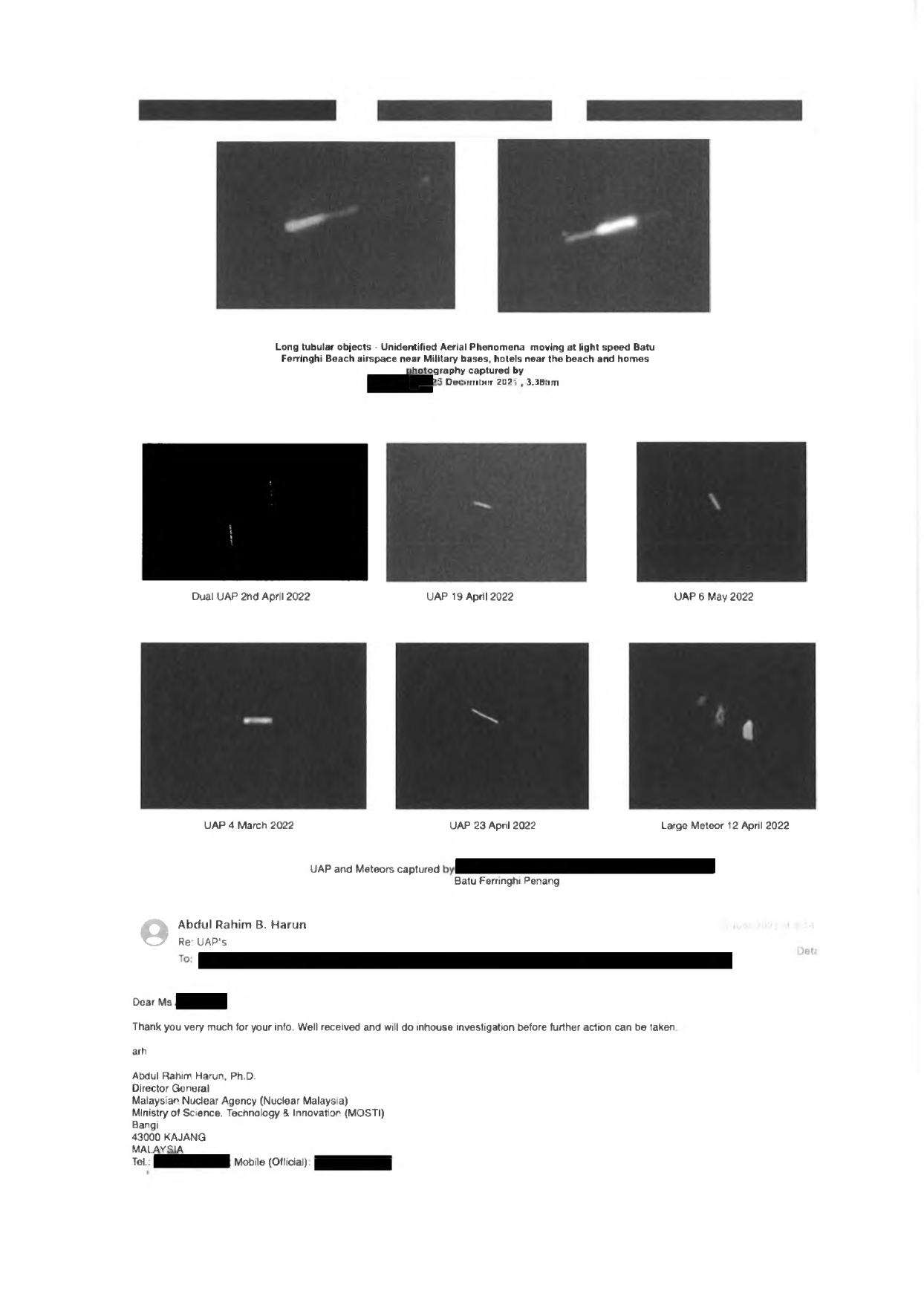
Images reproduced from correspondence released through European public-access rules. Terms such as “UAP” are observer-provided labels; neither the release nor the Commission reply identifies the objects.
Brussels wrote back
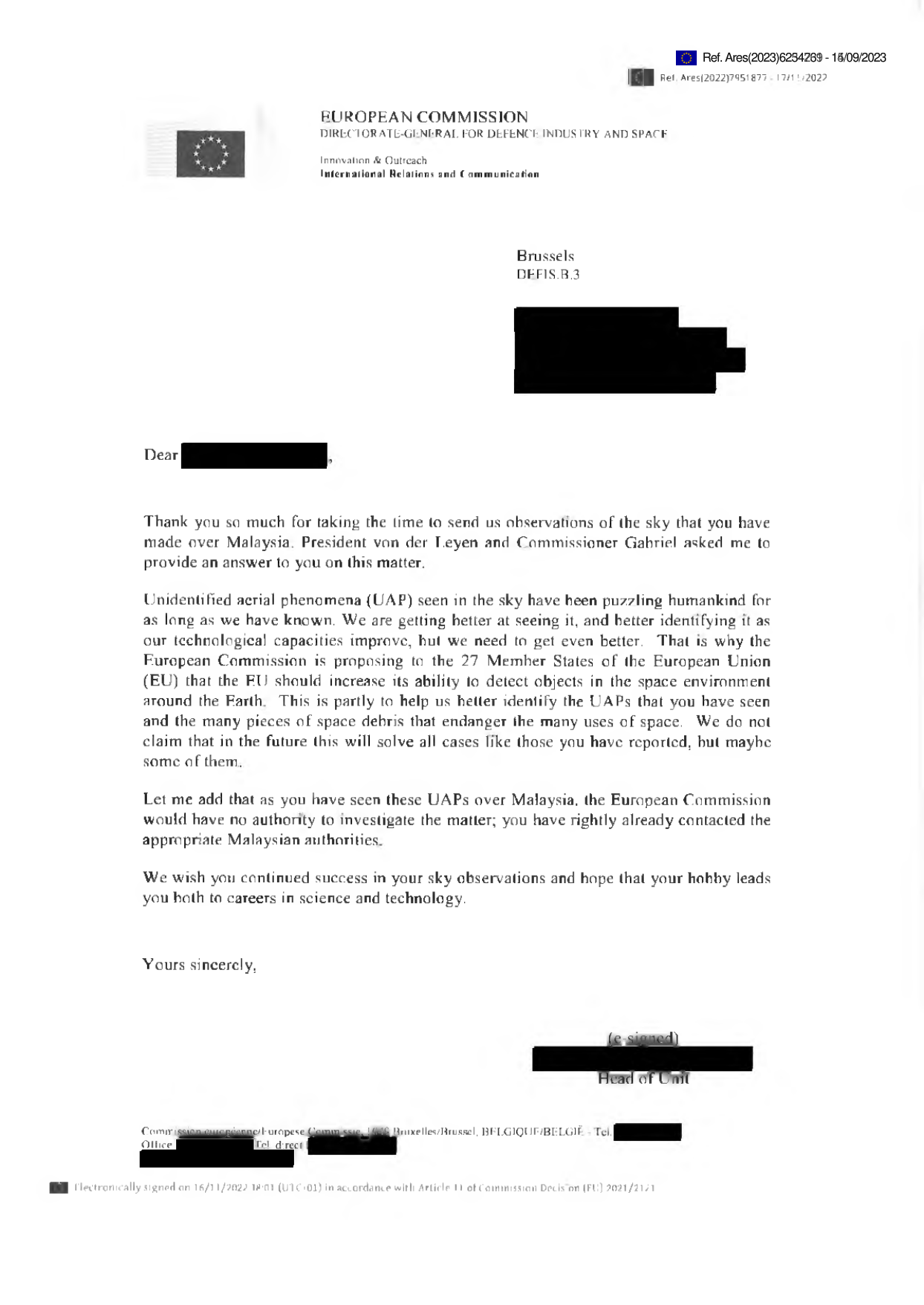
The response came from the European Commission’s Directorate-General for Defence Industry and Space, known as DG DEFIS. It did not say that the images showed aircraft, spacecraft or anything extraterrestrial. It did not promise an investigation over Malaysia.
“This is partly to help us better identify the UAPs that you have seen and the many pieces of space debris that endanger the many uses of space.”
Instead, the letter described a broader institutional aim: improving the ability to detect objects in the space environment around Earth, partly so that reported UAP and space debris could be identified more effectively.
The limits were just as important as the language about detection. The Commission said it had no competence to investigate the observations mentioned by the pair because they were made over Malaysia. Brussels had answered, but it had not adopted the photographs as a verified case.
Read the Commission replyWhat were they actually photographing?
The honest answer is that the released record does not tell us. The images may contain ordinary sky objects recorded under difficult conditions. They may contain optical artefacts, distant aircraft, satellites, meteors or other phenomena. The public documents do not provide the metadata, calibrated sensor data, independent chain of custody or technical analysis needed to distinguish those possibilities.
Nor does the phrase “37 images” mean that 37 separate unknown objects have been established. It means that the observers submitted a collection of photographs. Some appear on the released correspondence pages; whether every original file has been publicly released is itself one of the unanswered questions.
This is where the evidence should stop and the questions should begin. The photographs are real documents in a real public-access record. Their subject matter remains unresolved.
A 2022 reply becomes 2026 news
The correspondence was written in 2022. Euronews reported on its release on 17 August 2026; this article is dated 18 August. That timing can make an old exchange feel like a new institutional decision. It is not.
What is new is the public availability and renewed attention. What remains from 2022 is a careful, limited reply: better detection may help identify objects in the space environment; the Commission has no authority to investigate observations made over Malaysia; and no official body named in this record has identified the photographed objects.
The story matters because it shows how an unresolved observation travels. A homemade imaging project becomes a private archive, the archive becomes correspondence, and the correspondence becomes news years later. At every stage, the central question is the same one the documents cannot yet answer: what, exactly, was captured?
What happens next?
The next useful evidence would be original files, complete metadata, calibrated sensor information, independent technical review or further official correspondence. If any of those become public, they should be kept separate from the observers’ labels and from the Commission’s general discussion of detection.
For now, the correspondence is public, the objects remain unidentified and the strongest conclusion is also the most modest one: a Malaysian father and son sent photographs to institutions around the world, and one European department wrote back with an explanation of what it could—and could not—do.
What we know
- 37 images were submitted from Penang, Malaysia.
- The Commission replied in November 2022.
- The reply came from DG DEFIS.
- Several image pages appear in the released correspondence.
What we don't know
- What the pictured objects actually were.
- Whether all original images have been publicly released.
- Whether the objects showed extraordinary performance.
- Whether Brussels conducted technical analysis.