LORING AFB
MAINEWeapons-area incursion and security response.
Across roughly two weeks, sensitive northern military installations reported unidentified low-flying activity, visual observations, radar-related contacts and air-defence responses. The record is strongest when the incidents are kept separate.
The 1975 Northern SAC sequence matters because unidentified aerial activity appears in contemporaneous military reporting itself, across multiple northern-tier Strategic Air Command bases in a short period. Sensitive installations reported incursions, security personnel responded, and fighters were launched. The case becomes weaker if every report is forced into one object or one explanation: some incidents may have been helicopters, ordinary aircraft, or atmospheric effects, and some may not be related at all. The strongest conclusion is narrower and more interesting — a documented cluster of security alerts across separate installations, not one confirmed answer.
The significance of 1975 is not one spectacular sighting. It is the recurrence of security incidents across several Strategic Air Command and northern air-defence locations.
Loring Air Force Base in Maine entered the record first, with unidentified activity reported around a sensitive weapons area. Wurtsmith in Michigan followed. Then Malmstrom in Montana, where reports around missile areas escalated into an interceptor response. Additional reporting extended into the Minot and Canadian/NORAD picture.
The common thread was institutional rather than visual: military observers, protected sites, command channels and attempts to identify intrusions in airspace where uncertainty mattered.
Weapons-area incursion and security response.
Visual, aircrew and radar-related elements.
Missile-area reports and F-106 response.
Additional northern-tier reports in the wider cluster.


The value of the 1975 cluster is not that every later recollection agrees. It is that military reporting survived independently of later UFO culture.
For Malmstrom, the released Defense Department material obtained under FOIA case 97-F-1677 provides a documentary backbone. The National Archives also now maintains a dedicated UAP/UFO records portal that helps place surviving Air Force material in its archival context.
Released material obtained from the Office of the Assistant Secretary of Defense, Freedom of Information and Security Review Office. It records the November 1975 Malmstrom episode and response.
OPEN RELEASED DOCUMENT SET →Secondary archive hosting the released government documents.The National Archives maintains a dedicated guide to textual and microfilm UFO/UAP holdings, including Air Force record groups and surviving regulations.
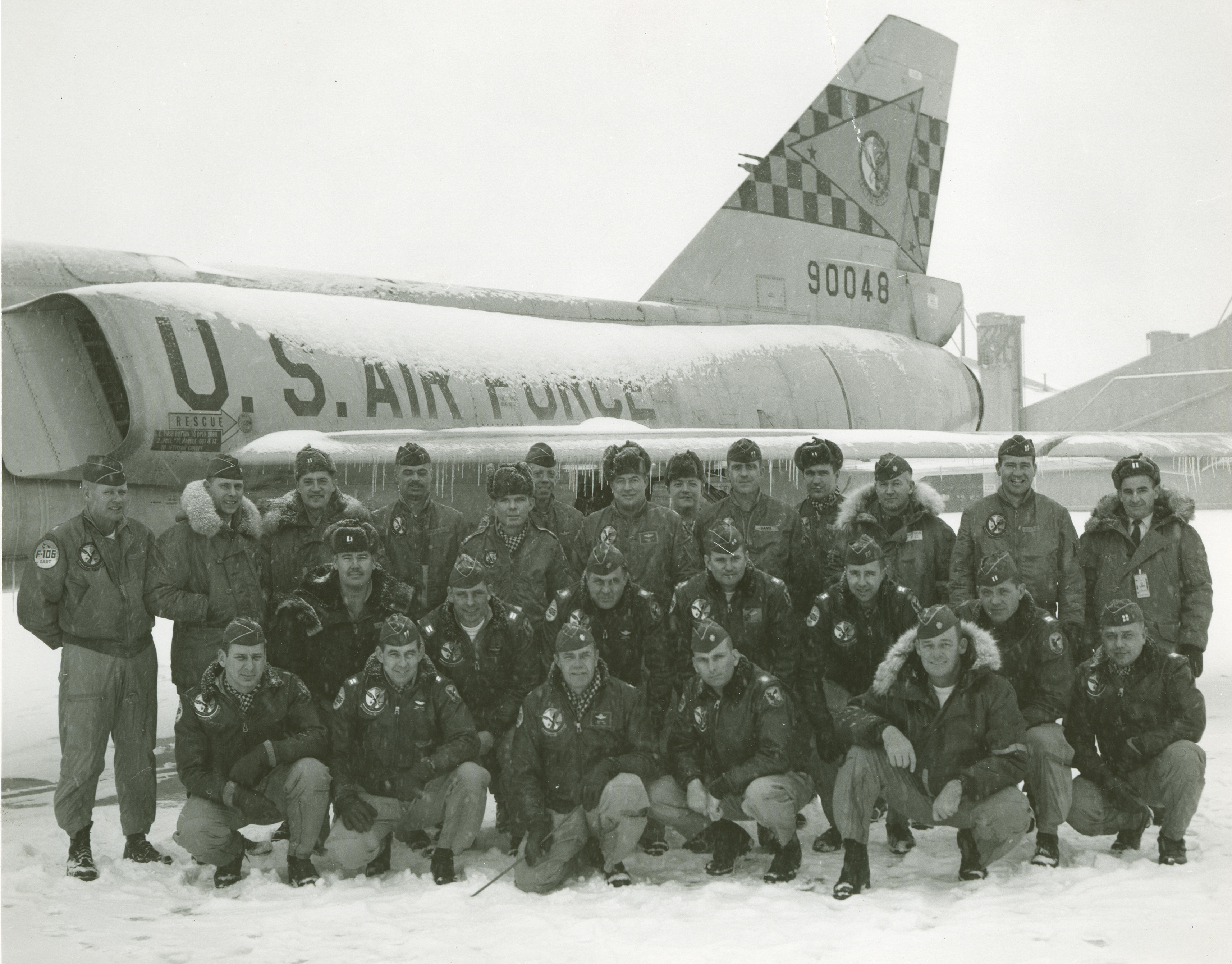
OPEN NARA RECORDS GUIDE →Primary archival discovery resource.The Air Force identifies the F-106 Delta Dart as a dedicated supersonic interceptor. Official historical photography survives from Loring and elsewhere.
OPEN OFFICIAL F-106 IMAGE →Context image only; not the specific Malmstrom intercept mission.By 7–8 November, Malmstrom was reporting unidentified activity around missile areas. The response escalated to F-106 interceptor aircraft.
That fact is important precisely because it does not need embellishment. A fighter scramble tells us the situation was taken seriously enough to justify an air-defence response. It does not automatically tell us what the target was, whether the pilots acquired it, or whether every earlier report belonged to the same object.
The F-106 was built for air defence. Official Air Force history describes it as a high-performance interceptor and official imagery confirms the type's northern-tier service. The image here is contextual and is not presented as the aircraft that flew the Malmstrom mission.
The evidential value of the scramble is that the event entered a real military response chain. The page does not inflate that into a successful interception, a continuous radar lock or proof of extraordinary manoeuvres unless the surviving record demonstrates those details.
Some reports may have involved helicopters or other conventional aircraft. Others may have involved astronomical lights, range errors or radar propagation. Those possibilities matter because this is a cluster, not a single observation.
A conventional explanation for one incident is useful progress. It should not be stretched across unrelated events without matching the date, location, geometry and source record.
The right question is therefore granular: which individual events can be identified, and which remain unresolved after the known traffic and observational conditions are reconstructed?
Serious for individual low-altitude sightings. Requires date-specific traffic correlation.
Potentially relevant to isolated lights. Must fit direction, duration and observer geometry.
Relevant to some radar returns. Does not by itself explain independent visual testimony.
Probably the safest starting model for a geographically distributed cluster.
Loring, Wurtsmith, Malmstrom, Minot and Falconbridge belong in one historical security cluster because of timing, institutional context and surviving reporting. That does not prove every witness saw the same object—or even the same class of phenomenon.
Echo Flight's 1967 missile shutdown is a separate flagship case. The 1975 incursions should not be used retroactively as proof of what caused Echo Flight, and Echo Flight should not be used to make the 1975 sightings more exotic than their records support.
The most valuable contribution may be identifying an individual incident rather than making the whole cluster stranger.
We welcome first-hand testimony, public or releasable records, aviation logs, radar expertise, Canadian archival material, chronology corrections and conventional identifications. Useful information does not need to support a UFO interpretation.
The 1975 Northern SAC sequence matters because unidentified activity appears in contemporaneous military reporting itself.
Sensitive installations reported incursions. Security personnel responded. Radar and aircrew elements entered parts of the record. Fighters were launched. The sequence spread across multiple northern military locations.
But the case becomes weaker if every report is forced into one object or one explanation. Some incidents may have been helicopters. Some may have involved ordinary aircraft, astronomical objects or atmospheric effects. Some may not be related at all.
The strongest conclusion is narrower—and more interesting: across a short period in 1975, multiple nuclear-security and northern air-defence locations recorded unidentified aerial activity serious enough to trigger military responses, while the surviving record does not reduce the whole cluster to one confirmed answer.
The War Zone — The Bizarre Mystery of Unexplained Aerial Incursions over Loring Air Force Base · The Black Vault — Unidentified Flying Objects over Malmstrom AFB, November 1975 · National Archives — UAP Record Group collections · National Archives — UAP textual and microfilm records · Air Combat Command — F-106 Delta Dart photograph
In October 1975, Loring Air Force Base in Maine—then a Strategic Air Command base with a nuclear-alert mission—reported unidentified low-altitude activity near sensitive areas. Operational accounts described an unidentified aircraft or helicopter, radar activity and repeated attempts to identify or intercept it. Later witness accounts described silent or unusually maneuvering objects. These layers should be kept separate.
The military response establishes that the reports were treated as a security problem. It does not identify the intruder or prove that later interpretations were correct. The strongest page will put the official operational record beside attributed witness testimony and show where they diverge.
Personnel report an unidentified low-altitude aircraft near Loring’s northern perimeter and weapons-storage area.
Another unlighted aircraft is reported and military attempts to establish identification remain unsuccessful.
Loring increases security and coordinates with Canadian authorities as the reports continue.
Later records and reporting place the Loring events alongside other northern SAC incidents.
Read the documented reconstruction in The War Zone and consult the National Archives UAP records guide. Compare the strategic-base context with Malmstrom Echo Flight and the pilot-record problem with Tehran F-4.