All ten sites.
“All LF's in E Flight lost strategic alert nearly simultaneously.”341ST STRATEGIC MISSILE WING / COMBAT SUPPORT GROUP COMMAND HISTORY · JAN-MAR 1967 · ECHO FLIGHT INVESTIGATION
The shutdown is documented. The UFO link is where the argument begins.
At 08:45 on 16 March 1967, something happened inside Malmstrom Air Force Base's Echo Flight that was serious enough to trigger a full engineering investigation.
All ten launch facilities in Echo Flight went to No-Go status and lost strategic alert nearly simultaneously.
This is not the disputed part of the story. It is recorded in the 341st Strategic Missile Wing's own history.
The scale matters. One missile going off alert would have been a maintenance problem. Ten sites doing it within seconds was something else entirely — a failure across a dispersed nuclear missile flight that demanded an explanation.
What happened next is why Echo Flight became one of the most argued-over nuclear-UFO cases in history.
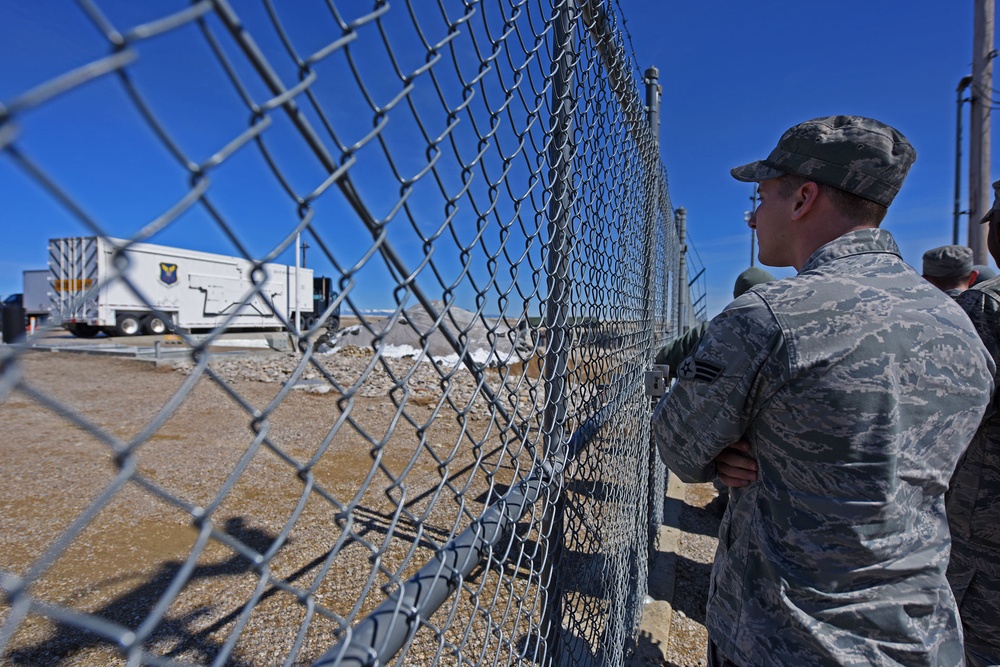
“All LF's in E Flight lost strategic alert nearly simultaneously.”341ST STRATEGIC MISSILE WING / COMBAT SUPPORT GROUP COMMAND HISTORY · JAN-MAR 1967 · ECHO FLIGHT INVESTIGATION
“No other Wing I configuration lost strategic alert at that time.”DECLASSIFIED COMMAND HISTORY · 16 MAR 1967 · 0845
The official record is unusually rich.
The wing history says all Echo Flight launch facilities shut down with No-Go indications on two reporting channels. No other Wing I configuration lost strategic alert at that time. Maintenance teams restored the sites without replacing launch-facility equipment.
A specialist engineering team from the Air Force, Boeing and Autonetics then investigated the event.
The investigation examined weather, crew action, power, system faults, outside signals and similar incidents. The history records that weather and the capsule crew were eliminated as causes. It also describes the possibility of externally generated signals affecting the logic couplers, but calls the probability of all ten couplers failing in that way within seconds 'very remote.'
In other words: the Air Force had a real, unusual technical event to explain — quite apart from the UFO story that later grew around it.

Robert Hastings began interviewing former and retired military personnel about UFO incidents at nuclear-weapons sites in 1973. By 2023, he said 167 USAF veterans and other military personnel had gone on the record with him.
That figure does not mean 167 people witnessed Echo Flight. Hastings' testimony corpus spans numerous missile fields, weapons-storage areas, test ranges and nuclear installations over decades. But it changes the context in which Malmstrom should be read: the nuclear-UFO story does not rest on one witness or one remembered conversation.
The correct question is not whether their rank makes every recollection automatically true. It is whether testimony from people selected, trained and trusted to operate or secure nuclear weapons deserves serious evidential treatment. It does.
Missile combat crews were entrusted with strategic nuclear forces and procedures where error could have national-security consequences.
Nuclear-duty reliability programmes are designed around continuing fitness, judgement, medical condition and trustworthiness—not one-time vetting.
Professional background makes these witnesses important. It does not remove the need to separate first-hand observation, hearsay, later memory and causal inference.
Figel was on duty in Echo Flight's underground launch-control centre when the missile failures occurred. His later recollections have become central because they concern what was reportedly communicated to the launch crew during the shutdown.
Carlson commanded the Echo Flight crew during the event. His account is essential because he was present for the actual missile-system failure, but he disputed later claims that a UFO was involved in Echo Flight.
Salas later described a separate Malmstrom missile-shutdown episode at Oscar Flight and reported receiving information about a glowing object near a security gate while missiles went off alert.
Jamison, a former missile maintenance technician, later gave testimony concerning unusual circumstances and maintenance activity associated with Malmstrom missile shutdowns. His role illustrates why the witness record extends beyond launch officers alone.
Personnel assigned to nuclear-reliability duties operated in a culture built around continuing fitness and trustworthiness. Modern nuclear Human Reliability rules explicitly require participants to report physical or mental conditions requiring medication or treatment and make prescription-drug use part of continuing reliability oversight. Historical Air Force programmes were not necessarily identical to today's DOE rules, so we should not turn the popular “even an aspirin had to be reported” line into a literal 1967 claim without the period regulation in hand.
But the underlying point survives scrutiny: the people entrusted with nuclear weapons were expected to meet unusually demanding standards of judgement, conduct and reliability. Their testimony deserves to be tested carefully—not dismissed casually.
Former Malmstrom personnel later associated unusual aerial activity with missile shutdowns during March 1967. Their accounts became the basis of the nuclear-UFO interpretation.
The 1967 command history says a mobile strike team was questioned and reported no unusual activity or sightings around the time of the Echo Flight fault.
The UFO layer is more complicated.
Former missile personnel later described reports of unusual aerial objects around Malmstrom during the March 1967 shutdowns. Those accounts became central to the claim that unidentified craft interfered with nuclear missiles.
But the contemporary unit history contains a strikingly different statement. It says rumours of UFOs around Echo Flight during the fault were investigated and 'disproven.' A mobile strike team was questioned and reported no unusual activity or sightings.
That contradiction is the heart of the case.
It does not prove the later witnesses wrong. Nor does later testimony automatically invalidate the contemporary history. It means the public record contains two incompatible pictures of the same period, written at very different times and for very different purposes.
There are really three questions here, and they are often collapsed into one.
First: did all ten Echo Flight missiles lose strategic alert? Yes. The official record establishes that.
Second: were unusual aerial objects reported around Malmstrom during the wider period? Later military witnesses say yes, while the contemporaneous Echo Flight history says the rumours it checked were disproven.
Third: did an anomalous object cause the Echo Flight shutdown? That is the leap the surviving public evidence does not establish.
The engineering record does not identify a UFO as the cause. It explores electrical, system and signal possibilities and shows how unusual the simultaneous failure was. That makes the shutdown genuinely interesting without requiring the strongest UFO interpretation to be treated as proven.
All ten Echo Flight launch facilities lost strategic alert nearly simultaneously. This is in the official unit history.
Later named military witnesses associated unusual aerial activity with Malmstrom shutdowns; the contemporaneous Echo history says the rumours it checked were disproven.
The surviving public engineering record does not demonstrate that an anomalous object caused Echo Flight to go off alert.
Echo Flight is exactly the kind of case where one original document, dated interview or technical clarification can materially improve the history.
We welcome corrections, engineering analysis, archival leads, original interviews and conventional explanations as much as evidence supporting the UFO interpretation.
The strongest contemporaneous record is the 341st Strategic Missile Wing command history: ten Echo Flight launch facilities lost strategic alert nearly simultaneously, and an engineering investigation followed. That establishes an unusual missile-system event.
The claim that an unidentified object caused the shutdown belongs to a later evidential layer. Veteran testimony and documentary discussion preserve an important historical question, but they do not by themselves constitute an official causal finding. The National Archives' Project Blue Book material confirms the wider Air Force investigative framework, not a demonstrated explanation for Echo Flight.
Keeping those records separate makes the case stronger. The outage can be assessed through the command history and technical investigation; the aerial-observation claim must be assessed through witness provenance, timing, and any surviving radar or security records. The public record does not justify collapsing those questions into one conclusion.
Echo Flight deserves to remain a major UAP case because the underlying event is not folklore.
Ten nuclear missile launch facilities lost strategic alert nearly simultaneously. An engineering investigation followed. The event appears in the wing's own classified history. And later named military personnel associated unusual aerial activity with missile shutdowns at Malmstrom.
But the causal chain remains incomplete.
The contemporary record explicitly says UFO rumours around Echo Flight were investigated and disproven. Later testimony challenges that picture. The engineering investigation confirms an unusual technical failure but does not establish an anomalous object as its cause.
That is not a weak case. It is a difficult one — a documented nuclear-system event with a contested second layer that still cannot be cleanly reconciled.
Ten missiles failed. The argument is still about why.
341st Strategic Missile Wing / Combat Support Group Command History — Jan-Mar 1967 (declassified) · Robert Hastings — interviews with former and retired military personnel (1973 onward; 167 on record by 2023) · National Archives — Project Blue Book records (wider Air Force investigative framework) · C-SPAN — Malmstrom nuclear-UFO discussion · Robert Hastings — 'UFOs and Nukes' (2008) · Wikipedia — 1967 Malmstrom Air Force Base UFO incident
Reference / Media: 1967 Malmstrom AFB UFO incident (Wikipedia)