On 7 August 2026, the Department of War published the fifth tranche of records in its PURSUE archive. The release is significant because it puts more primary material in public view. It is not significant because it settles what any one object was.
What was released
The Department of War’s announcement describes Release 05 as a collection of declassified and historical UAP files under the Presidential Unsealing and Reporting System for UAP Encounters—PURSUE. The archive’s own explanation is the essential starting point: these are unresolved records, meaning the government says it cannot make a definitive determination about the observed phenomena. That can reflect a lack of sufficient data; it is not a conclusion about origin.
The public material includes documents, images and video. Contemporary reporting that links back to the archive catalogued 41 files, but the official announcement does not publish a single release-wide count. What can be established directly is that this is the fifth scheduled tranche since the archive’s first release on 8 May 2026, and that further releases are planned on a rolling basis.
Read the archive correctly
The release makes official material available. It does not turn every description in that material into a verified measurement, and it does not make an unresolved observation evidence for a particular explanation.
The files worth examining first
Gulf of Oman, 2021. An AC-130 crew’s infrared observations during live-fire training, paired with six related secondary captures.
Airborne lights and triangle. An FBI FD-302 documents a pilot’s 2023–24 light reports and a remembered 2002 Bagram observation.
Thermal observation, 2026. An FBI record describes a special agent’s account of two slow-moving black-hot objects.
1. Gulf of Oman, 8 September 2021
The strongest item in the drop is not a dramatic still; it is a record with an identifiable platform, date and stated limitations. An intelligence information report says a U.S. Special Operations Forces AC-130 gunship was conducting a live-fire training sortie in the Gulf of Oman when its crew observed approximately 25 instances of UAP through an EO/IR sensor. The report describes observations the crew called “cold orbs,” including two over a water-activated flare.
The report says the crew calculated an observed speed range of 250 to 1,300 mph and saw no means of propulsion. Those are report and crew statements—not independent measurements published with the underlying native sensor file. The report also says the crew’s attempt to preserve the full footage was undermined when the aircraft’s DVR data became corrupted. What survives publicly is therefore incomplete.
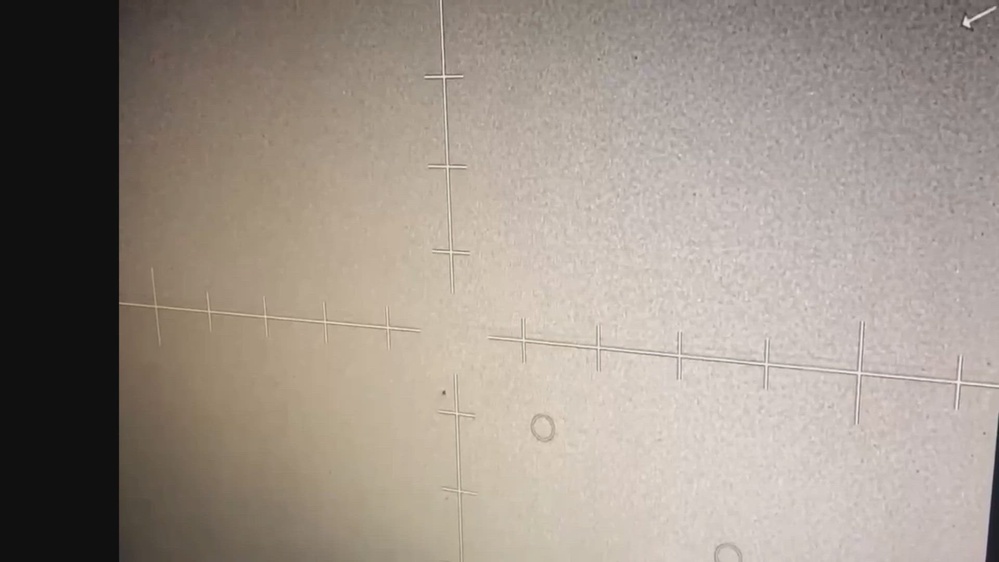
AARO’s accompanying DVIDS entries matter because they explain the visual record’s limits. The six public clips are secondary cellular recordings of an infrared display aboard the gunship, not the native primary sensor data. They may show contrast areas and movement in a display, but their recording method can introduce blur, flicker and loss of detail. That caveat belongs with the footage, not in a footnote.
2. The Bagram triangle account and recurrent lights
The release also includes an FBI FD-302 recording an interview with a former military pilot. It describes the interviewee’s reports of lights seen on flights from late 2023, including a 2024 phone video. In the same interview, the pilot recalled a June 2002 observation over Bagram, Afghanistan: a dark, equilateral triangular silhouette that appeared to obscure stars as it moved overhead. The account says another pilot was present.
The associated FBI digital rendering is a useful illustration of what the witness later described, but it is not a photograph and it does not independently establish the size, speed, shape or identity of the reported object. The form itself carries a clear limitation: an FD-302 contains neither FBI recommendations nor conclusions. It records an interview; it is not an adjudication of the report.
3. The 2026 thermal-optics record
A separate FD-302 documents a special agent’s account after an RF detection in 2026. According to the interview record, the agent used a thermal optical device and saw one black-hot object, then a second moving at the same speed. The record gives a five-to-ten-minute observation window but says the agent could not estimate the objects’ altitude or speed and was the only observer at the location using the optic.
That is precisely the sort of file that benefits from public release: it establishes that a record exists, identifies the kind of instrument involved and preserves its evidential gaps. It does not establish what the objects were.
What this release does—and does not—prove
What we can say
- The fifth tranche was officially released on 7 August 2026.
- The archive includes records from multiple agencies and several evidence formats.
- The Gulf of Oman record documents an AC-130 crew’s reported EO/IR observations during a named training sortie.
- The FBI forms preserve attributed interview accounts and their stated limitations.
What we cannot say
- That a secondary video recording alone identifies an object.
- That a witness account is the same as an official technical finding.
- That “unresolved” means extraterrestrial or proves any specific explanation.
- That absent or corrupted source data can be reconstructed from the public clips.
What is genuinely new?
The new element is the public availability of this selected set of records in the fifth PURSUE tranche—not a newly announced solution to the underlying cases. Several of the items are released in forms that remain intrinsically limited: secondary captures instead of native sensor files, redacted interview summaries instead of a complete investigative casebook, or illustrations of a report rather than event photography.
That distinction is the release’s most important lesson. Transparency adds material that researchers can scrutinise, compare and challenge. It does not convert a document dump into a verdict.
The bigger picture
Release 05 sits within an archive that the Department of War says will continue to grow as agencies identify, review and declassify material. The initiative makes historical and unresolved records easier to inspect alongside their provenance. That is useful for readers because it encourages a more disciplined question: what is actually in the record, what is inferred from it, and what remains missing?
For a comparison with a case that combines witness testimony, military reporting and surviving sensor material, read our Nimitz case file. For the closest internal point of comparison to this release, see the existing Gulf of Oman record. Neither page proves the claims in Release 05; both demonstrate why source type and evidential limits matter.
Source room
- Department of War: Fifth Release announcementPrimary confirmation of the fifth PURSUE tranche and the 7 August 2026 publication date.
- PURSUE archivePrimary explanation of the rolling programme and the archive’s definition of unresolved records.
- DOW-UAP-D101: Gulf of Oman information reportPrimary report for the AC-130 training sortie and its stated observations and limitations.
- DOW-UAP-PR118 on DVIDSOfficial AARO/DVIDS description of the secondary-capture footage used as this article’s lead visual.
- FBI FD-302: airborne lights and trianglePrimary interview record; not an FBI conclusion.
- FBI FD-302: slow-moving objects, 2026Primary interview record for the thermal-optics account; not an FBI conclusion.
- CBS News: contemporary catalogue and archive linksUsed only as a secondary cross-check for the reported 41-file count and archive navigation; the official records above govern this analysis.