Broad Haven schoolchildren holding drawings made after the 1977 sighting
BROAD HAVEN · PEMBROKESHIRE · 4 FEBRUARY 1977

Fourteen childrenpointed beyond the playground.

A group of primary-school pupils said a strange metallic object was sitting in fields near their school. Several described a silver-suited figure. Their headmaster later interviewed them separately and had them draw what they remembered. Within weeks, west Wales was deep inside a UFO wave.

AUTHENTIC CASE-RELATED HISTORICAL PHOTOGRAPH · RIGHTS / PROVENANCE CHECK REQUIRED
REVIEW HERO · Historical published photograph of Broad Haven pupils holding their witness drawings. This is authentic case-related material, not an AI reconstruction. Original publication rights and provenance must be confirmed before production.
4 FEB 1977school sighting
UP TO 14pupil witnesses
7 FEBseparate interviews / drawings
1977 WAVEPembrokeshire context
WHY THIS CASE MATTERS

Broad Haven is not famous because children drew saucers. It is famous because the story survived scrutiny.

The Broad Haven School sighting sits in a difficult evidential category. Child witnesses can be highly observant, but they are also vulnerable to suggestion, shared storytelling, adult prompting and memory contamination. A case involving a group of children therefore becomes stronger or weaker depending on what happened immediately after the sighting and how carefully their accounts were collected.

On 4 February 1977, pupils at Broad Haven County Primary School in Pembrokeshire reported seeing an unusual metallic object in a field beyond the school grounds. Several also described a tall figure in a silver or metallic-looking suit. Their reports reached adults quickly. Local investigator Randall Jones Pugh became involved. The headmaster, Ralph Llewellyn, later interviewed pupils separately and asked them to write and draw what they had seen.

Those drawings became iconic. For decades the standard retelling said they had been produced independently and immediately after the event. The surviving school record complicates that version: the formal separate interviews and drawing exercise took place on Monday 7 February, after the intervening weekend. That gap matters because the children had time to discuss the event with one another, family and friends. Similar drawings are therefore interesting, but they are not pristine blind-test evidence.

And yet Broad Haven does not collapse when that correction is made. The sighting itself preceded the drawings. Multiple named children were already reporting an unusual object, the school became the centre of an official correspondence trail, and the event occurred at the opening of a much wider sequence of 1977 UFO reports across Pembrokeshire. The case is worth reading because its strengths and weaknesses are both unusually visible.

The strongest Broad Haven is not “fourteen identical drawings prove a saucer.” It is “a group of children reported something unusual, and the way adults documented it left a record we can still test.”
01 / THE PLAYGROUND

Lunch break. A field. Something metallic beyond the school.

The sighting took place on Friday 4 February 1977 at Broad Haven County Primary School on the Pembrokeshire coast. During the lunch period, pupils were outside when attention shifted toward fields and scrub beyond the playground. A group of children said they could see something unusual on or close to the ground.

Descriptions varied. Some children used cigar-like language. Others drew or described a broad disc or oval with a raised dome. Colours included silver, metallic green and combinations of pale bodywork with coloured lights. Several accounts placed a flashing red, orange or yellow light on top. This is not the consistency of a measured engineering drawing; it is the looser overlap expected from young witnesses trying to describe a strange object from a distance.

Some pupils also reported a figure near the object. It was usually described as tall and wearing a silver, silvery-green or metallic-looking suit. More dramatic details — including unusual ears or other humanoid features — are less consistent and should not be flattened into a single “alien description.”

One of the better-known contemporary child accounts came from Jeremy Passmore, who described a silvery-green object with a coloured light and a person in a silverish-green suit. Other children gave simpler reports. The object was said to have remained visible for minutes, at times partly obscured by trees, bushes or the terrain.

But the duration is not stable. Passmore's near-contemporary account gives a sighting lasting up to about twenty minutes, while David Davies, speaking decades later, remembered the core appearance as only a few seconds. Later retellings sometimes stretch the episode across a much larger part of the afternoon. Those versions cannot all be literally correct. The page should preserve that conflict rather than average it into a false precision.

The children tried to alert adults. The initial reaction was sceptical. That is not surprising. Primary-school pupils reporting a landed flying saucer during lunch would test any headteacher's patience. What changed the story was persistence: the children continued to insist that something had been there.

Later case reconstructions also preserve a revealing detail: frustrated at not being believed, some of the pupils reportedly organised a petition asking the police to investigate. A petition is not corroboration of the object, but it is useful human evidence of how seriously the children themselves said they regarded what had happened.

4 FEB · LUNCH

The first reports

Pupils see an unusual metallic object beyond the playground; a subset also reports a silver-suited figure.

THE CORE EVENT PRECEDES THE FAMOUS DRAWINGS.
SAME DAY

Pugh enters the case

Parents and local UFO investigator Randall Jones Pugh become aware of the report. Later reconstructions place Pugh at the school / field area that afternoon or evening, giving the case an unusually early investigative chain.

THE CASE ENTERS A CONTEMPORARY INVESTIGATIVE CHAIN QUICKLY.
7 FEB

Separate interviews and drawings

Headmaster Ralph Llewellyn interviews pupils individually and asks them to record what they saw.

IMPORTANT: THIS IS THREE DAYS AFTER THE SIGHTING, NOT IMMEDIATELY.
FEB–APR

The wave expands

Further reports appear across Pembrokeshire, including adults, teachers, farms and coastal locations.

BROAD HAVEN BECOMES THE NAME ATTACHED TO A MUCH WIDER FLAP.
02 / THE CHILDREN

Fourteen witnesses does not mean fourteen independent cameras.

Multiple witnesses are usually an advantage in a UFO case, but group dynamics matter. The Broad Haven children were schoolmates. They were together before and after the sighting. They could see one another react. They could talk. By the time formal drawings were made, they had passed through a weekend in which the story could be shared repeatedly.

That does not mean their testimony is worthless. It changes the evidential question. Instead of asking whether fourteen completely independent witnesses supplied the same account, we should ask whether a real group event occurred and whether the early accounts preserve enough overlap to show that the children were responding to a common stimulus rather than inventing separate fantasies.

The answer is mixed but interesting. The broad themes repeat: an unusual metallic or pale object, low or landed, beyond the school; a raised dome or upper structure; coloured light; and, for some witnesses, a figure. The details vary enough to resist the claim that every child saw an identical machine. That variation may actually be more realistic than perfect agreement.

Headmaster Ralph Llewellyn was reportedly reluctant to accuse the children of a sophisticated sustained hoax after speaking to them. His reaction matters as a contemporary character assessment, but it is not a scientific finding. Teachers can be fooled. Children can sincerely share a mistaken interpretation. The value of Llewellyn's role is that he created a written and visual record while the event was still fresh.

HEADMASTER

Ralph Llewellyn

Interviewed pupils separately and created the school record that later entered official files. His judgement was that a sustained sophisticated hoax was difficult to accept.

LOCAL INVESTIGATOR

Randall Jones Pugh

Veterinary surgeon and BUFORA investigator who was involved very early, visited the school/field area on the day of the sighting, and helped preserve contemporary witness material. His much later religious/demonic interpretation of UFOs belongs to his later worldview, not to the evidential status of the 1977 school report.

PUPIL RECORD

Jeremy Passmore

One of the children whose fuller description entered contemporary UFO literature, including the object, coloured light and silver-suited figure.

PUPIL RECORD

David Davies

Another pupil who remained publicly associated with the case into adulthood. His much later recollection of the core sighting as only a few seconds is one reason the duration must remain disputed.

OTHER NAMED PUPILS

Michael Webb · David Ward · Shaun Garrison · Philip Rees

Names appearing in later case reconstructions and archival summaries. Their presence helps keep “fourteen children” from becoming an anonymous statistic, but individual account quality varies.

OTHER NAMED PUPILS

Tudor Jones · Paul Williams · David George

Part of the wider named pupil group associated with the school sighting. Where individual earliest statements are not recovered, they should not be given detail that the surviving source trail cannot support.

THE GROUP

The school witnesses

The evidential centre is the group as a whole: not identical testimony, but overlapping reports made by children who shared the same social environment.

03 / THE DRAWINGS

The famous pictures are evidence — but not the evidence people were told they were.

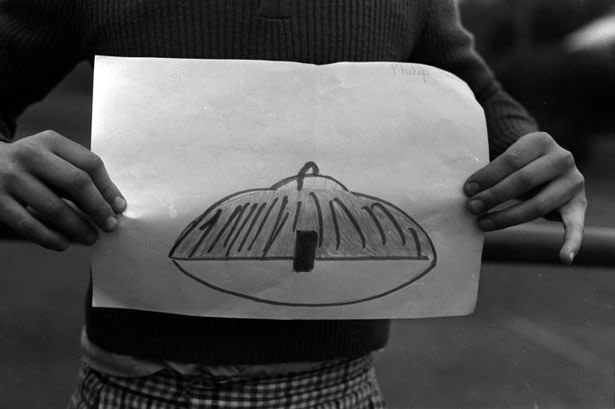
Broad Haven's drawings are among the most recognisable images in British UFO history. Children hold sheets showing domed discs, elongated craft and saucer-like forms. Their similarity is striking enough that the photograph has been reproduced for decades as shorthand for the case.

But the timing changes how we should use them. The drawings were not made in isolated rooms immediately after the sighting. The formal exercise took place on Monday, three days later. That means they preserve the children's remembered imagery after a period in which discussion was possible.

The drawings therefore work best as near-contemporary witness material rather than as a controlled psychological experiment. They show what the children were saying the object looked like in the first days after the event. They do not prove that every child independently generated the same image before hearing anyone else's description.

Broad Haven pupils holding their UFO drawings
HISTORICAL CASE PHOTOGRAPH Pupils holding drawings associated with the 1977 sighting. Rights/provenance check required before production.
Broad Haven pupil UFO drawing
WITNESS-DERIVED DRAWING A published child drawing from the Broad Haven record. This is testimony in image form, not a photograph of an object.
Collection of Broad Haven witness drawings
DRAWING COLLECTION · SECONDARY-HOSTED Useful for review only. Production should use archive-cleared reproductions wherever available.
The right question is not “why are the drawings identical?” The right question is “what features remained stable across the children's memories after three days?”
04 / THE ADULT WITNESS LANE

Adult corroboration exists — but it must stay source-disciplined.

Later that month, Broad Haven School returned to the UFO record when an adult teacher reported a large metallic object in the sky. Contemporary BUFORA summaries place that sighting on 17 February and describe a shiny oval body with a small dome and visible ridging.

A second adult-witness thread concerns the teacher usually identified as Mrs Morgan, who was later quoted as saying she had also seen the object and remembered a small whirlwind of dust crossing the playground as it departed. That is potentially important corroboration, but the surviving public trail for her account is thinner than the children's school record. Until the earliest independent statement is recovered, her testimony should be shown as reported adult corroboration, not elevated to a fully documented same-event control witness.

This distinction protects the case. A separate adult report in the same community can strengthen the broader picture without being used to retroactively authenticate every detail of the children's sighting.

The same caution applies across the wider 1977 flap. Pembrokeshire produced numerous reports of lights, discs, landed objects and figures. Some may have shared causes. Others may have been unrelated events pulled into a growing local narrative once Broad Haven hit the press.

05 / THE WELSH TRIANGLE

Broad Haven became the doorway into a much larger story.

By spring 1977, west Wales was producing enough reports that newspapers began speaking of a “Welsh Triangle” or “Broad Haven Triangle.” The label was sensational, but the underlying report volume was real. Sightings appeared around Pembroke Dock, Haverfordwest, Solva, the Brawdy area and coastal farms.

The wave included very different witness types: children, teachers, families, motorists and rural residents. Reports ranged from lights in the sky to claimed landed objects and humanoid figures. That diversity is both the wave's attraction and its problem. Once a region enters UFO fever, expectation rises. A strange aircraft, star, farm light or prank can be interpreted inside a narrative already circulating through newspapers and conversation.

Broad Haven should therefore be treated as the best-known opening case, not as proof that every later Pembrokeshire report shares one cause. The regional architecture of The UAP Map is useful here because readers can move from the school case into the wider 1977 chronology without forcing the entire flap into one giant Case File.

9 FEB

Pembroke Dock

A plate- or saucer-shaped object with yellow-green lights is reported, adding another local sighting only days after the school event.

10 FEB

Haverfordwest

Two boys report a low blue light that rises and appears orange or cigar-shaped before disappearing.

17 FEB

Broad Haven again

A teacher reports a large shiny metallic oval with a dome, providing an adult sighting in the same community.

MARCH–APRIL

Brawdy / Ripperston

The wave becomes stranger, with reports of landed objects, figures and repeated experiences around farms and rural roads.

PUBLIC RESPONSE

Press attention

National reporting amplifies the story, making later witness interpretation and contamination increasingly difficult to separate from genuine new events.

EXPLORE REGION

Pembrokeshire 1977

The broader wave belongs on the regional page, where individual reports can be compared without pretending every one deserves flagship treatment.

06 / THE OFFICIAL PAPER TRAIL

The public line was dismissive. The paperwork was more curious.

The Ministry of Defence did not publicly elevate Broad Haven into a national-security incident. Official responses generally maintained that nothing had occurred requiring extraordinary action. At the same time, the surviving UFO-desk files show that the Welsh reports were logged, correspondence circulated and the question of investigation was not ignored.

The relevant material sits in the National Archives DEFE 24 series. It includes correspondence relating to the west Wales sightings and records of discreet inquiries. That distinction matters. Government paperwork proves institutional attention, not government confirmation of a UFO. A file can exist because officials want to establish whether an ordinary explanation, prank or defence-related activity sits behind a report.

One date deserves to be visible on the page: 14 June 1977. The MoD branch handling UFO reports, S4 (Air), asked the RAF Police / Provost and Security Service to make a “discreet enquiry” into the Welsh reports. The surviving correspondence makes clear that this was unusual enough for the official to note that P&SS had not previously been invoked on UFOs.

By December, an internal briefing said the RAF Police thought the Welsh concern could have been the work of a practical joker. That is the closest thing to an official conventional conclusion in the surviving paper trail, but it is not a published final investigative report and no complete P&SS report is available in the recovered record.

In Broad Haven's case, the official record is valuable because it preserves contemporary reactions to the witnesses and the growing flap. It also reflects speculation about practical joking. The possibility of a hoax was alive at the time, not invented decades later by sceptics.

As with Socorro and JAL 1628, the most useful official evidence is often what it prevents us from exaggerating. Broad Haven entered government files. It was not officially confirmed as an alien landing. Those two facts can coexist.

07 / THE SILVER-SUIT CONFESSION

A real prankster enters the story — but he does not explain the school object.

In 1996, while researching the west Wales flap, broadcaster Ray Gosling identified local businessman Glyn Edwards, who admitted that during 1977 he had walked around parts of the area wearing a borrowed silver asbestos fire suit with a rigid helmet. Edwards said the suit made him appear about seven feet tall and that he sometimes hid when residents came out.

That confession matters because it provides a named person, a physical prop and a credible mechanism for at least some of the later silver-suited-figure stories around Pembrokeshire. It also fits an observation already present in the 1977 official file: Flight Lieutenant Cowan at RAF Brawdy thought descriptions of the figures resembled protective suits used around the nearby oil-refinery complex.

But the limit is just as important. Edwards did not claim to have staged the 4 February Broad Haven School object, and his confession does not identify the metallic object the children reported beyond the playground. A confession to part of the wider humanoid flap must not be allowed to become a confession to the school case.

One real prank can explain some of the mythology without explaining the thing the children said they saw.
08 / THE EXPLANATIONS

A prank, aircraft, shared interpretation — or something genuinely unidentified?

PRACTICAL JOKE

A staged figure — partly demonstrated

The wider humanoid flap has a named 1996 confession from Glyn Edwards involving a borrowed silver fire suit, and the MoD file records a similar protective-suit hypothesis in 1977. That substantially strengthens the prank explanation for some silver-figure reports. It still does not identify the school object.

AIRCRAFT / MILITARY

Harriers or unusual aviation

Later suggestions have linked some Welsh reports to military activity, including aircraft associated with nearby defence facilities. Aircraft can explain lights, noise and unfamiliar shapes, but a low apparently landed object beside a field requires more than simply naming a nearby base.

GROUP PERCEPTION

A shared mistaken interpretation

Children can influence one another rapidly. Once one pupil identifies a distant stimulus as a spaceship, others may begin fitting ambiguous features into the same frame. The three-day gap before formal drawings increases this concern, though it does not explain why the original report arose.

UNIDENTIFIED

A real unknown object

The possibility remains that the pupils saw something genuinely unfamiliar. The challenge is evidential: there is no authenticated photograph, radar track or physical trace that lets us identify the stimulus independently of witness testimony.

The broader wave complicates every explanation. If the school event was a prank, later reports may still have been unrelated genuine sightings. If the school event was a misperception, publicity may have primed the region for further reports. If something genuinely unusual was active in Pembrokeshire, later media contamination makes separating strong cases from weak ones progressively harder.

This is why Broad Haven deserves a Case File of its own while the rest of the wave belongs in a regional evidence map. The school sighting has a discrete witness group, date and documentary record. The “Welsh Triangle” is a pattern built from many different events.

09 / WHAT THE RECORD CAN CARRY

Broad Haven is strongest when the children are allowed to be children.

What the record supports

  • A group of pupils at Broad Haven Primary School reported an unusual object beyond the school on 4 February 1977.
  • Several children also reported a silver- or metallic-suited figure.
  • The reports reached adults and local investigators quickly.
  • Headmaster Ralph Llewellyn later interviewed pupils individually and collected written/drawn accounts.
  • The event became part of a genuine 1977 wave of UFO reports across Pembrokeshire.
  • Ministry of Defence files preserve official correspondence and inquiry surrounding the Welsh reports.

What it does not establish

  • The drawings were not produced immediately and independently on the day of the sighting.
  • The children were schoolmates and could influence one another's recollections.
  • No authenticated photograph shows the reported object or figure.
  • No radar or physical trace establishes a machine at the site.
  • The later Pembrokeshire wave does not prove the school sighting was part of one common phenomenon.
  • Government interest does not equal official confirmation of extraterrestrial activity.
Broad Haven remains compelling after the mythology is stripped away: a group of children said something strange was sitting beyond their school, and enough of the original paper trail survived for us to see exactly where certainty ends.
10 / SOURCE ROOM

Use the drawings — but read the dates first.

Broad Haven has been retold so often that errors can become stronger than the original record. The source room therefore prioritises contemporary BUFORA material, the Ministry of Defence files and later research that explicitly works from the school record. The regional Pembrokeshire page is used for the wider wave so the flagship case can stay focused on what happened at the school.

CONTEMPORARY UFO RECORD

BUFORA Journal — 1977 Welsh flap

Contemporary investigator material from the period, including child descriptions and later reports across Pembrokeshire.

OPEN BUFORA ARCHIVE MATERIAL →
GOVERNMENT ARCHIVE

National Archives — DEFE 24/1206

The Ministry of Defence file covering April–October 1977 UFO reports and correspondence, including Welsh material and the RAF Police discreet-enquiry trail.

OPEN NATIONAL ARCHIVES CATALOGUE →
RESEARCH SYNTHESIS

David Clarke / school-record chronology

Later archival research is especially important for correcting the widespread claim that the drawings were produced immediately on the day of the sighting.

VIEW ARCHIVAL DRAWING CONTEXT →
MODERN COMPETITOR / SYNTHESIS

UAP Globe — Broad Haven 1977

Useful modern synthesis for witness variants, RAF Police chronology, wider-wave separation and the later Glyn Edwards confession. Primary and contemporary records outrank it where recovered.

OPEN UAP GLOBE CASE →
THE UAP MAP

Pembrokeshire 1977 regional page

The broader chronology of reports around Broad Haven, Pembroke Dock, Haverfordwest, Brawdy and other west Wales locations.

EXPLORE THE WIDER WELSH WAVE →
THE QUESTION BROAD HAVEN LEAVES

What did the children see beyond the school?

The surviving evidence does not allow us to identify a craft, a prank or a misperceived ordinary object with confidence. It does allow something more useful: a reconstruction of what the children said, when their accounts were formally recorded, how the drawings were produced, how officials reacted and how one school sighting became the centre of Britain's strangest UFO year. The mystery survives — but only after the record is allowed to correct the legend.