IR track established
The sensor follows a small unresolved area of contrast over the Yellow Sea. No public range, altitude or speed solution is provided.
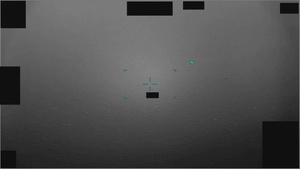
YELLOW SEA · 2023 · U.S. INDOPACOM · AARO
For nearly five minutes, a U.S. military electro-optical and infrared sensor followed an unresolved area of contrast over the Yellow Sea. The target survives mode changes, zooms and reacquisition — but never resolves into a clearly identifiable object, and the public record withholds the geometry needed to turn apparent motion into measured performance.
WATCH OFFICIAL PR100 VIDEO ↗
AUTHENTIC CASE FRAME
PR100 never resolves into a detailed craft. It remains an area of contrast held near the sensor centre, then appears as a dark object when the display switches to day-TV mode. That visual ambiguity is part of the evidence, not something to disguise with artwork.
WATCH FULL OFFICIAL VIDEO ↗WHAT THE SENSOR ACTUALLY DOES
This is the part most summaries rush past. The value of PR100 is not a single dramatic frame, but the continuity of the sensor record and the way the target behaves as the operator changes viewing modes and attempts to keep it centred.
The sensor follows a small unresolved area of contrast over the Yellow Sea. No public range, altitude or speed solution is provided.
The system switches collection mode and the object remains visible as a dark feature against the brighter background. This is the same sensor system using another mode, not a second independent sensor.
The target becomes progressively harder to resolve. Apparent changes in size or shape have to be treated cautiously because image quality is worsening.
The operator loses the area of contrast and searches for it again. Loss of track by itself is not evidence of sudden acceleration because the geometry is withheld.
The target is reacquired and followed for the remainder of the public sequence. AARO explicitly warns that this descriptive timeline is not an analytical judgment about what the object was.
The public file runs 4:45. AARO states that 4:57 of footage was submitted. The public record does not supply the geometry needed to convert apparent image motion into measured physical performance.
WHY THIS ONE MATTERS
PR100 stands out because the public recording is long. The sensor follows the same area of contrast for minutes, switches from infrared to electro-optical day-TV mode, returns to infrared, loses the target, reacquires it and continues tracking.
That gives investigators more sequence than the typical five- or ten-second UAP clip. AARO says 4 minutes 57 seconds were submitted, while the public DVIDS file runs 4:45 and ends with several seconds of no content. There is no named human witness statement attached to the public record. But duration is not the same as geometry. AARO does not publish a usable range, altitude, physical size or speed for the target.
The key discipline: describe what the sensor does without converting screen motion into extraordinary object motion.
SENSOR TIMELINE
The sensor tracks an area of contrast and progressively zooms in.
The display changes to electro-optical daytime television mode. AARO describes a dark object against a blue background.
The target disappears from the frame, the operator changes contrast and zoom, then reacquires and tracks it.
The footage briefly loses coherence, then resumes. Near the end the target repeatedly leaves and re-enters the field of view.
THE COMPETITOR GAP
UAP Globe currently describes the mode switch as giving “two independent looks.” The more precise reading is that this is one electro-optical/infrared sensor system operating in different collection modes, not two independent sensor systems. That distinction matters when assessing corroboration.
Likewise, auto-track or reacquisition demonstrates that the system could follow an area of contrast. It does not by itself establish the target's range, size, identity or performance.
UAP Globe correctly highlights the long duration and dual-mode presentation, but the stronger page is one that separates what the optics show from what the object physically did. That distinction is the centre of this build.
WHAT COULD IT HAVE BEEN?
| Candidate | Why it fits | What is missing |
|---|---|---|
| Balloon | A small drifting object can remain visually unresolved and show modest apparent motion over a long track. | Range, wind profile, altitude and object scale. |
| Aircraft / drone | Compact targets can appear as dark or bright contrast sources depending on mode and aspect. | Traffic data, range and enough resolved structure to compare morphology. |
| Debris / range fouler | A nearby object can create misleading apparent motion and leave/re-enter a narrow field of view. | Platform geometry and range. |
| Sensor / tracking effect | Zoom, contrast changes, loss of lock and operator reacquisition dominate parts of the sequence. | Raw sensor metadata and stable reference geometry. |
None of these is a demonstrated identification from the public material. They are the hypotheses the available geometry would need to test.
THE IMPORTANT LIMIT
The public designation tells us that no definitive identification is presented with the release. It does not mean the footage demonstrates technology beyond known aircraft, balloons, drones or sensor effects.
That restraint matters because PR100 is visually persuasive precisely because it is long. The temptation is to infer more from the persistence of the track than the published data supports.
SOURCE ROOM