No content
The public sequence begins blank.
WESTERN UNITED STATES · 2020 · NORTHCOM · AARO
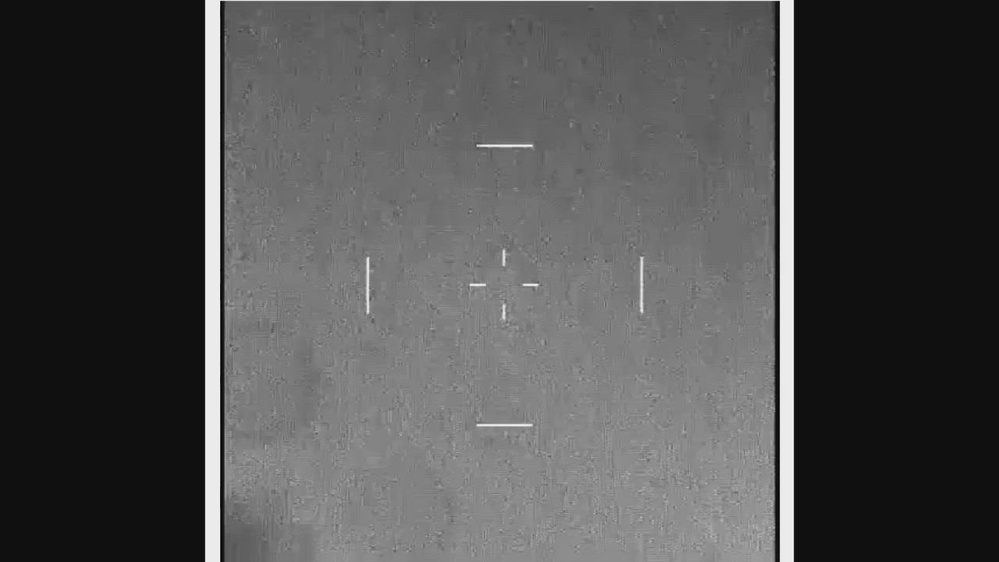
A U.S. military infrared sensor acquires a small bright area of contrast, holds it inside an auto-tracking reticle, adjusts zoom and contrast, then loses it off the left side of the frame. Later coverage noticed the elongated thermal profile looked superficially like the famous 2004 Tic-Tac footage. The resemblance is real. The evidence that they are the same kind of object is not.
WATCH OFFICIAL PR108 VIDEO ↗
THE ACTUAL RELEASED IMAGE
The public image is an unresolved thermal blob: bright, elongated and featureless at this resolution. There is no visible wing, exhaust plume, surface detail or reliable scale. The resemblance to the 2004 Nimitz Tic-Tac is a visual comparison, not an identification.
OPEN PRIMARY VIDEO ↗WHY THIS CASE MATTERS
PR108 is unusually clean as a government record. U.S. Northern Command submitted the report to the All-domain Anomaly Resolution Office, which later released the footage publicly under PURSUE. DVIDS identifies the file as Video ID 1014106, VIRIN 200101-D-D0360-2689.
AARO says the original report contained 2 minutes and 16 seconds of infrared footage from a U.S. military platform. The public DVIDS file is shorter at 1 minute 34 seconds. DVIDS displays the date as 01.01.2020, but the public record does not establish that the encounter literally occurred on New Year’s Day; it should be treated as a year-level public date unless more precise metadata is released. The platform type, exact location, range, altitude, unit and operator identity are not disclosed.
That means the strongest fact is simple: a U.S. military sensor tracked something it could not identify from the released record. What the public material does not give us is the geometry required to turn image motion into physical performance.
THE OFFICIAL SENSOR TIMELINE
The public sequence begins blank.
The footage flashes between normal operation and black several times as the sensor changes display modes.
The sensor zooms in and pans to track an area of contrast near the centre of frame.
An auto-tracking reticle surrounds the area of contrast while the sensor continues following it.
Zoom and contrast are adjusted several times. The target leaves the field of view to the left and the clip ends.
AARO explicitly warns that this timeline is descriptive only and should not be read as an analytical judgment or conclusion about what the object was.
THE “TIC-TAC” COMPARISON
The Debrief highlighted PR108 because the elongated infrared blob superficially resembles the famous 2004 Nimitz Tic-Tac image. UAP Globe has adopted the same comparison prominently.
But the comparison has to stop at morphology. The 2004 Nimitz case includes pilot testimony, shipboard radar accounts and a separate FLIR recording. PR108, as publicly released, supplies none of that surrounding evidence: no named pilot statement, no radar track, no visual-range observation and no second sensor.
That makes PR108 useful as a cautionary comparison. A low-resolution warm object can acquire a capsule-like appearance in infrared without telling us what the object actually is.
A small distant target may occupy only a few pixels, erasing wings, edges and surface detail.
Thermal imaging emphasises temperature contrast rather than ordinary visible-light shape.
Without range, a compact nearby object and a larger distant object can produce similar image size.
Sensor gain, zoom and blooming can make a point-like target look wider, smoother and more capsule-shaped.
WHAT COULD IT HAVE BEEN?
| Candidate | Why it can fit | What would be needed |
|---|---|---|
| Aircraft | A distant aircraft can collapse into an elongated infrared source with no visible wings at low angular resolution. | Range, bearing, traffic data and platform geometry. |
| Drone | A small unmanned aircraft may remain unresolved and can be held by auto-track. | Range, operating area data and resolved structure. |
| Balloon / aerostat | A drifting object can produce slow relative motion while presenting as a bright featureless target. | Wind profile, altitude and track geometry. |
| Sensor / display effect | Zoom, contrast settings, blooming and tracking behaviour can alter apparent size and shape. | Native sensor metadata and original-resolution imagery. |
None of these is a demonstrated identification for PR108. They are candidates the withheld geometry and raw sensor data would need to discriminate between.
THE PUBLIC-RECORD GAP
No named human witness is included in the public release. The sensor operator is not quoted. There is no statement describing apparent size, colour, distance, speed, sound, manoeuvres or visual shape outside the infrared display.
That matters because many UAP cases become stronger when sensor data and human observation independently reinforce one another. PR108 does not currently give us that. It is essentially a sensor record with clean provenance but weak geometry.
COMPETITOR PASS
UAP Globe is strong on the official timeline and on the Nimitz comparison, but its “Tic-Tac” framing risks becoming the headline before the evidence boundary. The Debrief is more restrained, calling the resemblance superficial and noting the lack of context.
The UAP Map keeps the comparison because it is genuinely useful search intent — readers will search for “PR108 Tic Tac” — but separates that visual resemblance from the question of whether the object shared any Nimitz-like behaviour. It also surfaces the DVIDS identifiers, the ambiguous public date convention, the missing geometry, and the imaging reasons an unresolved infrared target can appear capsule-shaped. There is no public evidence in PR108 of hypersonic motion, sudden acceleration, transmedium travel or unconventional propulsion.
PURSUE RELEASE 04 NETWORK
PR108 should not live as an isolated page. It sits alongside other Department of War / AARO Release 04 records, including the Yellow Sea and East China Sea cases. Cross-linking these pages gives readers a clearer picture of how the official release programme handles unresolved military sensor tracks — while also creating a stronger internal topical network for search.
Recommended internal links: Yellow Sea 2023 · East China Sea 2024 · PURSUE Release 04 hub / official-video collection.
SOURCE ROOM