ROAD / DEBRIS
Collision with debris
Stones or airborne material can crack glass and damage lamps, but a single debris event has not been shown to reproduce the full selective damage pattern.
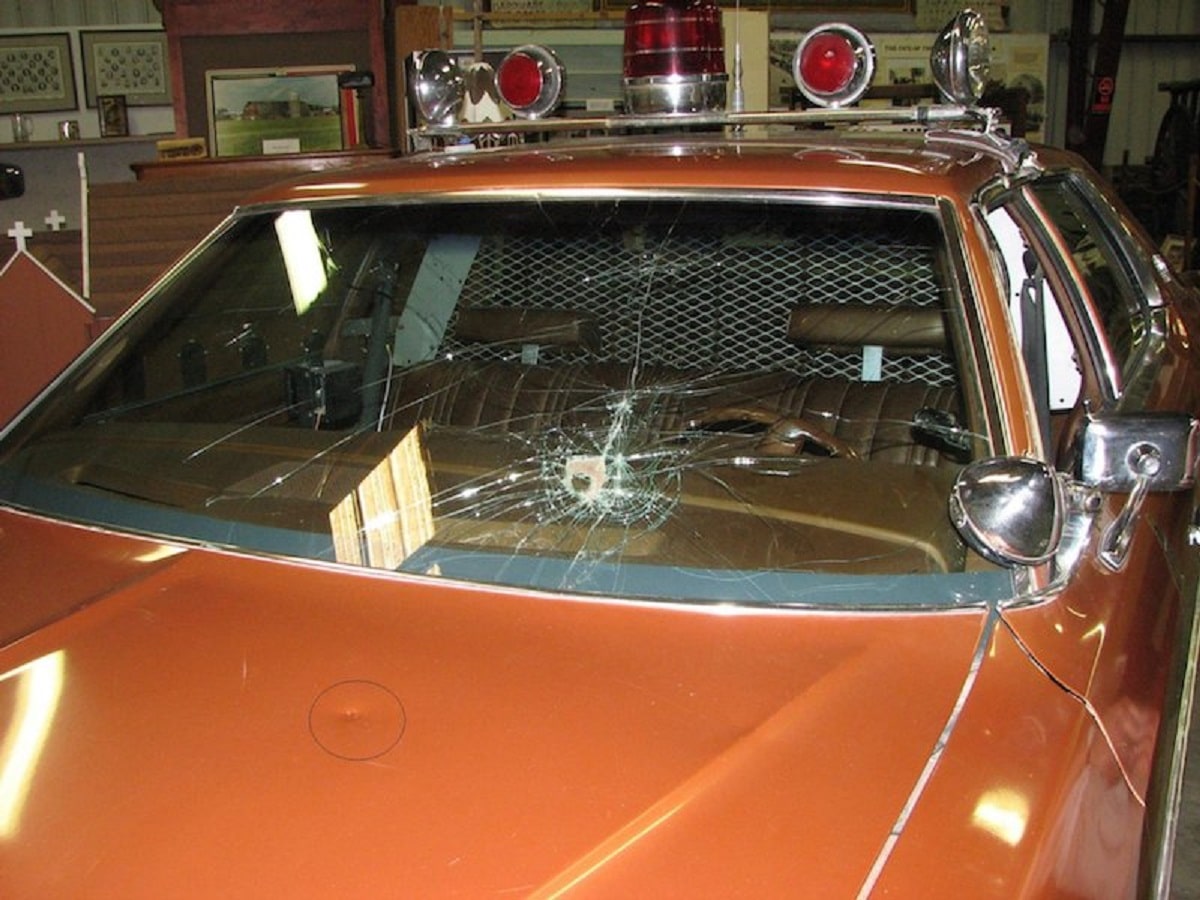
Deputy Val Johnson saw a sharply defined light low over Highway 220 and drove toward it. He remembered a flash and breaking glass. Thirty-nine minutes later he woke with eye pain, a head injury, and a squad car whose windshield, lights, hood and antennas were damaged.
In the early hours of 27 August 1979, Marshall County Deputy Sheriff Val Johnson was patrolling a remote part of northwestern Minnesota near Stephen. At the junction of County Road 5 and State Highway 220, he noticed a bright, sharply bounded light low over the road to the south.
Johnson initially thought it might be the landing light of an aircraft in distress. He turned onto Highway 220 and drove toward it. His account stayed remarkably restrained: he did not describe a saucer, occupants or alien beings. He described a light.
What happened next made the case famous. Johnson said the light rapidly closed on his vehicle. He remembered a flash or impact and the sound of breaking glass. His next conscious memory came roughly thirty-nine minutes later, with the squad car stopped at an angle across the roadway.
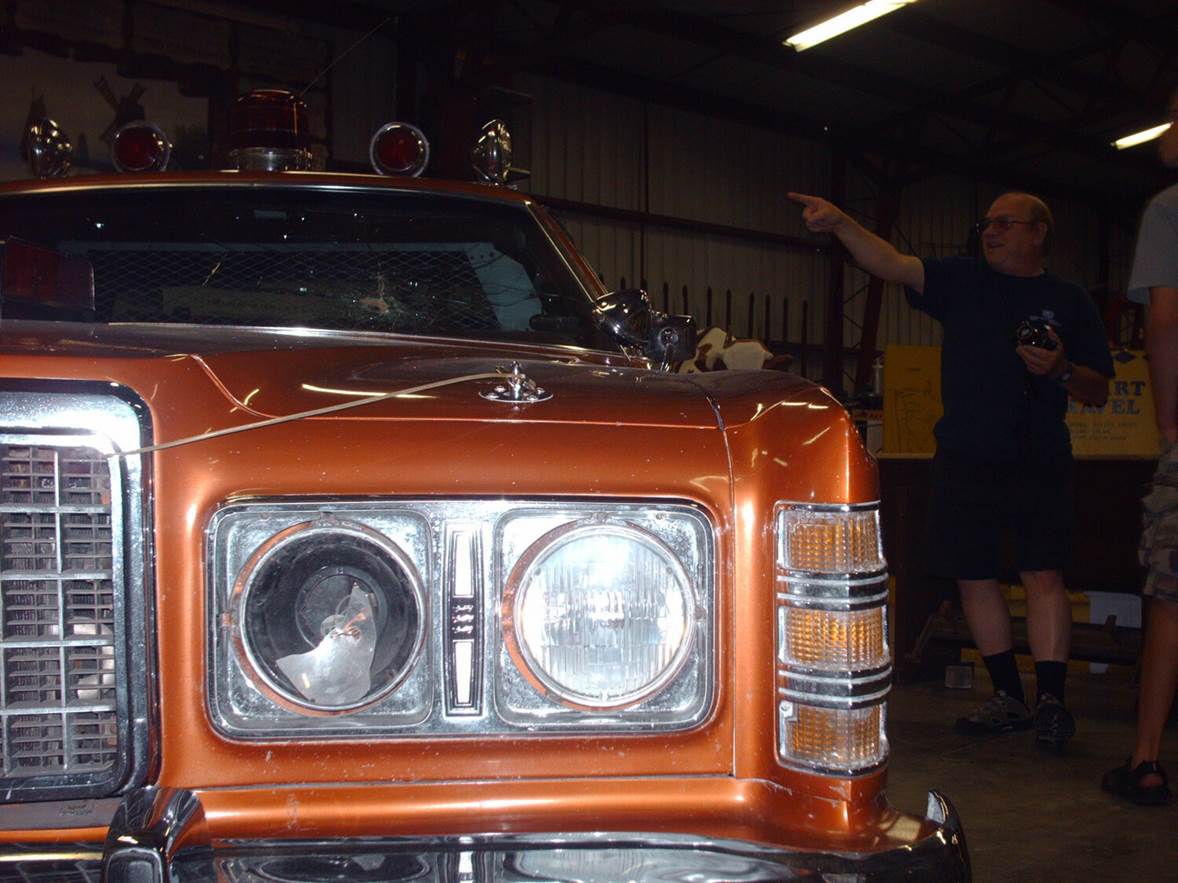
Responding deputies did not have to take his word that something had happened to the car. The windshield was cracked, lights were broken, antennas were bent, and the hood carried a small dent. The vehicle was photographed, examined and ultimately preserved unrepaired in a museum.
Marshall County Sheriff Dennis Brekke documented the scene and backed an external investigation rather than quietly repairing the car. The Minnesota Historical Society’s MNopedia account, updated in 2026, records that both the U.S. Air Force and the Federal Aviation Administration were asked about aircraft activity and reported no scheduled or known aircraft accounting for the event in the early hours of 27 August 1979.
That does not prove the light was extraordinary. It does remove one obvious testable explanation: a known aircraft emergency or documented near-miss directly corresponding to Johnson’s report.
In his taped account, Johnson estimated the light's apparent diameter at eight to twelve inches from his viewpoint and said it appeared roughly three to four feet above the road. Those numbers describe appearance, not physical size or distance.
He drove approximately a mile and a third toward it. The light then seemed to accelerate directly at the patrol car. There is no second eyewitness, photograph or radar record of that approach.
This is an important boundary. The case has often been illustrated with flying saucers, but Johnson's own description does not justify one. Whatever happened, the direct visual claim is a brilliant, well-defined light.
Johnson sees a brilliant light south of the intersection and considers an aircraft emergency.
The deputy heads south on Highway 220 to investigate.
Johnson reports the light rapidly closing and hears the windshield break.
Johnson regains awareness and calls for assistance.
While patrolling near State Highway 220, he turns south to investigate what he first considers a possible aircraft-related light.
Johnson regains awareness and radios the sheriff’s office. Deputy Doolittle is identified in later compiled records as the responding officer before medical care follows.
The damaged Ford, Johnson’s condition and the reported clock discrepancy become part of the immediate record.
The Marshall County Sheriff’s Office releases the case publicly; Johnson is placed on press-release duty as attention grows.
Guy Westcott interviews Johnson for the Center for UFO Studies. Additional field work and technical review follow during September.
The 1977 Ford LTD showed damage concentrated largely around the driver's side and upper body. The windshield had a complex fracture pattern, one headlight was broken, a roof emergency light was damaged, a small circular dent appeared on the hood, and two radio antennas were bent at different angles.
One ordinary front antenna was not bent. That asymmetry became part of the later debate because a simple high-speed crash or broad airflow should not necessarily affect selected aerials in such different ways.
CUFOS investigator Allan Hendry arranged examinations by outside specialists. Ford windshield specialist Meridan French reportedly found the fracture sequence difficult to explain, including apparent forces acting in more than one direction. Honeywell personnel later examined the antenna/electrical questions, and Roland Wardell visited the sheriff’s office in November. Magnetic testing did not produce a decisive anomalous signature.
The important boundary is that “unusual” is not the same as “exotic.” The corporate examinations did not identify a unique mechanism, and no surviving test result proves an electromagnetic weapon, unknown field or non-human technology.
French reportedly said that aspects of the windshield fracture pattern could be roughly approximated mechanically with a rubber mallet. That is evidence that some cracking can be reproduced by ordinary force. It was not a finding that a mallet had actually been used on Johnson’s car, and it did not resolve the full inward/outward fracture sequence or the rest of the vehicle damage.
None of that yields a unique mechanism. The tests support the fact that the damage was real and worth examining; they do not prove an electromagnetic weapon, exotic craft or unknown field.

After Johnson was found, his mechanical wristwatch and the patrol car's electric dashboard clock were reportedly both fourteen minutes slow. Because the devices used different mechanisms, the matching discrepancy became one of the most famous “time anomaly” claims in UFO literature.
But the wording matters. The clocks were reported fourteen minutes slow. They were not instrumented scientific timers recording a demonstrated interruption in time itself.
No publicly available calibration record establishes the exact pre-incident accuracy of both devices, and there is no continuous synchronized reference showing the exact moment either clock changed. The reported match is unusual; the evidential chain is not strong enough to convert it into a measured fourteen-minute interruption of physical time.
It is therefore fair to call the matching discrepancy unusual. It is not fair to call it proof that fourteen minutes of physical time disappeared.
Electric vehicle clock reportedly lost the same amount as Johnson's watch.
Mechanical watch independently reported behind by the same amount.
Johnson's loss of awareness was longer than the clock discrepancy.
The discrepancy is an observation about devices, not a direct measurement of altered time.
Responders found Johnson shaken and disoriented. He was taken for medical attention in Warren. Contemporary accounts describe a bump on his head and significant eye irritation, compared by a physician to mild “welder's burns.”
That comparison suggests exposure to intense light or ultraviolet radiation, but it is not a source identification. Similar eye irritation can arise from several causes.
Scene reconstruction placed the patrol car approximately 854 feet beyond the estimated impact point before it stopped at a sharp angle across the road. Tire marks then extended farther along the roadway. Those measurements became part of attempts to reconstruct what the car physically did while Johnson was unaware.
In a 2015 Minnesota Public Radio interview, Johnson again described the encounter as a ball of light. He did not retrofit the story into a detailed craft, occupants or extraterrestrial claim.
That later continuity does not prove the original event was extraordinary, and memory can change over decades. But it is useful because the central claim remained comparatively restrained rather than expanding into a more sensational narrative.
Stones or airborne material can crack glass and damage lamps, but a single debris event has not been shown to reproduce the full selective damage pattern.
Guy Westcott proposed that rapid deceleration could account for at least some antenna damage as flexible aerials whipped forward. It is a useful partial mechanism because it reduces the amount of exotic force required, but it does not by itself explain the windshield, lights, medical symptoms or clock discrepancy.
A luminous electrical phenomenon could fit the bright-light report and perhaps some electrical effects. It does not naturally explain all mechanical damage without additional mechanisms.
Klass argued Johnson may have fabricated the event, drawing partly on character/motive claims and the possibility of mechanically producing some damage. The theory never produced a demonstrated reconstruction that reproduces the full damage pattern, injuries and clock reports together.
If Johnson's account is accurate, some luminous source interacted with the car strongly enough to produce real physical effects. Its identity remains unknown.
The preserved vehicle makes Val Johnson unusually valuable, but every damaged component still requires a mechanism. The fact that the car exists is stronger than any claim about what struck it.
Strong state-history summary using contemporary reporting and Marshall County material.
OPEN MNOPEDIA →Preserves his restrained description of the light, approach, impact and awareness gap.
READ STATEMENT / CASE FILE →Early physical-evidence report drawing from the Grand Forks Herald and Minneapolis Star while CUFOS investigation was underway.
OPEN 1979 JOURNAL →Recent evidence-bound reconstruction keeping the light report, physical damage and clock claim separate from interpretation.
OPEN MODERN REVIEW →MNopedia’s state-history entry was last modified 4 August 2026 and includes the event chronology, aircraft checks, CUFOS involvement, Honeywell examination and museum preservation.
OPEN UPDATED MNOPEDIA →Current detailed competitor reconstruction, useful for checking the exact witness statement, Hendry investigation, Ford/Honeywell claims and the Klass dispute. Secondary to the contemporary record.
COMPARE CURRENT CASE FILE →Useful continuity check: decades later Johnson still described the encounter as a ball/light rather than upgrading it into a structured alien craft.
OPEN MPR INTERVIEW →Secondary compilation useful for the ~02:19 response time, Doolittle responder identification, 30 August public release and early September CUFOS timeline. These details remain subordinate to the primary/near-primary record.
OPEN CHRONOLOGY →Nearly every spectacular claim can be removed and the case still works. Johnson saw a light. Something happened. He lost awareness. Other officers arrived to find an injured deputy and a damaged vehicle. The Ford still exists. The mystery is not whether the windshield was broken or the antennas were bent. It is whether one ordinary event can account for all of it — and, if not, what else was on Highway 220 that night.