Not a later internet invention
The Colorado project physically received and examined the two original 35mm slides in January 1968.
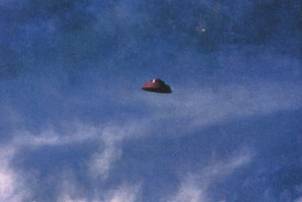
UTAH · SUMMER 1966 · CONDON REPORT CASE 7
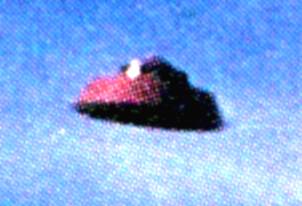
A retired U.S. Air Force command pilot said he photographed a brick-red saucer-like object from a C-47 about 25 miles southwest of Provo. The original slides were physically examined by the University of Colorado UFO project. The central dispute is not whether the photographs existed — it is whether the film chronology supports the witness story, and whether Condon ever proved what the object actually was.
THE FAST ANSWER
The Colorado project physically received and examined the two original 35mm slides in January 1968.
The project described the witness's reputation as irreproachable and documented 16 years of Air Force officer service and Command Pilot status.
The film-edge numbering indicated the UFO exposures were neither consecutive nor in the order the witness described.
Condon suggested an ordinary earthly object thrown into the air, but did not positively identify a specific object.
THE ACTUAL PHOTOGRAPH
THE PILOT'S STORY
The witness said he was flying a C-47 when he handed control to the co-pilot and prepared to photograph the mountains. His camera was already in his lap when an unknown object appeared around the ten-o'clock position.
He raised the camera, exposed one frame, advanced the film and took a second shot before the object swept upward and to the right out of view. He described no sudden turns, only apparent acceleration.
The co-pilot was occupied with calculations and did not see the object. No other crew member became a supporting witness.
THE CHRONOLOGY CONTRADICTION — VISUALISED
This is the strongest weakness in the case because the contradiction is not confined to handwritten slide labels: Condon reported it in the film-edge numbering itself.
THE FRAME-NUMBER PROBLEM
He said the exposures were made only seconds apart during one brief aerial encounter.
The processed slide mounts did not present the photographs as consecutive frames.
After removing the slides from the mounts, investigators found corresponding numbers on the film itself.
The project concluded the UFO exposures were made later than the witness's claimed summer sequence and in reversed order.
This was not merely a labelling error on cardboard mounts. The project said the contradiction also existed in the manufacturer's film-edge numbering, witnessed by five staff members.
WHAT CONDON ACTUALLY CONCLUDED
Investigators Craig and Levine concluded that the provenance discrepancies made detailed photographic analysis unjustified. The slides were returned with the comment that they could not be used to support claims that the object was anything other than an ordinary earthly object thrown into the air.
That wording matters. The project did not demonstrate a specific thrown object, reproduce the photographs experimentally or publish a positive identification of the photographed shape.
So “Condon proved it was a hoax” is stronger than the report. A better summary is: Condon judged the claimed chronology unreliable enough that it stopped short of a full object analysis.
WHAT CONDON PROVED — AND WHAT IT DIDN'T
The original slides were inspected, and the mount plus film-edge numbering was treated as inconsistent with the account of two consecutive summer exposures. That is a real evidential problem.
The published treatment did not identify a particular model, reproduce the photograph experimentally, publish a measured scale/distance solution or demonstrate a specific hoax mechanism.
So the careful wording is: Condon rejected the photographs as reliable evidence because of provenance contradictions; it did not positively identify the photographed object.
THE PRO-UFO COUNTERARGUMENT
Critics of the Condon treatment argue that the project moved from a chronology contradiction to an ordinary-object suggestion without completing the kind of photogrammetric or optical analysis that might have tested the pictured object's scale, focus, distance or likely method of production.
That criticism is fair as a question of analytical completeness. It does not erase the frame-number problem. Both can be true: the witness chronology can be seriously compromised, and the physical identity of the object in the photograph can remain unproven.
The strongest version of this case is not “credible pilot therefore alien craft.” It is “real historical slides, credible witness context, damaging provenance contradiction, and no demonstrated physical identity for the photographed object.”
EVIDENCE BALANCE
| Evidence | Supports the case | Weakens the case |
|---|---|---|
| Witness background | Retired USAF officer, Command Pilot, responsible civilian employment. | Credibility does not resolve physical contradictions in the film record. |
| Two photographs | Persistent saucer-like form appears in two historical slides physically examined by the project. | No independent modern forensic analysis of the original slides is publicly available. |
| Film chronology | The witness disputed the numbering and maintained his account. | Film-edge numbering strongly conflicts with the claimed consecutive summer exposures. |
| Condon ordinary-object suggestion | No specific object was demonstrated or experimentally reproduced. | The provenance problem gives a plausible basis for suspecting staged photography. |
| Corroboration | The case entered an official Air Force-funded study. | The co-pilot did not see the object and there were no independent event witnesses. |
FIRST COMPETITOR POSITION
The strongest competitor correctly treats the case as more than an orphaned internet photo: it is Condon Report Case 7 and the original slides were physically investigated. It also highlights that the project never performed a full object analysis after the chronology problem emerged.
The UAP Map's advantage should be clarity: show exactly what the witness claimed, exactly what the mount and film-edge numbers showed, exactly what Condon inferred — and exactly what Condon did not prove. That directly answers searches around Provo UFO 1966, Condon Case 7, Utah red saucer and C-47 UFO photograph instead of burying the key contradiction in a long narrative.
Primary terms covered directly: Utah Red UFO 1966 · Provo UFO 1966 · Condon Case 7 · C-47 UFO photo · red saucer Utah · USAF pilot UFO photograph · Utah UFO slides.
SOURCE ROOM