≈ 2.5 m
Witness estimate, not a measured dimension.
TRANS-EN-PROVENCE · VAR · FRANCE · 8 JANUARY 1981
Renato Nicolaï said a small metallic object descended, touched down roughly 30 metres away and departed rapidly. He was the only person who saw it. But the next day French gendarmes documented a real trace. GEPAN later found soil compaction, material deposits, evidence of heating and distance-related biochemical changes in nearby alfalfa.
EVIDENCE STREAM: WITNESS
At around 17:00 on 8 January 1981, Nicolaï reported hearing a slight whistling sound and seeing a grey metallic object descend toward a terrace on his property.
Witness estimate, not a measured dimension.
Witness estimate.
He described a circular/ovoid metallic form with protrusions underneath.
He said the object touched the ground and then rose rapidly and departed. No second witness independently saw that landing or departure.
EVIDENCE STREAM: PHYSICAL
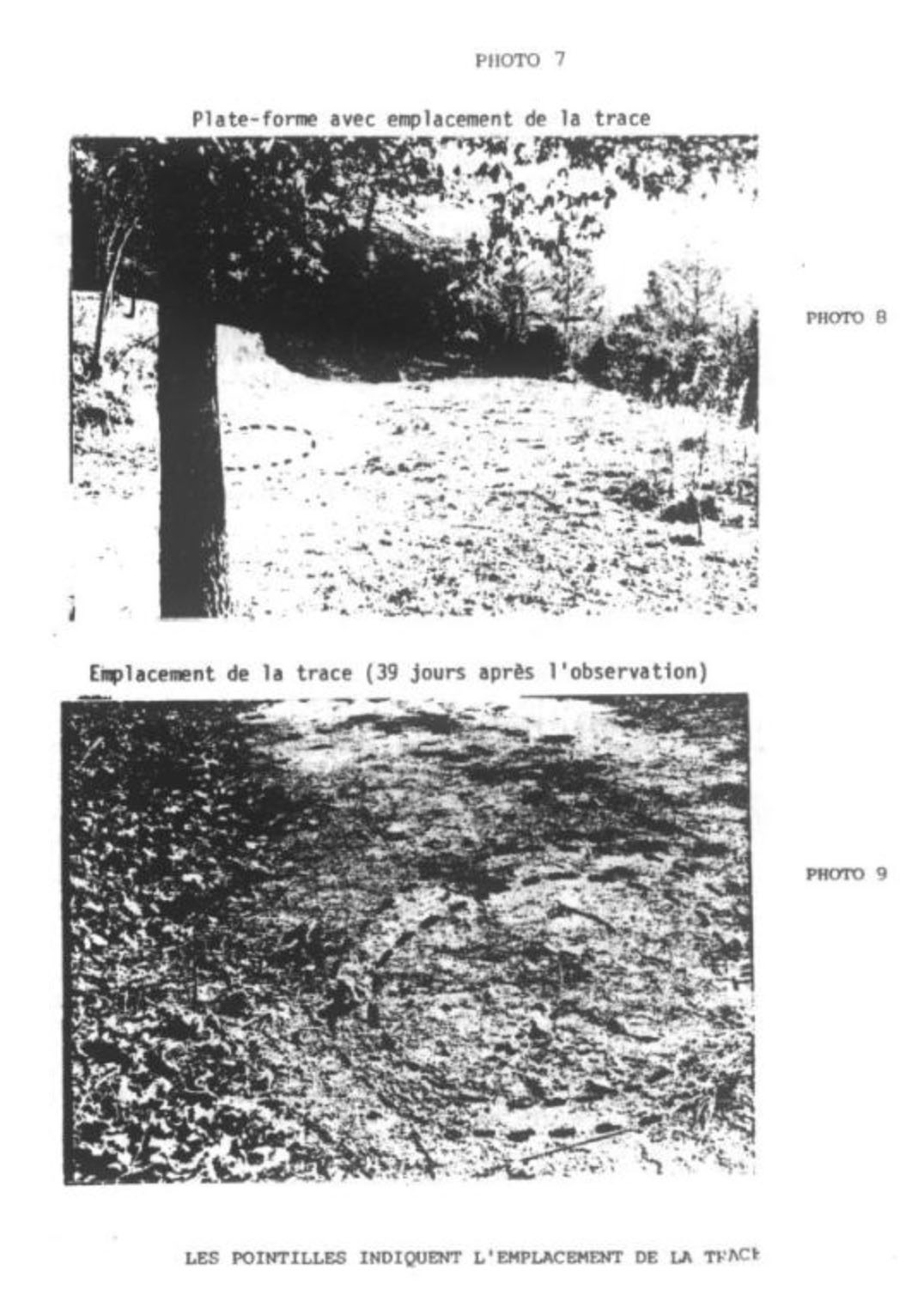
French gendarmes attended on 9 January — the day after the reported event. They inspected and photographed the ground mark and collected soil and wild-alfalfa samples from the trace and at increasing distances away.
GEPAN returned on 17 February. The trace was reportedly still visible, and further samples were collected.
This chronology is why Trans-en-Provence is stronger than a trace story first investigated months or years later.
WHAT THE LABORATORIES FOUND
Compatible with substantial localized mechanical loading.
Phosphates and zinc were also detected; blackish residues were considered compatible with combustion products.
A thermal effect was inferred, but no propulsion system was identified.
Those are genuine analytical findings. They establish that the site had been physically altered. They do not identify the source as a spacecraft.
THE 4–5 TONNE CLAIM
The famous tonne-scale figure comes from soil-mechanics interpretation of the compaction and pressure. Any estimate depends on assumptions about contact area, soil properties, moisture, force geometry and load distribution.
Heavy mechanical loading is supported. “A 4–5 tonne craft was measured” is not.
THE BIOCHEMICAL EVIDENCE
INRA analysis reported changes in chlorophyll-related pigments and other plant constituents. The effect was strongest nearest the trace and diminished with distance.
This is an explanatory gradient, not a reproduction of the original INRA graph. The laboratory finding was a distance-correlated biochemical difference; the cause was not identified.
WERE THE PLANTS “MICROWAVED”?
Electromagnetic or energetic mechanisms were later proposed as possible explanations for the plant chemistry. GEIPAN's modern synthesis says an intense electric field can be envisaged.
That is a causation hypothesis.
Biochemical disturbance = measured. Microwave irradiation = not directly measured.
GEIPAN'S MOST IMPORTANT LIMIT
GEIPAN's modern synthesis explicitly separates the physical findings from proof of the witness account.
The trace, deposits, thermal evidence and plant chemistry support that something unusual affected the site. They do not independently demonstrate that the specific metallic object described by Nicolaï caused those effects.
This is the evidential boundary of the entire case.
THE TRACE IS NOT KNOWN LANDING GEAR
The original imagery shows an irregular circular or semicircular trace with scraping or slippage characteristics.
Popular diagrams can make the mark look much cleaner than the evidence warrants. There is no basis for publishing precise tripod spacing, known foot-pad geometry or an engineered landing-gear plan.
CONVENTIONAL ALTERNATIVES
Tyres, machinery and other heavy loads can cause compaction and scraping.
Age, moisture, disease, soil and sampling differences can affect vegetation.
But no demonstrated hoax mechanism has been recovered that reproduces the full physical and biochemical pattern.
No specific mundane reconstruction in the recovered record has demonstrated the complete combination of trace geometry, compaction, deposits, heat, plant gradient and chronology.
COMETA
The later COMETA report used stronger language, essentially treating the case as evidence that a heavy metallic unidentified object landed.
That interpretation is historically relevant. But the public Case File should let the underlying GEPAN / GEIPAN material set the evidential limit, because GEIPAN explicitly states the analyses did not prove the witness narrative.
THE REAL MYSTERY
Renato Nicolaï reported a small metallic object landing. He was the sole direct witness.
Within a day, French police documented a physical trace at the reported location. Later laboratory analysis found substantial mechanical compaction, material deposits, evidence of heating and distance-correlated biochemical changes in nearby vegetation.
That is unusually strong physical evidence for a UFO case.
But it still leaves the central question open: what physically affected that patch of ground and vegetation immediately after Nicolaï reported a metallic object landing there?
SOURCE ROOM