A uranium pit lit up like daylight. Workers allegedly watched a round object rise vertically into the night. Two days later, one witness said, a 250-foot circle of ore had turned chalky white and stopped registering radioactivity.
Summer 1971Karnes County, TexasLate-reported case
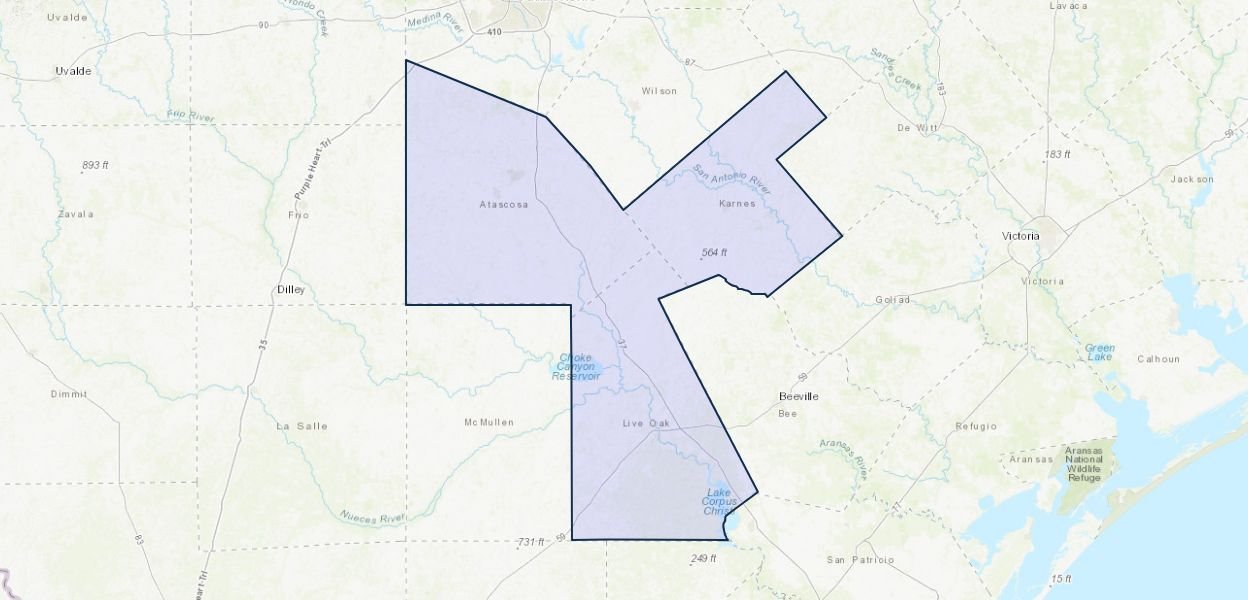
Authentic documentary context from the Karnes County uranium-mining district. This is not a photograph of the claimed object; no authenticated incident photograph is known.
Primary surviving source
NUFORC report filed 27 May 1999
Claimed witnesses
Six operators in narrative; NUFORC lists eight
Physical-trace claim
250-ft circle of allegedly non-radioactive white ore
Critical weakness
No 1971 mine, assay or co-witness record recovered
The case in one minute
The mine was real. The account is real. The physical trace is not yet verified.
The Karnes City story is one of those UFO cases that sounds stronger every time it is shortened. “Multiple workers. Uranium mine. Physical effects.” The surviving record is narrower.
Michael Harvey said that in the summer of 1971 he was working the night shift for Conoco Oil Company at an open-pit uranium mine west of Karnes City, Texas. According to his account, the entire pit suddenly became brilliantly illuminated at about 11:10 p.m.
He described a high-pitched hiss, the hair on his arms standing on end and an overpowering light that hurt his eyes. When the brightness faded enough to look upward, he said he saw a round object with a central underside light and many small coloured lights around its perimeter.
The object, he said, climbed slowly at first and then accelerated vertically out of sight.
That would be a striking multi-worker close encounter — except the public evidence is still one man's account written 28 years later.
The night shift
“The 85-acre pit lit up as if it was daylight.”
~11:10 p.m.
Shift change
Harvey said he and other Caterpillar 657B operators were preparing to start their machines when the mine was flooded by an intense white light.
First moments
Hiss and static-like sensation
He described a high-pitched hiss and the hair on his arms standing up. These are remembered bodily effects, not instrument readings.
~2 minutes
The object becomes visible
As the glare faded, Harvey said a round object could be seen above the pit, with a brilliant central light and numerous smaller coloured beams around its rim.
Departure
Straight up
He said it rose slowly before accelerating vertically and disappearing in roughly ten seconds.
2 days later
The ore claim
After overburden was removed, Harvey said workers found a 250-foot-diameter circle of chalky white material where uranium ore should have been, with no detectable radioactivity inside the circle.
27 May 1999
The story enters the public record
The first surviving public report appears almost 28 years after the claimed event.
The physical-trace claim
If the ore really changed, this should have left paperwork.
The alleged white, non-radioactive circle is the most dramatic part of the story — and the part that should be the easiest to verify from industrial records.
Claimed sizeAbout 250 feet across in the centre of the pit.
Claimed changeBrown uranium-bearing material became chalky white.
Claimed readingNo radioactivity inside the circle, while ore outside remained active.
No contemporaneous assay report, Geiger-counter log, core record, ore sample, radiation-safety document or mine-manager report tied to this anomaly has surfaced in the current research trail. Until one does, the “uranium was neutralised” claim remains Harvey's interpretation of an alleged observation, not established physical evidence.
A real industrial backdrop
The setting checks out better than the UFO evidence does.
The Texas uranium boom in Karnes County is well documented. Continental Oil Company — Conoco — and Pioneer Nuclear Corporation developed the Conquista project southwest of Falls City, with open-pit mining planned within a broad surrounding radius and mining scheduled to begin in 1971.
That matters because Harvey's industrial description is not generic scenery pasted onto a UFO story decades later. Large open-pit uranium operations, heavy Caterpillar equipment, radiation surveys and night-shift mine work all belong to the real Karnes County landscape of the period.
But authentic setting is not the same thing as authenticated incident. The documentary record verifies the mining environment, not the hovering object or the alleged transformed ore.
The witness-count problem
Six men in the story. Eight observers in the database.
Harvey's narrative
He wrote that he was one of six Caterpillar 657B operators and described everyone as shaken by the event.
NUFORC metadata
The database entry lists eight observers.
That discrepancy should not be “fixed” by choosing whichever number sounds better. It is a provenance problem. Until the original submission metadata or additional witness names are recovered, the exact observer count remains unresolved.
Could the mine explain parts of it?
An industrial site creates plenty of ordinary things worth testing.
Open-pit mines contain powerful lighting, large electrical systems, generators, reflective dust and heavy machinery. Electrical corona or high-voltage equipment can produce hissing sounds and static-like sensations. Aircraft or helicopters around industrial sites can also be hard to judge for size and distance at night.
None of those possibilities currently solves the case. Harvey described an overwhelmingly bright source over a huge pit and a round object making a rapid vertical departure. Without site geometry, equipment layout, weather, flight activity and independent accounts, no conventional candidate can be matched confidently to the full narrative.
The correct ordinary case is therefore not “it was mine lighting.” It is that the industrial environment offers several testable alternatives that have never been reconstructed.
The nuclear-site temptation
Uranium makes the story memorable. It does not prove intent.
Even if the sighting happened exactly as described, the location alone does not show that an unknown object was “interested” in uranium.
The stronger claim — that the object somehow extracted, altered or neutralised radioactive material — depends entirely on the unverified ore anomaly. No recovered instrument record currently links the alleged object to any measurable change in uranium-bearing material.
What the case actually gives us
A detailed story with a very thin evidence chain.
One surviving first-person account written in 1999 about a claimed 1971 event.
A historically credible Karnes County uranium-mining setting.
A claimed daylight-bright illumination, hiss and static-like bodily effect.
A round luminous object and rapid vertical departure.
Other workers said to have been present — but no independent statements from them.
A claimed 250-foot physical anomaly — but no contemporaneous assay, radiation or sample record.
A six-versus-eight witness-count discrepancy that remains unresolved.
What remains
This case could change dramatically if the mine records survive.
Unlike many late memory cases, Karnes City contains claims that should have intersected with industrial paperwork.
If a Conoco incident log, radiation survey, shift roster, core-sample sheet or named co-worker statement from 1971 emerges, the case becomes much stronger.
If mine records show a mundane geological layer or no radiation anomaly at all, its most exotic element could collapse.
If nothing survives beyond Harvey's 1999 submission, then the case remains what it is today: a memorable close-encounter story with a real setting but no independently recoverable event record.
Reader test
What would you need before calling this physical evidence?
A 1971 radiation log showing a sudden dead zone?
A core or assay record proving uranium-bearing material changed composition?
Named co-workers independently describing the light and object?
A company incident report or local newspaper story from the period?
Or is the 28-year gap already too large to overcome without primary documentation?
Source room
Follow the surviving trail
NUFORC sighting 7896 The surviving 1999 first-person report. This is the central public source and should be read in full.
Handbook of Texas — Uranium Mining Independent industrial history confirming Conoco/Pioneer Nuclear's Conquista project and open-pit mining in Karnes County beginning around 1971.