A wave of witnesses. Archived FAA radar. Military activity. And a Texas night that refused to collapse into one simple explanation.
Stephenville separates witness testimony, archived radar, military activity and later technical analysis. The key question is correlation, not whether any one strand sounds extraordinary on its own.
On the evening of 8 January 2008, reports began to spread around Stephenville and nearby Dublin, Texas. Residents described large, bright or apparently structured objects moving through the night sky. The witnesses did not all describe the same thing in exactly the same way, and the case should not be simplified into one perfect sighting.
What made Stephenville different was scale. The story grew from a local report into a much wider witness wave. People with aviation and law-enforcement backgrounds were among those who spoke publicly. Local press attention accelerated. Then the case acquired something that many famous civilian UFO events never obtain: archived FAA radar data that could be examined after the fact.
That does not mean radar 'proved' the object witnesses described. It means Stephenville became testable in a way most mass-sighting cases are not.
The first layer is human.
Dozens of civilians reported unusual aerial activity in the Stephenville–Dublin area. Pilot Steve Allen became one of the better-known public witnesses, while other reports came from people with law-enforcement or aviation backgrounds.
Large witness numbers can be impressive, but volume alone is not enough. People can see the same ordinary aircraft from different angles. Stars, planets and distant lights can be misjudged. Once a story becomes public, later reports can also become entangled with the original event.
Stephenville becomes more interesting because the testimony does not stand alone. The witness geography can be compared against other information recorded in the same region.
Reports came from around Stephenville and Dublin, including civilians with aviation and law-enforcement backgrounds.
The military story complicated the case almost immediately.
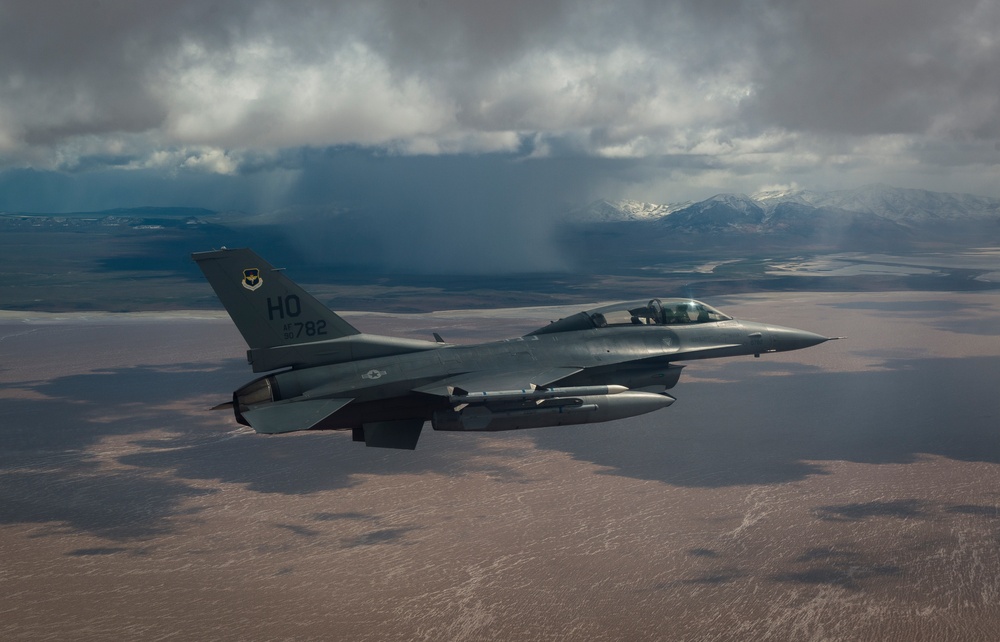
The Air Force initially said there had been no fighter activity relevant to the reports. It later acknowledged F-16 training in the area.
That reversal matters for two reasons. First, it gives investigators a known source of aircraft activity that can explain at least some visual observations and some radar traffic. Second, it means the simplest early public account of what was in the sky was incomplete.
The correct conclusion is not that the military explanation therefore collapses. F-16s were genuinely present. The correct question is narrower and harder: how much of the witness and radar record can those aircraft actually explain?
The FAA archive gave investigators a real traffic picture to analyse. Published studies identified complex traffic and some tracks they considered unresolved.
The FAA supplied radar data that later investigators analysed alongside witness reports.
MUFON's special report and later work by the Scientific Coalition for UAP Studies examined the traffic picture and identified radar tracks that were not straightforwardly resolved in the published analyses. The region also contained known military activity, which makes the dataset more complicated rather than less valuable.
This is where Stephenville stops being simply a mass-witness story.
Radar can show that something was being tracked in a region. It cannot, by itself, tell us that a particular return was the large structured object a particular witness believed they saw. The decisive problem is correlation: can an unresolved radar track be matched to a strong witness report closely enough in time, location and direction to justify treating them as the same event?
That question remains open.
The strongest interpretation of Stephenville is therefore not 'radar confirmed a giant UFO'. That overstates what the public record can support.
The stronger formulation is that a large witness wave occurred in a region for which archived FAA radar exists; technical investigators found a complex traffic picture containing known military aircraft and some tracks they regarded as unresolved; and the most important remaining task is to match individual witness timelines against individual radar events with greater precision.
This is less sensational than a perfect radar lock on a giant craft. It is also much harder to dismiss as folklore, because there is still data to interrogate.
One of the better-known civilian witnesses in the case. His aviation background makes his report important, while still leaving normal limits of night-time visual estimation.
The scale of the witness wave is part of the case, but not every report should be treated as identical or equally probative.
Some reports came from observers with relevant professional experience, adding weight without making them infallible.
The surviving radar data turned Stephenville into a case that could be analysed after the witness wave had passed.
Conventional explanations deserve substantial weight in Stephenville.
F-16 training aircraft account for some activity. Civilian traffic would have been present. Bright stars or planets may explain some point-light observations. Witnesses can misjudge distance, speed and size at night, especially when viewing lights without a reliable scale.
The case becomes difficult only when these explanations are asked to account for the strongest reports and the radar picture together.
Some sightings may be unrelated to one another. Some may be ordinary aircraft. Some radar returns may be data artefacts or known traffic. The question is whether all of the unusual material can be dissolved that way without leaving a residue of reports and tracks that still resist identification.
Explains known military traffic and potentially some visual reports. It does not by itself identify every unresolved radar track or strongest structured-object account.
Almost certainly account for part of the traffic picture. The challenge is matching them to specific reports rather than invoking them generally.
Plausible for some point-light observations, but less useful for detailed structured-object reports unless the viewing circumstances support it.
Some reports and radar events may never have belonged to one phenomenon at all. This possibility is central to a disciplined reconstruction.
Stephenville endures because it sits between two unsatisfactory extremes.
It is not responsible to say that a giant craft was conclusively tracked over Texas. The witness-to-radar correlations are not precise enough for that.
It is equally unsatisfactory to reduce the case to 'there were F-16s in the area'. Military activity is part of the explanation, but its mere presence does not demonstrate that every strong witness report or every unresolved radar track belonged to those aircraft.
The surviving case is more interesting than either slogan.
A substantial witness wave occurred. FAA radar data survived. Military activity was real. Technical analyses found a complex picture containing both identifiable traffic and unresolved elements. The remaining mystery is whether the most unusual testimony and the most unusual tracks intersect strongly enough to describe the same physical event.
That is the Stephenville problem—and it is still open.