10 July 2026 · Release 04
PR101 was released as part of the Department's fourth PURSUE media tranche, giving the case a traceable public-release context rather than an isolated social-media upload.
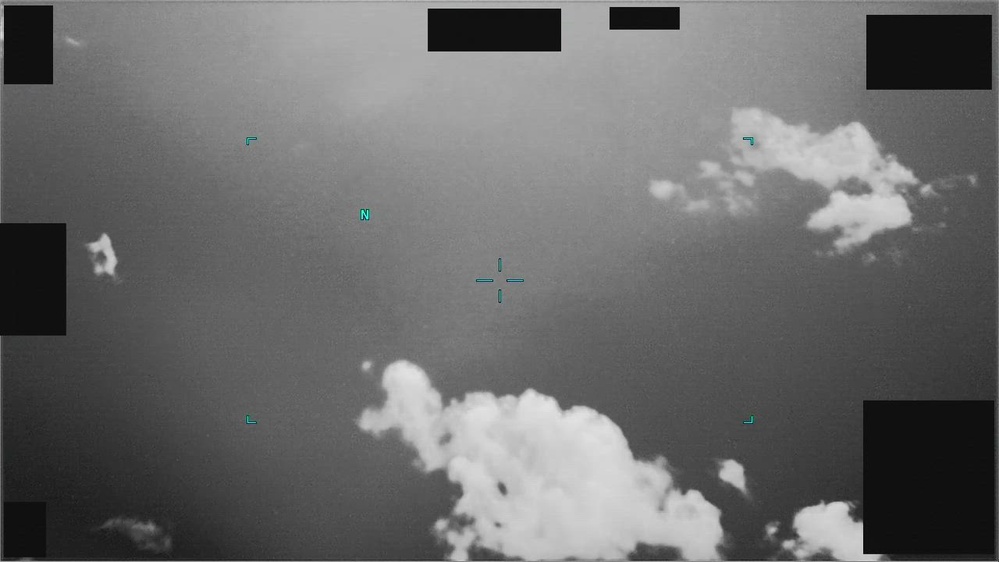
INDOPACOM · SOUTH CHINA SEA · 2024 · PURSUE PR101
A single infrared contrast is tracked, becomes elongated as the sensor zooms, then appears as a line of several areas of contrast moving diagonally across the field. That sequence has been described online as an object “splitting” into multiple craft. AARO does not say that. It says the image appears as a line of several areas of contrast after zoom, then becomes less distinct as distance from the sensor increases.
WATCH OFFICIAL PR101 VIDEO ↗RELEASE PROVENANCE
PR101 was released as part of the Department's fourth PURSUE media tranche, giving the case a traceable public-release context rather than an isolated social-media upload.
AARO describes 1 minute 46 seconds of submitted footage, while the DVIDS public file runs 1 minute 44 seconds. The page preserves that discrepancy instead of silently harmonising it.
THE FAST ANSWER
The released sequence changes from a compact target to an elongated target and then to several distinct-looking contrasts.
After the line appears, the sensor continues to pan with the contrasts in view as they become progressively less distinct.
There is no released range, altitude, measured speed or sensor geometry to tell us what the changing image means physically.
THE ACTUAL RELEASED IMAGE
PR101 is one of the better examples of why UAP footage has to be read as a sensor record. The apparent morphology changes during successive zoom levels, so each visual stage has to be separated from claims about physical shape.
THE IMAGE SEQUENCE — THREE DISTINCT STAGES
One area of contrast is tracked near the centre of the infrared field.
After zooming, the target image becomes stretched or elongated rather than remaining a compact spot.
After another zoom, AARO says the image appears as a line of several areas of contrast.
The morphology change happens in step with sensor zoom changes. That timing is central to interpreting the footage.
WHAT THE OFFICIAL RECORD SAYS
The U.S. Indo-Pacific Command submitted PR101 to AARO as a 2024 South China Sea UAP report from an infrared sensor aboard a U.S. military platform.
DVIDS publishes a 1:44 public file, while AARO's description says the submitted report consisted of 1:46 of video footage. That two-second difference should be retained rather than silently harmonised.
AARO explicitly says its video description is informational only and is not an analytical judgment, investigative conclusion or factual determination about the event's validity, nature or significance.
THE OFFICIAL TIMELINE
The sensor tracks one area of contrast, generally centred.
The sensor zooms in and tracks an elongated area of contrast left of centre.
After another zoom, the image appears as a line of several contrasts moving bottom-right to top-left.
The sensor pans to track the contrasts for about a minute; they become less distinct as distance from the sensor increases.
THREE WAYS TO READ THE MORPHOLOGY
One physical target could resolve into multiple hotter or colder regions as magnification increases.
Several closely spaced targets could blend together at lower magnification and become individually apparent after zoom.
Resolution, bloom, focus and processing can divide or stretch a compact source into structured image features.
The public record does not publish enough raw sensor information to choose decisively among these families.
WHY “BECOMING A LINE” IS NOT AUTOMATICALLY FRAGMENTATION
The most dramatic morphology shift appears immediately after another sensor zoom. That timing matters. If the display resolves previously blended structure, the image can change sharply without the underlying physical target splitting apart.
“The object split into multiple craft” is stronger than the released evidence. The safe statement is that the image resolved into a line of several contrasts after zoom. Fragmentation is one interpretation, not an observed fact.
Likewise, if several separate targets were already close together, extra magnification could reveal them as multiple areas of contrast. The footage does not show a clear explosive separation event or a measured increase in real-world spacing.
WHAT COULD IT HAVE BEEN?
| Candidate | Why it can fit | What is missing |
|---|---|---|
| Aircraft / multiple aircraft | Distant aircraft can appear as compact IR sources and a close group can resolve into multiple contrasts under zoom. | Range, traffic data, altitude, heading and resolved structure. |
| Drones / UAS | A small group of drones could produce several discrete contrasts moving together. | Scale, mission context, range and platform geometry. |
| Balloons / debris | Wind-borne objects can share drift and become less distinct as separation from the sensor grows. | Wind profile, altitude, range and size. |
| Sensor / optical effects | Focus, gain, bloom and image processing can change apparent elongation and multiplicity as zoom changes. | Sensor model, native frames and calibration. |
None of these has been publicly demonstrated as the PR101 identification. The case remains unresolved in the released record.
THE DISTANCE CLUE
As sensor-target distance grows, the same physical target occupies fewer detector pixels and becomes harder to resolve.
If multiple sources are present, increasing distance can compress them into fewer apparent image features.
Lower contrast against the thermal background can make the targets fade without any physical disappearance.
What AARO does not publish is the actual range, rate of separation or target speed. “Distance increases” is qualitative context, not a kinematic solution.
This is why the late fading should not be described as cloaking, disappearance or anomalous dimming when the official description itself ties reduced distinctiveness to increasing distance.
COMPETITOR PASS
UAP Globe correctly foregrounds the compact-to-elongated-to-line sequence, the South China Sea / INDOPACOM provenance and the missing range and speed data.
The UAP Map's opportunity is to make the central question more useful: does zoom reveal one structured object, several previously blended targets, or sensor/image structure? By separating those hypotheses, preserving the 1:46-vs-1:44 discrepancy, surfacing Release 04 provenance and explicitly rejecting the unsupported “split into multiple craft” claim, we give readers more information without pretending the record settles the answer.
SOURCE ROOM