Socorro is one of the rare classic UFO cases where a close-range witness report, immediate police response, physical traces and Project Blue Book investigation all converge within hours and days of the event.
Lonnie Zamora was a Socorro police officer, not a UFO investigator. He was pursuing a speeding vehicle when he heard a loud roar and saw a bluish-orange flame descending southwest of his position. He broke off the chase to investigate what he thought might be an explosion or accident.
After climbing a rough dirt road, he briefly saw a shiny whitish object in a gully, initially resembling an overturned car. Near it he reported two small adult-like figures in white coveralls, visible only briefly and without facial detail.
As he approached again, Zamora described a white oval object with a red insignia-like marking. He then heard a loud roar, saw a blue-orange flame beneath it and ran for cover as the object rose.
During the dash for cover, Zamora lost his glasses. His unaided eyesight was poor enough that later skeptics used this as part of their reconstruction of the final moments. That limitation matters most for what he perceived while running after the powered departure began; it does not erase the earlier close views he reported while still wearing them.
Once airborne, he said the roar stopped and the object moved away silently at low altitude before climbing into the distance. The encounter became Project Blue Book case 8766.
Zamora is pursuing a speeder when he hears a roar and sees a blue-orange flame descending roughly southwest.
He turns onto a rough road, climbs a hill and sees a shiny whitish object roughly 800 feet away in a gully, with two small white-clad figures beside it.
He radios headquarters that he is investigating a possible car accident, drives closer and stops near the ridge above the gully.
Zamora hears loud thumps, moves forward and sees the object at much closer range, including a red symbol/marking on its side.
A loud roar begins, a blue-orange flame appears beneath the object and Zamora runs for cover. The object rises, clears nearby terrain and a dynamite shack, then moves away rapidly.
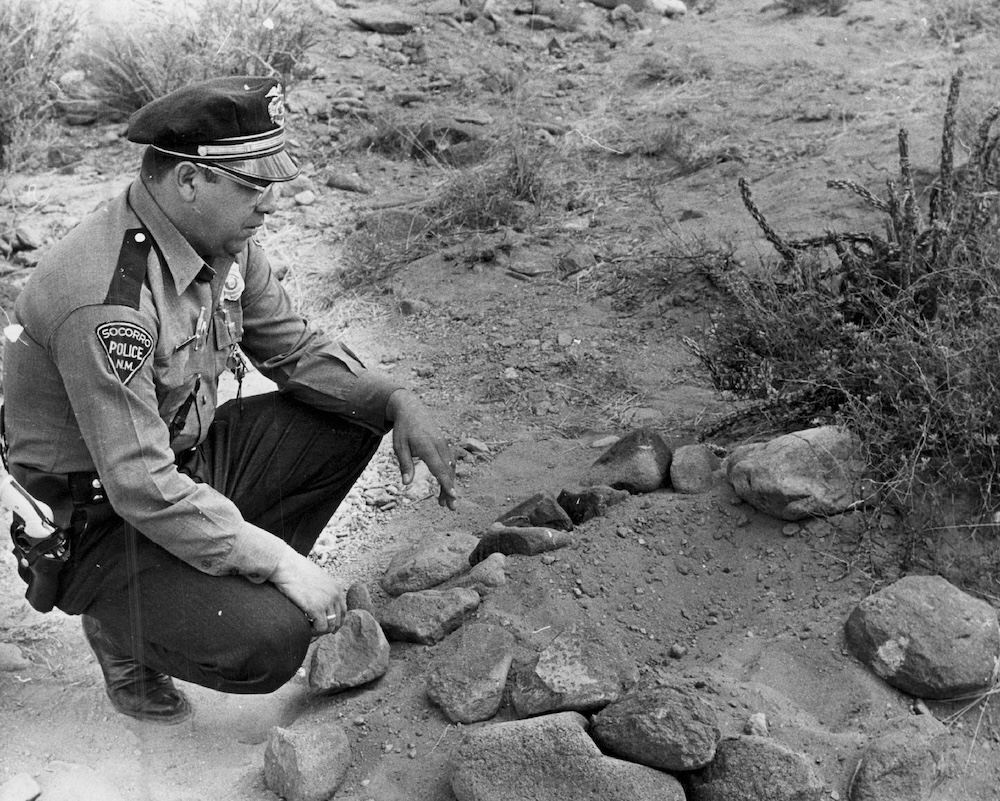
Officers and military personnel begin documenting the site. Ground impressions and scorched vegetation are recorded before the case becomes national news.
The traces are why Socorro remained harder to dismiss than a testimony-only close encounter.
Investigators documented four angular/deep impressions in the sandy ground arranged around the reported resting position of the object. Later measurements placed individual marks at roughly sixteen by six inches and about two inches deep.
Burned or blackened brush was reported near the site, consistent with Zamora's description of a hot or fiery exhaust-like departure. The traces demonstrate local heating or burning; they do not by themselves identify the cause.
Additional smaller impressions were reported near the landing area and were sometimes interpreted as tracks associated with the two figures. Their evidential value is lower because attribution is uncertain.
Kirtland personnel later checked the site for radioactivity. Public summaries do not show a significant anomalous radiation result that would independently identify the object.
New Mexico State Police officer Sam Chavez arrived soon after Zamora and saw the site while the event was still fresh. Capt. Richard T. Holder of White Sands Missile Range also became involved quickly, as did FBI Special Agent D. Arthur Byrnes Jr.
The FBI report became part of the early information flow into the Air Force investigation.
Within days, Project Blue Book personnel and consultant J. Allen Hynek visited Socorro, interviewed Zamora and Chavez, and examined the physical-trace claims.
That speed matters. It reduces — though does not eliminate — the risk that every trace was produced later by tourists, journalists or enthusiasts.
The Air Force did not solve Socorro.
Blue Book chief Maj. Hector Quintanilla Jr. later discussed the case in the CIA's internal journal Studies in Intelligence. His wording is unusually strong: Zamora's reliability was not the problem, and the Air Force remained unable to identify the stimulus that had frightened him.
Quintanilla described Socorro as the best-documented case on record while still noting that the investigation had not found the vehicle or stimulus responsible.
That is not an official admission of extraterrestrial technology. It is an official admission of investigative failure to identify the event.
Project Blue Book retained the case as Unknown, which makes Socorro one of the programme's most famous unresolved close-range cases.
The declassified Blue Book file runs to dozens of pages and shows investigators checking witness credibility, site traces, nearby military activity, possible experimental hardware and other mundane explanations rather than simply accepting Zamora's account.
One major line of inquiry concerned lunar-lander or Surveyor-type test equipment. The regional setting made that a sensible hypothesis, but the investigation did not produce a matching documented test vehicle at the Socorro site and time.
Later summaries of the Blue Book work note that available White Sands testing information pointed to morning activity, while Zamora's encounter occurred in the late afternoon. That weakens a simple “known test vehicle wandered off range” explanation.
The Air Force's failure to identify a matching test does not prove the object was exotic. It means the most obvious aerospace explanation was investigated without being closed.
J. Allen Hynek flew to New Mexico and investigated the case directly. He interviewed Zamora, examined the traces and considered the witness unusually credible.
In a 29 September 1964 letter to Donald Menzel, Hynek wrote that he could not substantiate either a hoax or hallucination and indicated that Quintanilla was also convinced it was neither, while still wondering whether an unidentified test object could be involved.
Later, Hynek repeatedly cited Socorro as a case that resisted the routine astronomical or misidentification explanations applied to many Blue Book reports.
Hynek's correspondence also preserved a report from a tourist at a local gas station who allegedly spoke of seeing something land beyond the hill before a police car headed toward the area. This is not a second direct witness to the landed object, but it may represent weak independent corroboration of unusual activity in the same time window.
Hynek's later interpretation should still be kept separate from the contemporary physical record. His growing dissatisfaction with Blue Book is historically important, but it is not additional sensor evidence from 1964.
The famous “metal evidence” did not become a recovered fragment of the craft.
NICAP investigators later collected metallic material from a rock in the landing area and arranged analysis through NASA Goddard metallurgist Henry E. Frankel.
The tentative result pointed toward an ordinary zinc-iron alloy, with case literature comparing it to mundane zinc material such as a pail.
That result matters because it prevents the sample from being promoted as exotic debris. The sample's association with the object was never established securely in the first place.
Socorro's strongest physical evidence remains the trace pattern and burned vegetation — not recovered exotic metal.
Socorro has survived because several mundane mechanisms are plausible — but none has been demonstrated with a complete historical chain.
White Sands and other aerospace facilities made experimental hardware an obvious possibility. Blue Book investigated that line, but the available test chronology did not produce a specific vehicle matching the Socorro place and late-afternoon time. Similarity to a lunar-lander profile is suggestive, not a flight log.
Donald Menzel and Lyle Boyd developed a more specific hoax reconstruction involving a lightweight mock-up or balloon/foil-like object, simulated roar or pyrotechnics and staged ground traces. The strength of this theory is mechanistic plausibility: it shows how key effects might be faked with ordinary means.
The strongest documentary support for a student-hoax idea comes from New Mexico Tech president Stirling Colgate, who wrote to Linus Pauling that he had “a good indication” of the student involved. No identified participant, confession, apparatus or contemporaneous prank record has publicly surfaced.
Philip Klass later accused Zamora and local interests of staging the case to attract tourism, while Larry Robinson proposed a hot-air-balloon mechanism to account for the changing roar. Both offer ordinary mechanisms; neither is anchored by direct evidence tying the exact apparatus to 24 April 1964.
After Menzel and Boyd advanced their staged-hoax scenario, Hynek revisited Socorro and checked practical details including local geography, wind, timing and available witnesses.
He remained unconvinced that their proposed setup matched the site and sequence well enough to close the case. That does not prove the hoax impossible; it means the specific reconstruction did not survive field scrutiny as cleanly as its paper version suggested.
A later variant attributed to Kevin Ashley claimed that two mining students in white coveralls had used dynamite beneath an overturned metal barrel. The story is memorable because it maps neatly onto several reported details, but it appears as retrospective hearsay rather than contemporaneous documentation.
The general lesson is important: a theory that can reproduce individual features is not the same thing as evidence that the historical event occurred that way.