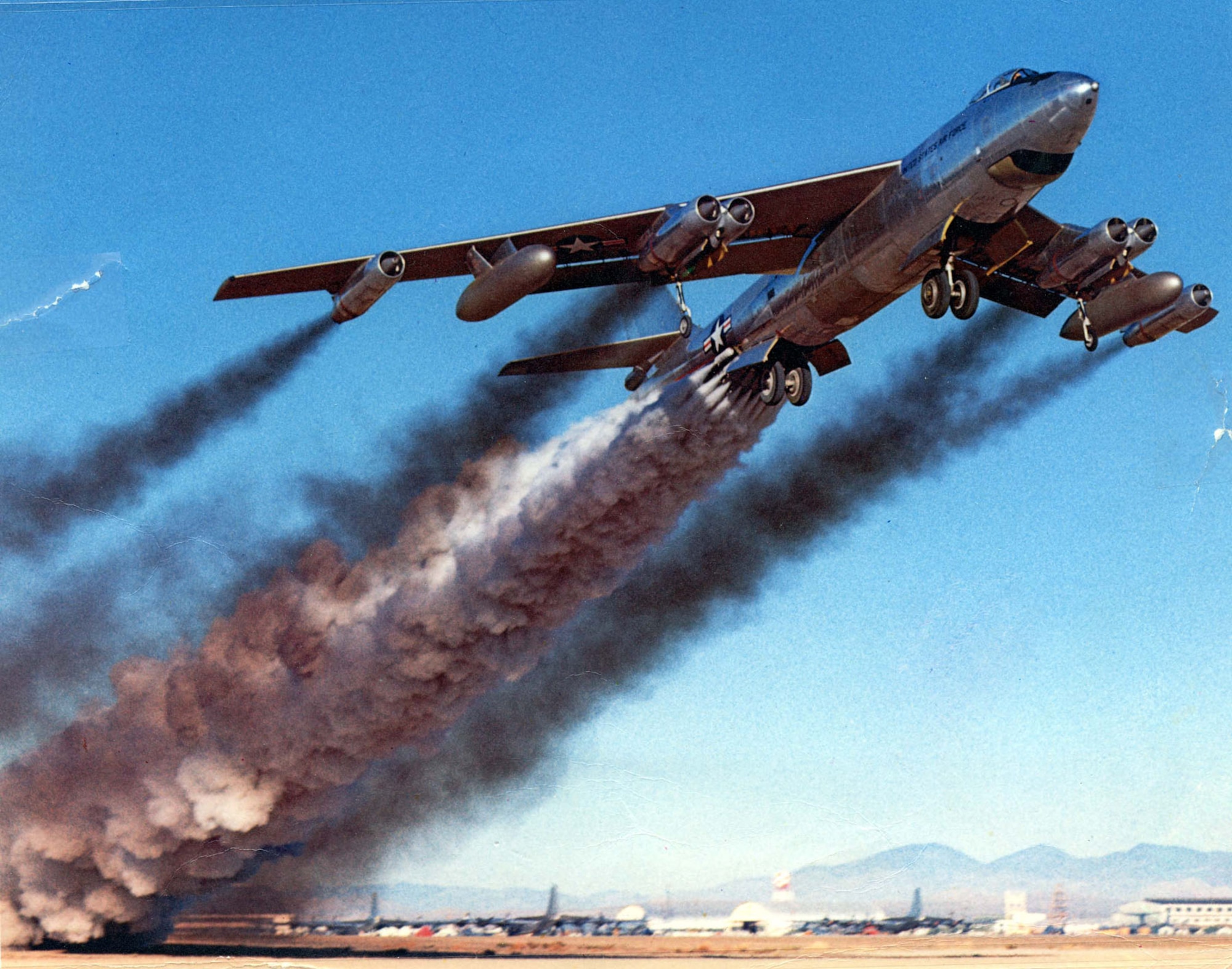
US Air Force RB-47H Stratojet in flight
THE UAP MAP
EVERY CASE HAS A PLACE
17 JULY 1957 · USAF ELECTRONIC INTELLIGENCE · SOUTH-CENTRAL UNITED STATES

The RB-47 Incident

Six Air Force officers. A reconnaissance aircraft built to hunt radar. A brilliant light seen from the cockpit. A moving electronic signal on passive ELINT gear. Ground-radar involvement over Texas. The argument has lasted for nearly seventy years because those strands appear to overlap — but the raw sensor record does not survive.

PROJECT BLUE BOOK · SIX-MAN USAF CREW · PASSIVE ELINT / ECM · VISUAL CONTACT · GROUND RADAR · AIRLINER EXPLANATION DISPUTED · RAW SENSOR DATA MISSING
Authentic U.S. Air Force RB-47H contextual imagery · National Museum of the U.S. Air Force / Department of Defense. This is not the incident aircraft and not incident photography.
17 JUL 1957Pre-dawn training mission across the Gulf Coast and south-central United States.
6 OFFICERSExperienced USAF flight crew and electronic-warfare personnel.
3 EVIDENCE LANESVisual observation, airborne ELINT/ECM and reported ground radar.
NO RAW RECORDINGThe surviving case is documentary: reports, interviews and later analysis.
THE SIX-MAN CREW

Six officers. Different stations. Different evidence.

Later technical reconstruction identified the full RB-47H crew. Their roles matter because the visual and electronic evidence came from different people and systems aboard the same aircraft.

Lewis D. ChasePilot / aircraft commander
James H. McCoidCopilot
Thomas H. HanleyNavigator
John J. ProvenzanoNo. 1 electronic-warfare monitor
Frank B. McClureNo. 2 electronic-warfare monitor
Walter A. TuchschererNo. 3 electronic-warfare monitor

Do not collapse the witnesses into one voice. Chase and McCoid had the key forward visual access; McClure was central to the unusual passive ELINT detections; the other stations contributed different parts of the record.

WHY RB-47 MATTERS

This was not a radar operator staring at one unexplained blip.

The RB-47 case is important because the aircraft itself was an electronic-intelligence platform designed to detect, analyse and locate radar emissions.

During the 17 July 1957 training mission, crew members reported an unusual radar-like signal on passive electronic-countermeasures equipment, a brilliant light seen visually from the cockpit, and ground-radar involvement over Texas at different stages of the encounter.

That combination has made RB-47 one of the classic “multi-sensor” UFO cases.

But the phrase needs discipline. The surviving record does not give us a continuous modern dataset proving that one physical target was tracked simultaneously by every instrument for the entire event. The strongest moments are the reported correlations between separate evidence channels — particularly when visual and electronic contacts appeared and disappeared together.

RB-47 is genuinely multi-sensor by historical standards. It is not equivalent to having a preserved, time-synchronised digital sensor package available for independent reconstruction today.

THE THREE CHANNELS

Visual. ELINT. Ground radar.

The case becomes interesting when these strands stop looking like three unrelated anecdotes.

CHANNEL 01

Cockpit visual

Pilot Lewis Chase and copilot James McCoid reported a very intense bluish-white light moving rapidly across their field of view and later reappearing during the northbound leg.

CHANNEL 02

Airborne ELINT

Electronic warfare officers used passive direction-finding equipment to detect radar-like emissions and estimate bearing. These were not conventional airborne search-radar returns from the RB-47 itself.

CHANNEL 03

Ground radar

Air-defence radar personnel around the Dallas/Fort Worth area were reported to have tracked an unidentified target while the RB-47 crew continued to report visual and electronic contacts.

The historical claim is strongest where the channels reportedly correlate in time and direction. It is weakest when later retellings silently fuse every light, signal and radar return into one continuous craft.
THE FLIGHT

An encounter spread across several states.

The RB-47 was flying a composite training mission from Forbes Air Force Base in Kansas, including navigation and electronic-countermeasures work over the Gulf region before returning north through the south-central United States.

MISSISSIPPI / LOUISIANA

Early electronic contacts and the first dramatic cockpit visual report entered the chronology as the aircraft moved westward.

EAST TEXAS

Visual and electronic reports continued, with crew members attempting to interpret an apparently moving radar-like source rather than a fixed ground emitter.

DALLAS / FORT WORTH

Ground-radar involvement became central. Later investigators focused heavily on whether the ELINT bearings, cockpit sightings and radar reports converged here.

NORTHBOUND

The encounter was remembered as continuing into Oklahoma, although crew recollections differ on exactly how long the final portion lasted.

THE ELECTRONIC WARFARE SYSTEM

The signal looked like ordinary S-band radar. Its bearing did not behave ordinarily.

The RB-47 carried passive electronic countermeasures equipment intended to detect radar emissions, analyse pulse characteristics and determine their direction. McDonald’s later reconstruction identifies McClure’s principal No. 2 system as an ALA-6 direction finder feeding an APR-9 receiver and ALA-5 pulse-analysis equipment.

The intercepted signal was reported at approximately 2,995–3,000 MHz, with a 2.0 microsecond pulse width, roughly 600 pulses per second, and an apparent 4 rpm scan rate. Those characteristics resemble an S-band ground-search radar much more than some exotic unknown technology.

2995–3000 MHzreported frequency
2.0 μsreported pulse width
600 Hzreported PRF
4 rpmreported scan rate

The anomaly, in the crew’s account, was therefore not the waveform itself. It was the changing bearing. A fixed ground emitter should move predictably down the direction-finder display as the aircraft flies past it. McClure reported behaviour he interpreted as a source moving relative to the RB-47.

Important provenance limit: those signal parameters survive through documentary reconstruction and testimony. The original raw ELINT recording is not publicly available for independent re-analysis.

THE MOST PROVOCATIVE MOMENT

When the signal, the light and the radar contact reportedly disappeared together.

James McDonald regarded the reported simultaneous losses across separate channels as the heart of the case.

His reconstruction, based on interviews with all six crew members and surviving official records, argued that the onboard electronic signal, the visual target and the ground-radar contact showed repeated correlations too structured to dismiss as independent mistakes.

One particularly important episode involved the reported disappearance of the visual object at the same time the electronic-warfare operator lost the radar-like signal and ground control reported losing its target.

That is why advocates call RB-47 one of the strongest historical multi-sensor cases.

But it is still reconstructed from reports and later interviews. The independent raw streams that would let a modern analyst align those events frame by frame do not survive publicly.

PROJECT BLUE BOOK

The official file identified an airliner. Later technical review did not consider that enough.

Project Blue Book ultimately associated the Dallas/Fort Worth portion of the case with American Airlines Flight 655. That is the official identification attached to the surviving file.

The problem is scope. An airliner may address a visual or radar episode without automatically explaining the earlier Louisiana sighting, the passive ELINT detections, the reported changing bearings or the full multi-state chronology.

Blue Book reading

A conventional civil aircraft supplied the identification for the key Texas portion of the file.

Later objection

The identification does not, by itself, reconstruct every reported electronic and visual episode in the sequence.

GORDON THAYER / CONDON REPORT

The Colorado Project did not simply inherit Blue Book’s closure.

Atmospheric physicist Gordon Thayer revisited RB-47 for the University of Colorado UFO study. His treatment is important because it was not a pro-UFO advocacy document: it was part of the government-sponsored Condon investigation.

Thayer did not regard the American Airlines identification as an adequate explanation of the complete case. His analysis instead treated RB-47 as a difficult radar-visual-electronic incident whose surviving evidence resisted a clean conventional reconstruction.

This does not prove an extraordinary craft. It does mean that one of the major skeptical-era technical reviews did not consider Blue Book’s simple airliner closure sufficient.

MCDONALD VS KLASS

Two technical reconstructions. Two very different ways to read the same record.

The enduring argument is not whether the witnesses existed. It is whether several ordinary events can reproduce the reported correlations without requiring one extraordinary airborne source.

James E. McDonald

  • Interviewed all six RB-47 crew members.
  • Used surviving official paperwork alongside later interviews.
  • Emphasised repeated agreement between visual direction and passive ELINT bearing.
  • Treated the reported Dallas/Fort Worth ground-radar correlation as particularly important.
  • Argued that simultaneous or near-simultaneous losses across channels were difficult to dismiss as coincidence.

Philip J. Klass

  • Argued that the waveform itself resembled known ground radar.
  • Explored known S-band emitters, including the possibility of radar installations in the Gulf-region reconstruction.
  • Treated anomalous bearings as potentially arising from propagation, equipment interpretation or mis-correlation.
  • Used ordinary aircraft and other mundane visual stimuli to account for separate episodes.
  • Rejected the need to assume one extraordinary craft produced every reported light, signal and radar return.
THE KEESLER / CPS-6B HYPOTHESIS

Could a known ground radar have produced the early ELINT signal?

One conventional line associated with Klass focuses on powerful S-band ground radar in the Gulf Coast region, including an AN/CPS-6B installation associated with Keesler Air Force Base. The attraction of that hypothesis is obvious: the reported RB-47 signal characteristics look much more like a terrestrial search radar than an unknown emission.

Its burden is equally clear. A fixed emitter has to reproduce the bearing behaviour reported by McClure, and any composite explanation must also account for why visual and electronic episodes were later remembered as correlating in direction and time.

This is a hypothesis, not an established identification. The missing raw ELINT recording prevents a modern analyst from independently testing the original signal and bearing history from first principles.

The ranking-relevant question — and the substantive one — is whether a conventional reconstruction can explain the chronology without quietly dropping the strongest cross-channel correlations.

PRIMARY RECORDS

Start with the original Air Force file.

RB-47 has one of the better surviving documentary trails of any 1950s military UFO case. The strongest ranking advantage we can build is to make the source material part of the investigation, not hide it at the bottom.

56-PAGE PROJECT BLUE BOOK FILE

The original case paperwork

The surviving Blue Book file contains the official investigation trail, the later airliner identification and the documentary basis every subsequent reconstruction has had to confront.

It is also where an important limitation becomes visible: the public file is documentary. It does not preserve the original continuous ELINT recording or a complete raw ground-radar dataset.

James McDonald technical analysis

Detailed reconstruction using official material and interviews with all six crew members.

Why the source chain matters

McDonald’s reconstruction drew on crew interviews and surviving contemporary material, including an Airborne Observer’s Data Sheet and other Air Force documentation. The later interview record is valuable, but it must remain distinct from what was written in 1957.

Primary record first. Reconstruction second. That separation is what keeps RB-47 from becoming a legend assembled entirely from later retellings.

WHAT REMAINS UNRESOLVED

The case is strongest where the records overlap — and weakest where the raw data vanished.

OPEN

Were the three channels tracking one source?

The correlations are the centre of the case, but surviving public material does not give a complete independent time-synchronised reconstruction.

OPEN

What generated the ELINT signal?

The signal appeared radar-like and directionally mobile to the crew, but the original raw electronic record is not available for modern re-analysis.

OPEN

How much can the airline explain?

The civil-aircraft explanation may address a portion of the chronology, but whether it explains the full encounter remains disputed.

OPEN

How reliable are the late reconstructions?

McDonald’s interviews were unusually thorough, but they were conducted years later and therefore must be kept distinct from the 1957 documents.

WHAT WOULD MOVE THE CASE?

The missing evidence is technical, not rhetorical.

  • Original ECM/ELINT recordings or scope photography.
  • Ground-radar plots with precise timestamps.
  • Complete flight-navigation logs and ownship positions.
  • Raw pulse-characteristic data from the anomalous signal.
  • Contemporaneous transcripts from the Duncanville radar operators.
  • Exact air-traffic records for every conventional aircraft candidate.

If those records surfaced, RB-47 could be reconstructed much more like a modern aviation incident. Without them, the case remains unusually rich in documentation but permanently constrained by missing sensor originals.

RB-47 QUESTIONS

Quick answers

What was the RB-47 UFO incident?

A 17 July 1957 USAF encounter in which a six-man RB-47H crew reported unusual electronic, visual and ground-radar contacts during a training mission over the south-central United States.

Why is the RB-47 case considered multi-sensor?

Because the surviving record contains three distinct evidence lanes: visual observations from the cockpit, passive ELINT/ECM detections aboard the aircraft, and reported ground-radar tracking.

Did Project Blue Book solve the RB-47 case?

Blue Book ultimately associated the case with an American Airlines flight, but later investigators argued that this did not adequately explain the full chronology or electronic evidence.

Did James McDonald interview the crew?

Yes. McDonald interviewed all six crew members and used those interviews alongside official documents in his later technical reconstruction.

Is there a photograph of the UFO?

No authenticated photograph of the object is known. The case is supported by documentary records, witness testimony and reported sensor detections rather than incident photography.

What frequency did the RB-47 crew report?

McDonald’s later reconstruction gives approximately 2,995–3,000 MHz, with a 2.0 microsecond pulse width, roughly 600 pulses per second and a 4 rpm scan rate. Those figures come from the documentary/interview record; the original raw ELINT recording is not publicly available.

What was Gordon Thayer’s conclusion about RB-47?

Thayer’s Condon-era technical review did not regard Project Blue Book’s airliner identification as an adequate explanation for the complete radar-visual-electronic case.

Could Keesler AFB radar explain the RB-47 signal?

Philip Klass explored conventional ground-radar explanations, including an S-band radar hypothesis associated with the Gulf region. It remains a disputed reconstruction rather than an established identification because the original raw signal and bearing record does not survive publicly.

SOURCE ROOM

Core references