BALLOONS
Weather balloons
The first interpretation. A strong headwind and the reported coordinated departure are the main reasons witnesses later rejected it.

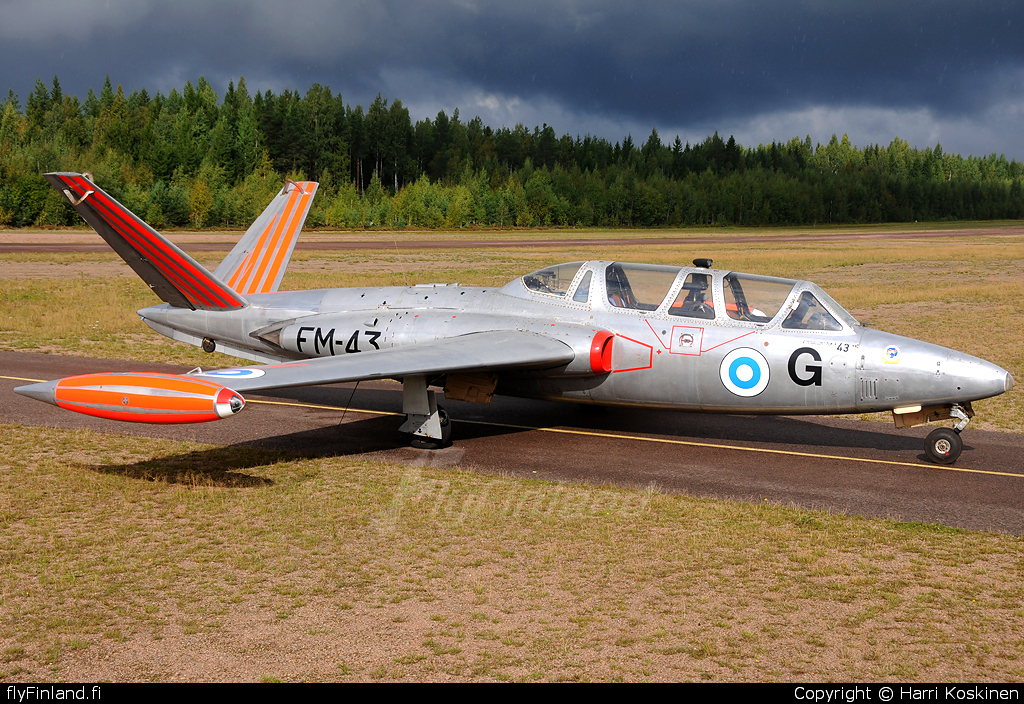
During a Finnish Air Force training exercise, seven pale-yellow objects were reported hovering above Pori. Pilot Tarmo Tukeva was told to investigate. As his Fouga Magister approached, the formation moved north and rapidly pulled away.
On 12 April 1969 the Finnish Air Force was conducting training at Pori Airport on the country's western coast. Fouga Magister jet trainers were operating from the field, and the weather was clear enough for visual flying.
During the exercise, a flight controller directed Tarmo Tukeva — already airborne in a Fouga — to inspect seven objects above the airfield. Another trainee pilot, Jouko Kuronen, later said he heard the radio exchange while preparing to depart and saw the objects himself.
The objects were initially referred to over the radio as “balloons.” That label matters because it shows the first interpretation was ordinary. The mystery begins with what the witnesses said happened next.
Tukeva later described the objects as round or ball-like, pale yellowish, and lacking sharp edges. He also stressed that he could not determine their distance accurately because there were no useful reference points. That makes many later size and speed claims less secure than the underlying pursuit.
The formation was reported at roughly 1,500 to 3,000 metres altitude. Kuronen later described seven disc- or ball-like objects visible above Pori, while Tukeva described them as generally round and pale yellow.
Some later retellings say about twenty pilots saw them. That number appears in retrospective media accounts, but the publicly traceable named witness core is smaller: Tukeva, Kuronen and the controller chain around the exercise.
The same caution applies to radar. Pori is often called a “radar-visual” case, but no public raw radar plot from Pori has surfaced. The stronger radar claim concerns later unidentified returns reportedly appearing near Vaasa, around 200 kilometres to the north.
Objects are noticed above Pori during the Air Force exercise.
The airborne Fouga pilot turns toward the formation.
As Tukeva closes, the seven objects reportedly depart together.
In later television interviews, Tukeva was careful about what he could and could not estimate. He said the objects had no hard outline and that, without reference points, distance was impossible to determine reliably.
His own aircraft speed was around 700 kilometres per hour. He said the objects departed north at a speed many times greater than his own, leaving him no chance to catch them.
That statement is qualitatively strong but quantitatively weak. If distance was unknown, a precise velocity cannot be reconstructed from visual motion alone. The useful claim is that an experienced military pilot believed the formation accelerated away much faster than his jet.
Kuronen later described the objects as moving in formation against a strong northerly wind. Again, the wind figure quoted in later accounts varies and should not be converted into a precise performance calculation without the original meteorological log.
Later summaries say that unidentified radar returns appeared near Vaasa, about 200 kilometres north of Pori, shortly after the seven objects departed. This has often been used to calculate extremely high transit speeds.
The problem is provenance. The public record does not provide the raw radar plot, operator log or a formal cross-reference proving that the Vaasa returns were the same objects seen at Pori.
That makes the Vaasa element potentially important but secondary to the direct witness account. It can support a broader sensor context, but it should not be presented as a mathematically verified 200-kilometre sprint.
Pori is often described as the only UFO observation acknowledged by the Finnish Air Force. The important word is “observation.” The military record and later Finnish Defence Forces coverage accept that personnel reported unidentified objects during the exercise.
Later official discussion suggested foreign reconnaissance aircraft or some transnational intelligence platform as a possibility, noting similarities with observations near military activity and over water.
That explanation has its own problems. Seven objects apparently holding position, then departing together at a speed that impressed a jet pilot, do not map neatly onto known 1969 aircraft. But “difficult to fit” is not the same as “ruled out.”
The first interpretation. A strong headwind and the reported coordinated departure are the main reasons witnesses later rejected it.
Later Finnish military discussion raised foreign surveillance as a possibility. No specific platform has been identified publicly.
Tukeva himself said range was impossible to determine. Misjudged distance can produce spectacular apparent acceleration.
If the witnesses accurately judged the coordinated motion, the seven objects behaved unlike ordinary balloons and were never positively identified.
The case remains impressive without claiming a verified impossible speed. Tukeva's own caution about range should be treated as evidence of careful observation, not a weakness to be edited away.
Finnish-language retrospective preserving the military context and later witness testimony.
OPEN YLE REPORT →Finnish transcription of Tukeva describing the objects' colour, indistinct outline, impossible range estimate and rapid departure.
READ TUKEVA TRANSCRIPT →Authoritative aircraft history confirming the Magister's Finnish training role and service context.
OPEN AIRCRAFT HISTORY →Useful modern source audit highlighting the missing raw radar, flight-log and 1969 documentation limitations.
OPEN MODERN REVIEW →If the objects were balloons, their reported departure was extraordinary. If they were aircraft, no specific type has been matched to them. If distance fooled the witnesses, the event becomes more ordinary — but not automatically explained. Pori remains valuable because the witness at the centre of it did not pretend certainty. He flew toward the objects, watched them leave, and later said that a normal explanation was difficult to imagine.