What were the New Mexico green fireballs?
A wave of brilliant green luminous phenomena reported from late 1948 into the early 1950s, particularly around New Mexico military and nuclear installations.
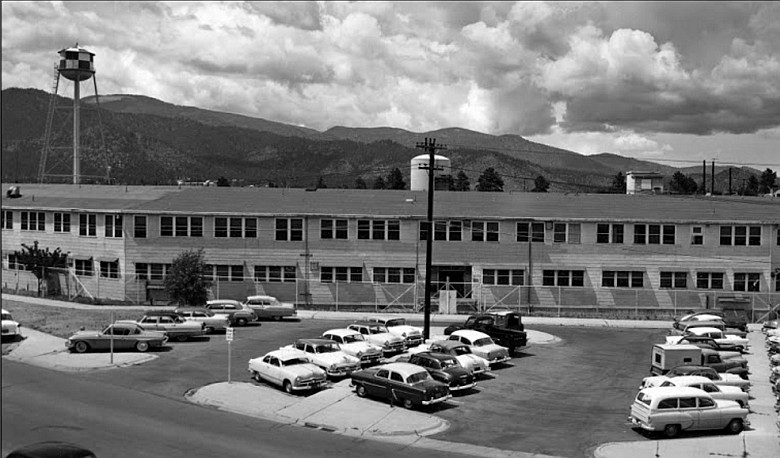
Pilots, intelligence officers, weather observers and scientists reported brilliant green fireballs crossing New Mexico. The concern became serious enough for a secret Los Alamos conference, a 209-sighting Sandia file and an Air Force instrument programme built to catch the phenomenon in the act.
The New Mexico green fireballs sit at the point where UFO history, early Cold War intelligence and the atomic-weapons programme collide.
From late 1948 onward, luminous green objects were reported over the New Mexico corridor that contained Los Alamos, Sandia Base, Kirtland, White Sands and Holloman. The witnesses included military aircrew, intelligence personnel, weather observers and scientists. The geographical concentration around strategic installations made a natural explanation desirable — and a foreign-device explanation impossible to ignore.
The modern documentary picture is stronger than it was even a year ago. In May 2026, PURSUE Release 02 published DOW-UAP-D017, a 116-page Sandia correspondence file described by the government as containing 209 sightings of green orbs, discs and fireballs reported from 1948 to 1950. In July 2026, Release 04 added DOE-UAP-D004, the declassified transcript of the 16 February 1949 Los Alamos Conference on Aerial Phenomena.
Reports intensify across New Mexico.
Scientists and officials meet at Los Alamos to test explanations.
Sandia and Air Force records accumulate; instrumental study is proposed.
Project Twinkle attempts photographic and triangulation work.
DOE-UAP-D004 records a meeting held on 16 February 1949 inside Los Alamos Scientific Laboratory to discuss the green-fireball phenomenon.
The attendees included leading scientists and government representatives, among them Edward Teller and meteoritics expert Lincoln LaPaz. The released record shows that the group did not settle on a single attribution. Shallow, high-altitude meteor entry remained a serious candidate, while LaPaz stressed characteristics he believed were difficult to reconcile with ordinary meteorite falls.
That distinction matters for ranking and for the reader. This is no longer a second-hand claim that a secret meeting happened. The Atomic Energy Commission transmittal and conference material are public government records.
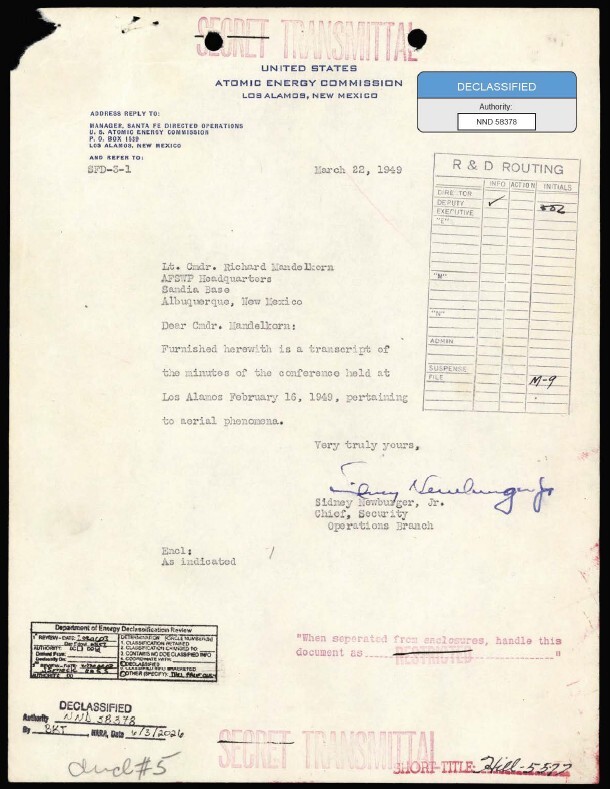
The transmittal identifies a transcript of the minutes of a Los Alamos conference concerning aerial phenomena. It provides direct documentary provenance for an episode that older UFO histories had to reconstruct from participant accounts and later records.
The important point is not that the meeting endorsed an exotic explanation. It did not. The value is that senior scientific and security personnel regarded the reports as serious enough to convene, compare hypotheses and seek better measurements.
OPEN PURSUE RELEASE 04 →LaPaz mattered because meteorites were his field. He reconstructed trajectories, interviewed witnesses and searched projected fall areas. The core difficulty in the historical record is that the reported objects were repeatedly described as unusually green, unusually level, often silent and without recoverable fragments.
That does not make them spacecraft. It does mean the most qualified natural-phenomenon specialist in the investigation did not regard the fit as straightforward.
The new conference transcript makes that tension visible in the participants' own discussion. A natural answer remained live; so did the recognition that important details did not fit comfortably.
Repeated descriptions created the name and became one of LaPaz's objections to an ordinary meteor interpretation.
Long, level-looking trajectories were difficult to reconcile with the fall geometry investigators expected.
The reported silence and failure to recover expected fragments kept the question open.
DOW-UAP-D017 is a 116-page Armed Forces Special Weapons Program and Air Force correspondence file covering 209 reported phenomena near Sandia and the wider New Mexico complex from 1948 to 1950.
The government's description groups “green orbs,” “discs,” and “fireballs” together. That does not make all 209 reports one phenomenon. It does make this one of the richest primary archives for understanding what officials were actually receiving, classifying and investigating around the atomic-weapons complex.
The file includes reports from military and professional observers with varying reliability and detail.
Entries include objects described as maneuvering, disappearing, exploding or simply crossing the sky.
Contemporary correspondence includes investigation of residual copper powder associated with some reported locations; association does not by itself establish causation.
Some investigations fed into the wider Project Grudge-era UFO record, connecting Green Fireballs to the early institutional history of Air Force UFO investigation.
The ranking advantage comes from doing something thin summaries do not: treating the archive as an archive. The reader can distinguish categories, witness quality, chronology and investigation history instead of being handed one inflated number.
Project Twinkle was the instrumented response to the Green Fireballs: stop arguing from eyewitness descriptions and photograph, triangulate and measure the phenomenon.
The 1951 final report says the Geophysics Research Division was directed in early 1950 to investigate the peculiar light phenomena seen in the Southwest. Its stated end position was strongly conventional: most observations could be attributed to aircraft, balloons, rockets, birds, clouds or meteorites, and it found no indication that the strange observations called Green Fireballs were anything other than natural phenomena.
But the operational history matters just as much as the conclusion. The programme envisioned multiple observation stations and cinetheodolite photography so simultaneous views could yield altitude, speed and size. In practice, equipment and station coverage were limited, and the project never produced the decisive multi-station triangulation the concept required.
The official report itself leaned hard toward ordinary and natural phenomena. Shallow meteors, rockets, balloons, aircraft and atmospheric effects all belonged in the explanatory field, and there is no authenticated measurement proving extraordinary technology.
The strongest version of Twinkle was never fully realised. Limited station coverage and lack of decisive triangulation mean its broad natural conclusion was stronger than the quantitative dataset available for every earlier Green Fireball report.
The strongest conventional family. It explains brightness and rapid traverse, with shallow-entry geometry potentially addressing long paths.
An upper-atmosphere or electron-related process was discussed because not every report behaved like a falling material body.
The nuclear-site geography made reconnaissance or classified technology a live national-security hypothesis even without proof.
The strongest page does not need to choose one of these for the reader. It needs to show where each explains the record, where it fails, and what evidence never existed.
A wave of brilliant green luminous phenomena reported from late 1948 into the early 1950s, particularly around New Mexico military and nuclear installations.
Yes. Air Force, Atomic Energy Commission and security personnel investigated the reports; the response included Los Alamos conferences and Project Twinkle.
An Air Force-backed instrumented observation effort intended to photograph and triangulate the phenomena and obtain quantitative data.
The official programme ultimately favoured a natural explanation, but the surviving archival record and incomplete instrumentation left important event-level questions unresolved.
The New Mexico Green Fireballs became serious because trained observers kept reporting them over the most sensitive places in America. The government convened physicists, intelligence personnel and a leading meteoriticist. It then tried to build an instrument programme to catch the phenomenon properly.
The natural case is plausible. The historical residue is real. The archive is now substantially richer than it was before the 2026 releases.
That is where this Case File should leave the reader: not with a verdict, but with the original problem finally visible in the documents.