THE UAP MAP
EVERY CASE HAS A PLACE
LAXOU · NANCY · FRANCE · 21 OCTOBER 1982

The sighting survived.
The trace did not.

A biology researcher told French gendarmes that a small ovoid object descended into his suburban garden, hovered silently for roughly twenty minutes, then shot vertically away. GEPAN investigated — and later found its own plant evidence far less decisive than the sighting itself.

SINGLE WITNESS · CLOSE STRUCTURED OBJECT · SAME-DAY GENDARMERIE REPORT · GEPAN FIELD INVESTIGATION · WITNESS SKETCH · PLANT SAMPLES · TRACE INCONCLUSIVE
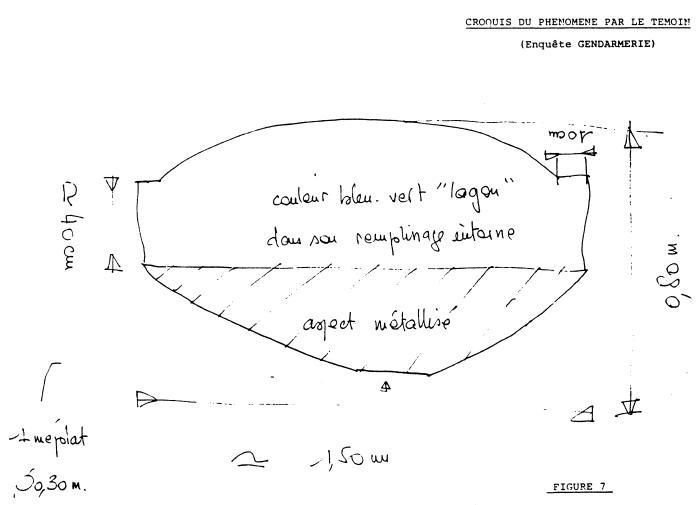
Witness sketch of the Amarante Laxou object reproduced from GEPAN Note Technique No. 17
Authentic case evidence. Witness drawing recorded in the Gendarmerie/GEPAN investigation and reproduced in Note Technique No. 17. This is a drawing, not a photograph. Review uses an available reproduction; Hermes should internalise the highest-generation lawful GEPAN scan.
~20 MINUTESWitness estimated a prolonged hover over his garden.
~1.5 × 0.8 MApproximate dimensions given by the witness, not measured.
~1 M ABOVE GROUNDReported hover height in a suburban garden.
GEPAN INVESTIGATIONFieldwork, witness reconstruction and plant analysis followed.
THE ENCOUNTER CLOCK

Twenty-three minutes separate first sight from departure.

The official reconstruction is unusually specific about timing. That matters because this was not reported as a two-second glimpse—it was a prolonged observation during which the witness changed position and fetched a camera.

First sightHenri notices a bright point and initially thinks of an aircraft.
DescentThe point enlarges and resolves, in his account, into an oval object approaching the garden.
HoverHe reports the object stationary roughly one metre above the lawn while he observes it from several positions.
Camera attemptHe goes upstairs for his loaded camera, returns, and says the shutter jams—a fault he acknowledged had happened before.
DepartureThe object rises vertically and disappears rapidly; nearby grass is reported to stand upright briefly.
PRIMARY DOCUMENT SPINE

This case has something most UFO stories do not: a full official field investigation.

GEPAN Note Technique No. 17 is not a later retelling. It records the witness reconstruction, drawings, garden geometry, colour matching, vegetation sampling, laboratory work and the investigators’ own doubts.

That means the page does not need to lean on folklore. We can follow the investigation itself—what Henri said, what investigators measured, where the evidence weakened, and what remained unresolved.

GEPAN · 21 MARCH 1983

Note Technique No. 17 — “L’Amarante”

Event: 21 October 1982, Laxou near Nancy.

Witness: anonymised biology researcher, “Monsieur Henri”.

Official path: same-day Gendarmerie deposition → GEPAN notification → field investigation → technical note.

What makes it unusual: prolonged close-range daylight testimony plus plant effects that appeared testable.

What prevents easy closure: single witness, no photograph, compromised biological sampling and physical models that generate contradictions of their own.

WHY AMARANTE MATTERS

France investigated the case seriously — including the parts that later weakened it.

Amarante is valuable because the official record is unusually detailed and unusually self-critical.

On 21 October 1982, an anonymised 30-year-old biology researcher — usually referred to as “Monsieur Henri” — was at home in Laxou, a western suburb of Nancy.

Late that morning, he reported seeing a bright object approach his garden and resolve into a compact ovoid form.

He estimated it at roughly 1.5 metres long and 0.8 metres high, hovering about a metre above the ground.

The lower part appeared metallic. The upper portion was described as blue-green or translucent.

It made no sound.

It stayed long enough for Henri to study it, retrieve a camera and attempt to photograph it.

Then it departed rapidly upward.

What makes Amarante unusual is not that GEPAN “proved” a UFO affected the garden. It is that GEPAN investigated the claim in enough detail to show exactly where the evidence became uncertain.

THE APPROACH

A point of light becomes an object.

Henri first noticed something bright in the sky.

As it approached, he said the light resolved into a clearly bounded object rather than remaining a distant luminous point.

The object descended toward the garden.

He described a smooth ovoid or ellipsoidal form.

The lower section looked metallic or dull grey. The upper area appeared blue-green and somewhat translucent.

There were no obvious wings, rotors, wheels or conventional aircraft surfaces.

Those shape and colour descriptions are witness testimony, not photographic evidence.

The case is therefore unusually detailed but still geometrically dependent on one observer.

THE HOVER

Twenty minutes is a long time to watch something at close range.

If Henri's duration and distance estimates are broadly accurate, this was not a fleeting glimpse.

The object reportedly hovered about a metre above the garden surface.

Henri said it remained largely motionless.

No engine noise was heard.

He did not report a blast of heat, cold, static, vibration or obvious physiological effect.

That absence matters later because GEPAN explored physical-field models that would imply strong environmental effects near the witness.

The long duration also sharpens the single-witness problem.

Laxou was a populated suburban environment. Yet no independent observer has been established as seeing the same object during the hover.

A long close sighting strengthens the witness narrative — but also increases the importance of asking why nobody else saw it.
THE CAMERA

The photograph that does not exist.

Henri reportedly went to retrieve a camera.

When he attempted to take a photograph, the shutter did not operate.

This detail is sometimes converted into a classic UFO electromagnetic-interference claim.

The surviving research does not support that leap.

Henri reportedly acknowledged that the camera had malfunctioned previously.

No instrumental evidence links the shutter failure to the object.

So the correct statement is simple: the camera failed to produce a photograph.

Not: the UFO disabled the camera.

THE DEPARTURE

A rapid vertical exit.

After the hover, Henri said the object rose vertically at high apparent speed and disappeared.

That departure became one of the most extraordinary features of the account.

But speed was not measured.

There was no radar track, video or second observer to establish acceleration.

The correct evidential language is therefore “rapid apparent vertical departure.”

It remains interesting witness testimony without turning a visual estimate into a measured performance claim.

THE GENDARMERIE REPORT

The event entered an official record immediately.

Henri reported the incident to the local gendarmerie on the same day.

That chronology is important because it reduces the possibility that the central narrative was built only after years of UFO publicity.

The gendarmes recorded the witness account and later collected material connected to the claimed vegetation effects.

The witness also produced a sketch of the object.

Those near-event records are more valuable than later retellings because they preserve the original description before the case acquired a public reputation.

GEPAN STEPS IN

A national scientific UFO unit investigates a suburban garden.

The chronology is unusually well documented.

GEPAN — the UFO-study unit within the French space agency CNES — was notified by telex on 23 October.

An intervention decision followed on 27 October.

Investigators conducted fieldwork on 29 October.

The case then went through further analysis, culminating in Technical Note No. 17 in March 1983.

21 OCT

Witness reports the sighting and contacts gendarmerie.

23 OCT

GEPAN receives notification.

29 OCT

Field investigation at the site.

21 MAR 1983

Technical Note No. 17 formalises analysis.

THE AMARANTH PLANTS

The physical trace looked promising at first.

Vegetation near the reported hover location showed visible desiccation or wilting.

Because Henri was a biology researcher and because the object had reportedly hovered close to the plants, the anomaly attracted immediate attention.

Samples were collected.

Laboratory analysis followed.

This is the point where popular summaries often become much stronger than the original report.

GEPAN did not conclude that the plants had been damaged by a UFO.

Its own technical work ultimately found the biochemical evidence inconclusive.

21 OCTWitness reports the event; plant effects are noticed.
INITIAL SAMPLINGVegetation is collected, but preservation is not ideal.
LAB ANALYSISDifferences are observed, but cause cannot be cleanly isolated.
METHOD LESSONLater GEPAN guidance cites Amarante as a reason for stricter biological-sample protocols.


MEASURED VS ESTIMATED

The numbers look precise. Most were not instrument readings.

One of the easiest ways to accidentally overstate Amarante is to repeat witness estimates as if GEPAN measured the object itself.

WITNESS ESTIMATE
~1.5 m

Reported diameter. No physical object was available to measure.

WITNESS ESTIMATE
~0.8 m

Reported thickness. Drawings and verbal proportions were not perfectly self-consistent.

WITNESS ESTIMATE
~1 m

Reported hover height above the lawn, reconstructed after the event.

MODELLING
30+ kV/m

Calculated field strength explored for the grass effect—not a sensor reading from 21 October.


THE SAMPLE-HANDLING PROBLEM

The evidence was compromised before the laboratory could answer the question cleanly.

The first biological samples were not preserved under ideal conditions.

Some plants had already been uprooted.

Delay, storage and handling can change plant chemistry after collection.

That makes later comparisons between “affected” and control material much harder to interpret.

The problem was significant enough that GEPAN later used Amarante as a methodological lesson when developing better biological-sampling procedures.

Immediate freezing and stricter preservation protocols were recommended for future cases.

The trace did not fail because “science could not explain alien damage.” It failed because the available samples could not support a firm causal conclusion.
THE FROST ALTERNATIVE

Ordinary weather remained a serious explanation for the plants.

The previous day and night had included sub-zero conditions.

Frost can produce localised wilting, dehydration and tissue damage.

That does not automatically explain every visual feature reported at the site.

But it gives the plant damage a plausible ordinary mechanism that does not require the hovering object to have physically affected the vegetation.

This is the crucial separation:

The plant anomaly may be conventional even if Henri's sighting remains unexplained.

THE ELECTRIC-FIELD MODEL

GEPAN tested a physical mechanism — and found a problem.

MODEL AT GRASS
~30 kV/m+

GEPAN explored a field of this order as a minimum capable of producing the reported grass-uprighting effect. This was modelling, not a measured encounter-time value.

IMPLIED NEAR WITNESS
>60 kV/m

At the witness’s reported closest distance, the same model implied a stronger field—yet Henri reported no corresponding electrical or physiological effect. That contradiction is central.

GEPAN explored whether a strong electric field might account for vegetation behaviour near the reported hover area.

Its modelling suggested that a field on the order of tens of kilovolts per metre might be required to produce the observed grass effects.

But that creates an immediate consistency problem.

If Henri was standing very close to the object, the same model could imply an even stronger field at his position.

He reported no corresponding physiological or electrical effect.

This does not prove the model wrong or the sighting false.

It shows that the proposed physical mechanism did not sit comfortably with the witness account.

And importantly, the electric field was modelled — not measured at the time of the event.

SINGLE-WITNESS GEOMETRY

The strongest visual details all come through one observer.

Henri's account is detailed.

But there was no second observer standing at another angle.

That means distance, size and altitude are not triangulated.

If range was misjudged, apparent size changes.

If the object was farther away than believed, a smaller or larger conventional source could be interpreted differently.

The long observation helps the witness description but does not create independent geometry.

WHAT GEPAN DID NOT SAY

Official investigation is not official validation.

TRUE

GEPAN investigated

Fieldwork and technical analysis were genuinely conducted.

TRUE

Plant samples existed

Vegetation was collected and examined.

TRUE

Witness sketch exists

The official record includes structured-object representation.

NOT PROVEN

UFO plant damage

The biochemical work did not establish exotic causation.

NOT MEASURED

Electric field

Field strengths were modelling exercises, not event-time readings.

MISSING

Object photograph

The failed camera produced no image of the stimulus.

WHY THE SIGHTING SURVIVES BETTER THAN THE TRACE

One evidence stream weakened without automatically erasing the other.

The plant analysis and the object testimony should not be fused.

If frost caused the amaranth damage, that does not prove Henri imagined the object.

If Henri genuinely saw something unusual, that does not prove it altered the plants.

This is exactly why Amarante is useful.

The official investigation lets us watch one part of the case degrade under analysis while another part remains unresolved.

The physical trace was testable and became weaker.

The sighting itself remains largely a credibility and geometry question.

THE UFO READER'S BEST CASE

A close, structured, prolonged sighting reported immediately.

For a pro-UFO reading, Amarante has several attractive features.

The witness was educated in biology.

He reported promptly.

His description is highly structured rather than vague.

The event lasted long enough to observe details.

GEPAN considered the case serious enough for on-site investigation.

And no simple conventional identification was established for the object itself.

The weakness is that all of those visual details still originate with one person.

WHAT GEPAN DID — AND DIDN'T — TEST

A serious investigation still had blind spots.

INVESTIGATIVE STRENGTH

Fast official follow-up

The witness reported the same day. Gendarmerie documentation followed immediately, GEPAN was notified within days, and a field team reached Laxou on 29 October. Plans, photographs, witness reconstruction and plant samples entered the case file.

INVESTIGATIVE LIMIT

No systematic neighbourhood canvass

The case remained single-witness. Later critics have stressed that GEPAN did not conduct a broad door-to-door canvass or public witness appeal, despite the claimed bright daylight approach over a dense urban area. That does not disprove Henri’s account, but it limits corroboration.

INVESTIGATIVE LIMIT

Biological sample degradation

The amaranth differences were documented, but collection and preservation problems prevented a clean causal inference. GEPAN later tightened biological-sampling procedures partly because cases like this exposed the weakness.

INVESTIGATIVE STRENGTH

The report records contradictions

GEPAN did not simply certify the witness story. Its own technical modelling created tensions—for example, an electric field strong enough to affect the grass should have produced effects near a witness standing far closer than the plants.


THE STRONGEST CONVENTIONAL RECONSTRUCTION

Could a metallised balloon and perception do most of the work?

WHY IT FITS

Runaway metallised balloon

French sceptical work by Éric Maillot and colleagues argues that a biface metallised balloon caught among tall garden plants could account for silence, apparent hovering, reflective lower surfaces, blue-green upper colour and sudden departure in a changed airflow.

WHY IT DOESN'T CLOSE THE FILE

No recovered prop, no confession

No balloon was recovered and the witness never conceded such an explanation. The model also has to reproduce a reported twenty-minute close-range inspection from several positions, not merely a fleeting distant shape.


THE CONVENTIONAL CASE

Single witness, uncertain scale, ordinary plant stress.

A conventional reading separates the impressive narrative from the limited controls.

There is no photograph.

No independent observer confirms the object.

No radar or instrument fixes its distance.

The camera malfunction was pre-existing rather than established as an effect.

The plant evidence was badly preserved and compatible with frost.

That leaves open the possibility of misperception, an unrecognised local object or another ordinary stimulus observed under unusual geometry.

WHY THE WITNESS'S PROFESSION MATTERS — AND DOESN'T

A biology background helps with description, not identification.

Henri's scientific training is often presented as though it automatically upgrades the sighting.

It does add context.

A biology researcher is likely to be comfortable describing colour, shape, plant condition and environmental detail.

But expertise is domain-specific.

Being a biologist does not make someone an expert in aircraft identification, optical illusions or distance estimation.

The witness's profession therefore supports the seriousness of the account without turning subjective geometry into measured fact.

WHY THE SUBURBAN SETTING MATTERS

A twenty-minute hover in Laxou creates an uncomfortable question for both sides.

The case did not occur in an isolated desert or mountain valley.

Laxou was a populated suburb of Nancy.

If a compact object really hovered low for around twenty minutes, it is reasonable to ask whether neighbours, pedestrians or motorists should also have noticed something.

The absence of a confirmed independent witness weakens the external-object case.

But it is not fatal by itself.

Line of sight, garden walls, trees, buildings and simple chance can isolate surprisingly dramatic events from nearby observers.

Without a precise site plan and visibility study, the “someone else must have seen it” argument remains suggestive rather than decisive.

THE OBJECT'S APPEARANCE

Metal below. Blue-green above.

The split visual description is one of the most memorable features of Amarante.

Henri described the lower part of the object as metallic-looking and the upper part as blue-green or translucent.

That has encouraged comparisons with domed saucers and enclosed craft.

But the description should not be converted into windows, cockpit glass or a canopy unless the witness explicitly said so.

A luminous or reflective surface can appear translucent under some lighting conditions.

The safe evidential language is therefore “blue-green/translucent appearance,” not “transparent cockpit.”

THE GRASS EFFECT

A subtle physical claim became a modelling problem.

Investigators did not only look at the wilted amaranth.

They also considered the reported orientation or uprighting of grass beneath or near the object.

That led to exploratory modelling of electrostatic or electric-field effects.

This is where GEPAN's technical approach becomes especially interesting: rather than simply accepting the trace as “UFO damage,” investigators asked what ordinary physical field strength would be required to produce the observed plant behaviour.

The answer created the inconsistency described elsewhere on the page — a field strong enough to affect vegetation should arguably have produced noticeable effects on a witness standing very close by.

That does not prove the observation false. It weakens one proposed mechanism.

WHY THE PHYSICAL TRACE LOOKED STRONGER IN RETELLING

“Plants were damaged” became “scientists proved radiation.”

Over time, UFO cases often accumulate stronger language than their original reports justify.

Amarante is a good example.

The real sequence is already interesting: visible plant stress, official sampling, laboratory work and technical modelling.

But later summaries sometimes imply that the vegetation showed an exotic radiation signature or a uniquely artificial energy effect.

The original evidence does not support that conclusion.

No measured radiation dose was recorded.

No unique biochemical marker identified an unknown propulsion system.

No laboratory result excluded frost and ordinary stress conclusively.

That is why the page should preserve the official uncertainty rather than amplify the mythology.

GEPAN AS A SOURCE

The value of the case is partly institutional.

GEPAN was unusual among government UFO programmes because it attempted field investigation and technical analysis rather than simply cataloguing reports.

That does not make every GEPAN case extraordinary.

It does mean the source trail is richer than in many civilian reports.

Investigators documented environmental conditions, collected samples, analysed testimony and tried to test physical mechanisms.

For The UAP Map, that source architecture is valuable because it lets readers see how an official team actually handled a case that seemed physically testable.

THE METHODOLOGY LESSON

Amarante became useful even if the trace was not anomalous.

One of the most revealing outcomes was procedural rather than ufological.

Because the plant samples had not been preserved optimally, later GEPAN guidance emphasised faster, colder and more controlled collection of biological material.

In other words, the case improved the investigation method.

That is scientifically valuable even if the final trace turns out to be frost damage.

It also shows why “inconclusive” is not the same as “failed.”

A well-documented inconclusive result can still teach investigators how to handle the next case better.

THE BEST EXTRAORDINARY READING

A compact craft hovered close enough to study, then departed vertically.

Under the strongest pro-UFO reading, Henri encountered a real structured object at close range.

The long duration, detailed shape, silent hover and rapid upward departure are difficult to compress into a fleeting misidentification.

The prompt same-day report reduces the chance that the core story was invented years later.

And the visible plant anomaly gave investigators a physical reason to take the event seriously.

The difficulty is that every extraordinary performance claim still comes through one observer.

No sensor independently establishes the hover, dimensions or departure speed.

THE BEST CONVENTIONAL READING

A single witness can be sincere and still wrong about geometry.

A conventional model does not require fabrication.

Henri may have sincerely observed an unfamiliar object or optical stimulus whose distance and scale he misjudged.

The vegetation anomaly may have been ordinary frost damage.

The camera failure may have been unrelated.

Once those physical-effect claims are removed, the case becomes a detailed but uncorroborated visual encounter.

That still leaves a genuine identification question — just a narrower one.

WHAT WOULD CHANGE THE CASE?

The original file still matters more than later summaries.

  • Highest-generation scan of GEPAN Technical Note No. 17.
  • Complete gendarmerie witness statement and sketch.
  • Full plant-analysis annexes and laboratory notes.
  • Original sampling locations and preservation timeline.
  • Exact meteorological record for Laxou on 20–21 October 1982.
  • Precise site geometry and sight lines.
  • Any contemporaneous neighbour or independent witness reports.
  • Documentation of the camera's prior shutter problem.
WHAT REMAINS

A serious official investigation that became more interesting by admitting uncertainty.

Amarante is not a story where French scientists proved a craft damaged plants.

They did not.

They documented a striking single-witness encounter, investigated the scene, collected biological material and explored physical mechanisms.

Then the trace evidence weakened under scrutiny.

The samples were imperfect.

Frost remained plausible.

The electric-field model created its own inconsistency.

But the original close-range object report was never converted into a simple conventional identification.

The sighting survived. The trace did not.

WHAT STILL MAKES AMARANTE INTERESTING

The balloon theory is plausible. The witness duration is the hard part.

THE MUNDANE CASE FITS

Shape, reflectivity, stillness, colour, frost and departure

A metallised balloon/perceptual reconstruction can plausibly address several individual features without exotic physics. Frost also offers a straightforward plant-stress mechanism.

THE RESIDUAL PROBLEM

A prolonged close-range inspection

Henri did not describe a distant fleeting light. He reported roughly twenty minutes at close range, multiple viewing positions, a trip indoors for a camera, and deliberate inspection. Any mundane reconstruction has to account for that full behavioural sequence—not just the object's outline.

The strongest version of Amarante is neither “GEPAN proved a craft” nor “a balloon explains everything.” It is a well-documented single-witness case in which the official investigation generated both intriguing observations and serious reasons for caution.
SOURCE ROOM

Start with the French official investigation.