Ninety-nine seconds of tracking
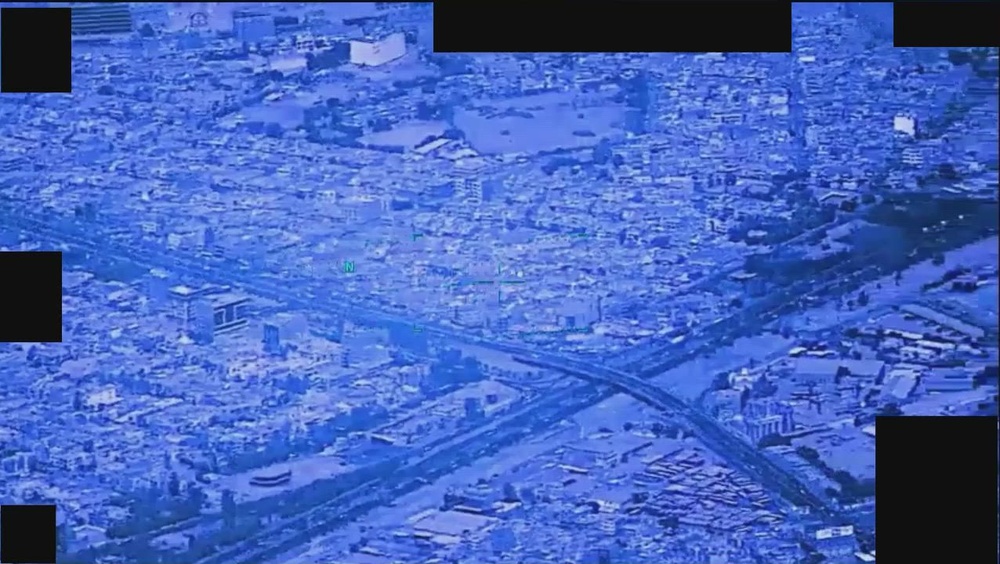
A military EO/IR sensor follows an area of contrast over a dense urban background and changes collection mode and magnification several times.
CENTCOM · MIDDLE EAST · 2025 · PURSUE RELEASE 05
Two U.S. Central Command sensor clips were released from the Middle East in 2025. PR134 tracks an area of contrast for ninety-nine seconds over a dense urban background; PR142 contains roughly four seconds of visible transit inside a fourteen-second report. Both remain publicly unresolved. Neither comes with a witness statement, radar track, range, speed solution or unredacted telemetry — and the Department does not link the two records to each other.
WATCH PR134 ↗THE FAST ANSWER
A military EO/IR sensor follows an area of contrast over a dense urban background and changes collection mode and magnification several times.
An infrared contrast enters from the left, crosses the field and exits right. The official narrative spans 14 seconds; DVIDS lists an 11-second public file.
No public range, altitude, platform motion, heading or unredacted telemetry means no defensible public size or speed solution.
THE TWO RECORDS
The EO/IR sensor pans left-to-right while keeping an area of contrast generally centred, with repeated collection-mode and magnification changes.
WATCH OFFICIAL PR134 ↗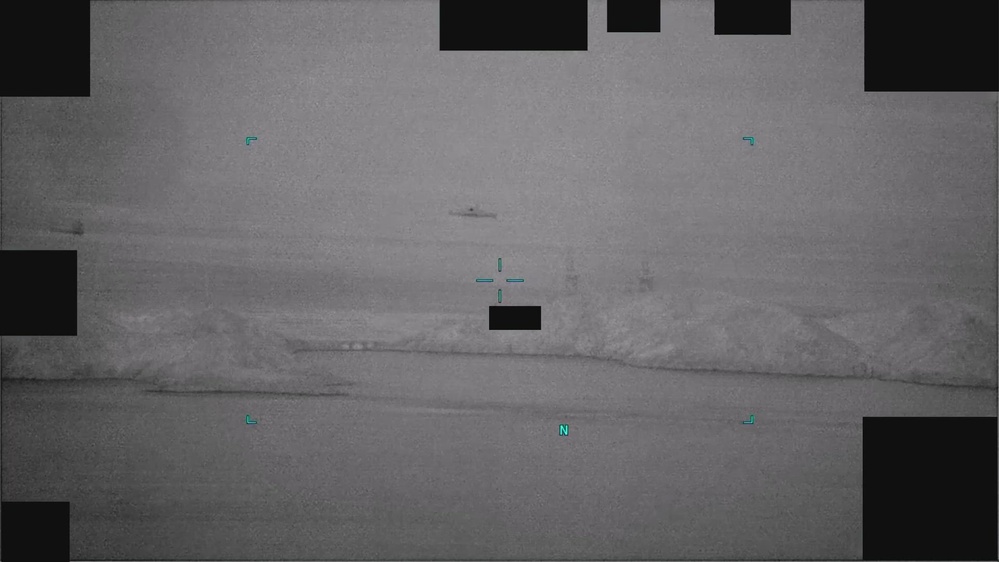
The infrared target enters from the left, crosses the field of view and exits right between 00:05 and 00:08. The DVIDS file itself is listed as 11 seconds.
WATCH OFFICIAL PR142 ↗The Department does not pair PR134 and PR142 with each other, with a supporting document, or with another released video. Treating them as one event would go beyond the public record.
WHAT THE GOVERNMENT ACTUALLY SAYS
For PR134, CENTCOM submitted 1 minute 39 seconds of footage from an electro-optical and infrared sensor aboard a U.S. military platform. The sensor pans to track an area of contrast from left to right and adjusts collection mode and magnification several times.
For PR142, CENTCOM submitted 14 seconds from an infrared sensor. The official description says there is no content for the first four seconds, an area of contrast crosses the field of view from left to right from 00:05 to 00:08, and no content follows.
AARO attaches the same warning to both records: the description is informational and should not be interpreted as an analytical judgment, investigative conclusion or factual determination about the event's validity, nature or significance.
PR134 was held in frame for the full 99-second clip while the operator changed collection mode and magnification several times. That suggests the target was interesting enough to keep examining. It does not tell us what it was, but it is the closest the public record comes to human context.
RELEASE METADATA
| Record | DVIDS / VIRIN | Public runtime | What is withheld |
|---|---|---|---|
| PR134 | Video 1017792 · VIRIN 250101-D-D0360-7849 · DOD_111887390 | 1:39 | Exact location, platform, range, altitude, heading, time, mission context. |
| PR142 | Video 1017797 · VIRIN 250101-D-D0360-3085 · DOD_111887419 | DVIDS says 0:11; description runs to 0:14 | Exact location, platform, range, altitude, heading, time, mission context. |
Both DVIDS pages show 01.01.2025, while the release manifest gives only the year 2025. The safest treatment is year-level dating, not a claim that both events occurred on New Year's Day.
WHY THE REDACTIONS MATTER
The published frames contain black boxes over areas where sensor telemetry would normally appear. That can be entirely routine operational-security redaction, but analytically it is decisive: without slant range, platform attitude, heading, altitude and precise time, apparent image motion cannot be converted into trustworthy physical size or speed.
That is why headlines describing an “orb racing over a city” go beyond the release. The urban setting is visible in PR134. The words orb and racing are not government findings.
That is especially important for PR142. Crossing a field of view in roughly four seconds sounds dramatic until range is known. A nearby bird, a drone at intermediate range and a distant aircraft can all traverse the image differently while producing superficially similar angular motion.
THE CLOSEST OFFICIAL PRECEDENT
That comparison matters because it sets a baseline for interpretation. In the separate “Middle East Red Balloon 2024” case, AARO reviewed roughly a minute and a half of military-platform video and assessed the object with high confidence as a reflective foil balloon, based on morphology and motion consistent with wind.
PR134 has a nearly identical runtime profile but has not been publicly closed with the same kind of identification. That is a genuine difference in status. It is not proof that PR134 is exotic; it means the public record does not show a completed attribution.
AARO's own annual reporting also shows that many unresolved Middle East cases remain open because the data are insufficient, not because they exhibit extraordinary behaviour. “Unresolved” should therefore be read as a status, not a verdict on origin.
WHAT COULD THEY HAVE BEEN?
| Candidate | Why it fits | What is missing |
|---|---|---|
| Balloon | A small drifting object can remain unresolved for long periods. AARO has already resolved a similar Middle East military-video case as a reflective foil balloon. | Wind, range, scale and native telemetry. |
| Drone / UAS | CENTCOM airspace routinely contains small unmanned systems that can present as unresolved EO/IR contrast. | Exact location, mission data, range and flight correlation. |
| Bird | A nearby biological target can cross a field quickly and appear as a compact thermal/contrast source. | Range, wingbeat-resolving imagery and frame-level geometry. |
| Aircraft | A distant aircraft can remain unresolved and apparently move smoothly across a sensor field. | Traffic data, aspect and range. |
| Sensor / parallax effect | A moving platform, zoom changes and tracking can generate strong apparent image motion. | Platform motion and raw sensor metadata. |
COMPETITOR PASS
UAP Globe does an excellent job surfacing both official frames, the black telemetry redactions, the PR142 runtime inconsistency and the lack of witnesses. It also correctly warns against press descriptions such as an “orb racing over a city,” because the Department never uses those terms.
The UAP Map's opportunity is to make the distinction between the two records even harder to miss: PR134 and PR142 are grouped because they share region, year and release context, not because the Department says they are the same event. Unlike the tightly cross-referenced Gulf of Oman and Pacific video sets in the same release, these two records are unpaired and carry no linked intelligence report. We also put the missing geometry and unpaired-record status above the fold, where readers cannot accidentally skip past it.
SOURCE ROOM