Same tranche, separate records
The videos entered the public record together, which explains why archive and competitor pages often pair them. Shared publication does not establish a shared event.
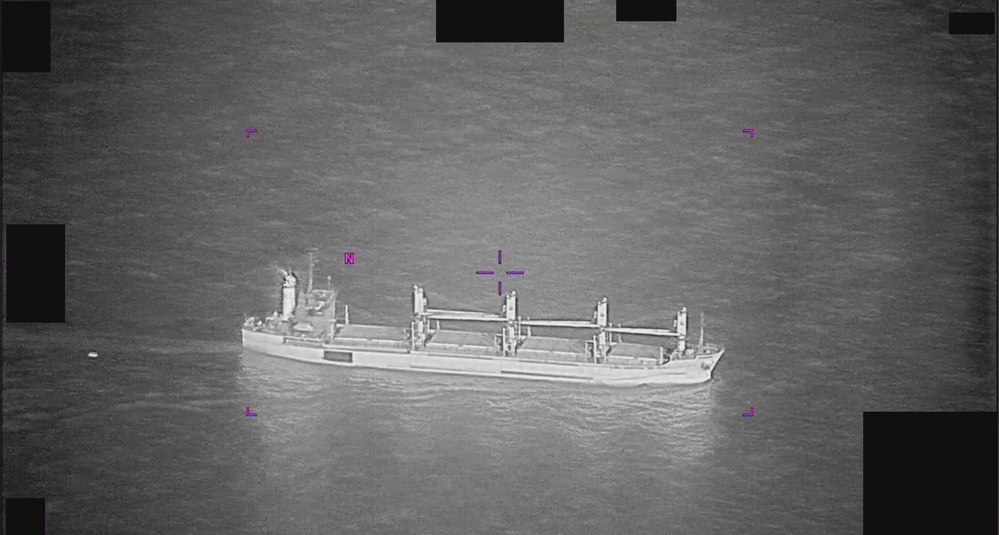
CENTCOM · MIDDLE EAST · 2023 · PR136 + PR149
Two short CENTCOM infrared videos from 2023 entered the public record in the same release tranche. PR136 looks down across broken terrain while part of the host platform repeatedly occludes the sensor. PR149 appears to track a separate target over open water. The pairing is editorial, not evidential: the government release does not establish that the clips show the same object, mission or event.
RELEASE PROVENANCE
The videos entered the public record together, which explains why archive and competitor pages often pair them. Shared publication does not establish a shared event.
The public release does not link either clip to a companion PDF or formally pair PR136 with PR149. That absence is an important metadata boundary.
THE FAST ANSWER
AARO says the sensor pans to track one area of contrast. A component of the aircraft/platform passes in front of the sensor and obscures the background. The sensor later zooms and a reticle briefly surrounds the contrast.
AARO says an area of contrast crosses from the lower-right toward the lower-left in the first four seconds. From 00:05 onward, the sensor pans to keep it generally centred for the remainder of the 51-second clip.
WHY THEY ALMOST CERTAINLY ARE NOT THE SAME EVENT
The released imagery appears to look down across rugged or uneven land while the host platform repeatedly intrudes into the sensor view.
The second clip presents a much cleaner horizonless scene consistent with open water or a maritime background.
Visual setting alone does not prove exact geography, but the stark scene difference reinforces the government's own lack of any formal pairing between the two records.
THE TWO OFFICIAL IMAGES
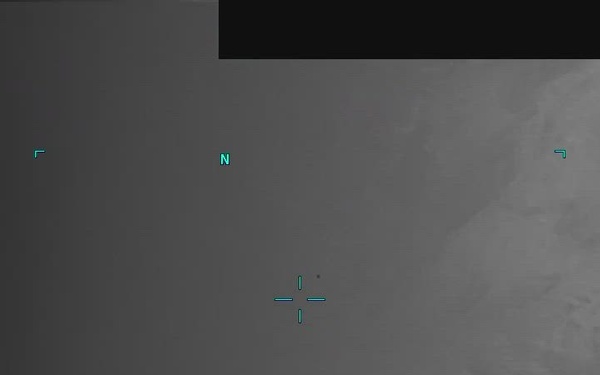 PR136
PR136Part of the sensor view is blocked by a component of the military platform. That can alter the apparent scene and must be kept separate from anything attributed to the target.
PR149PR149 is a different official file with its own 51-second sequence. Grouping the pages for reader convenience does not establish a common source.
PR136 — OFFICIAL TIMELINE
AARO describes PR136 as a 30-second report from an infrared sensor aboard a U.S. military platform in the Middle East in 2023. The public player, however, shows 0:33. The page preserves that discrepancy rather than guessing why it exists.
Large areas of on-screen data are redacted or withheld. That matters because the missing fields could contain precisely the geometry analysts need — field of view, sensor state, platform attitude, pointing data, timing or other metadata. The redactions do not prove hidden extraordinary performance; they limit what can be calculated from the public clip.
The sensor pans to keep the area of contrast generally centred.
A component of the platform passes in front of the sensor and obscures the background.
The sensor zooms on the contrast; a reticle briefly surrounds it, and platform structure again obscures the display.
PR149 — OFFICIAL TIMELINE
AARO describes PR149 as 51 seconds of infrared footage from a U.S. military platform in 2023.
The target can present a bright centre with a darker surrounding edge. That appearance should not automatically be treated as literal physical morphology: IR focus, contrast, bloom, processing and polarity can all influence how compact sources are rendered.
An area of contrast moves from the bottom-right edge toward the lower-left edge of the field of view.
The sensor follows the contrast and keeps it generally near the centre of the frame.
No public range, target size, measured speed or platform-motion solution accompanies the footage.
PR149 — FULL RELEASED FRAME
WHY THE TWO FILES SHOULD NOT BE COMBINED INTO ONE “CASE”
| Question | PR136 | PR149 |
|---|---|---|
| Duration | 30-sec report / 33-sec public player | 51 sec |
| Key visual feature | Target tracking with repeated platform occlusion | Initial transit followed by sustained sensor tracking |
| Witness narrative | Not publicly supplied in the release description | Not publicly supplied in the release description |
| Range / speed | Not published | Not published |
| Common identity established? | No. The public release does not state that PR136 and PR149 depict the same target or event. | |
The page groups them because searchers and the government release catalogue place them in the same Middle East 2023 tranche. Editorial grouping must not become evidential conflation.
WHAT THE MISSING WITNESS NARRATIVE COSTS US
We do not know whether crew saw anything visually outside the sensor display.
No witness estimate or contextual distance cue is published.
No paired radar or traffic-track narrative is included in the public record.
We do not know what the operators believed they were tracking at the time.
That gap is why these records should be treated as sensor observations first and physical-performance claims second.
WHAT COULD ORDINARY SENSOR GEOMETRY EXPLAIN?
| Factor | Why it matters |
|---|---|
| Platform motion | A moving aircraft can create substantial apparent target motion even when true target speed is modest. |
| Sensor panning | Keeping a target near centre removes an intuitive visual reference for its true angular rate. |
| Occlusion | In PR136, platform structure physically blocks parts of the view and can change the apparent scene. |
| Unknown range | Without distance, angular motion cannot be converted reliably into physical speed or size. |
COMPETITOR PASS
Direct competitors tend to benefit from the neatness of pairing PR136 and PR149 under one Middle East 2023 heading. That is useful for discovery, but it can make two separate records feel more connected than the evidence supports.
The UAP Map's advantage is to keep both records side-by-side while preserving their independence: separate timelines, separate sensor behaviour, separate evidential limitations, no inferred common identity, and a clear explanation of why the terrain/maritime contrast plus empty government pairing fields make a shared event unlikely. V2 also surfaces the telemetry-redaction problem, the missing-witness cost and PR149 morphology caution.
SOURCE ROOM