Release 04 · 10 July 2026
PR024 was released as part of the fourth PURSUE tranche rather than as an isolated viral clip, giving the case a traceable government-release context.
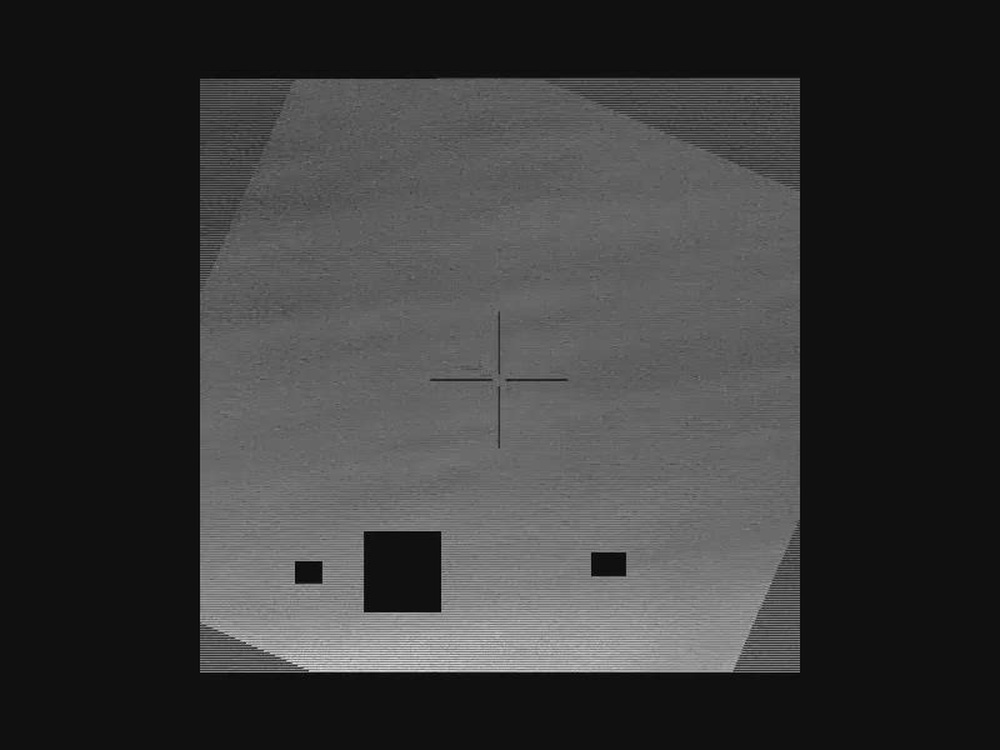
CENTCOM · MIDDLE EAST · 2023 · PURSUE PR024
A dark area of contrast is tracked near the centre of a military infrared display. Two bright areas then sweep left-to-right across the frame and leave. Seconds later, the sensor reacquires the original dark target. That sequence is exactly why the popular “it split into two and darted away” reading is tempting — and exactly why it is weaker than it first appears.
WATCH OFFICIAL PR024 VIDEO ↗RELEASE PROVENANCE
PR024 was released as part of the fourth PURSUE tranche rather than as an isolated viral clip, giving the case a traceable government-release context.
The clip is an official U.S. government release from the CENTCOM area of responsibility. Exact filming location remains undisclosed.
THE CENTRAL QUESTION
Because the bright pair enters just after the sensor has focused on the dark contrast, a viewer can naturally connect them into one dramatic movement.
AARO describes one dark area being tracked and two bright areas transiting the frame. It does not establish that they are the same source or physically related.
THE SEQUENCE — VISUALLY
The sensor narrows field of view around a dark area near centre.
The pair moves left-to-right and exits the frame.
The sensor returns to the original dark contrast and centres it again.
AARO attributes the flash to sensor contrast and zoom changes.
Once the sequence is separated this way, the “one object split into two” story becomes much harder to sustain as a factual description.
THE ACTUAL RELEASED IMAGE
The most important visual fact is that the sensor later returns to and tracks the dark area after the two bright contrasts have already left the frame. That makes the viral “one object split into two” story much less secure than it first appears.
THE OFFICIAL RECORD
U.S. Central Command submitted an unidentified-anomalous-phenomenon report to AARO consisting of 18 seconds of infrared footage from a U.S. military platform in 2023.
DVIDS lists the location as undisclosed. The release gives no public range, altitude, platform track, sensor model, measured speed or radar correlation.
AARO also states that its frame-by-frame description is informational only and must not be read as an analytical judgment or factual determination about the event's nature or significance.
THE 18-SECOND TIMELINE
The sensor focuses on a dark area of contrast and narrows field of view.
Two bright areas transit left-to-right; the sensor zooms out to keep them in frame before they exit right.
The sensor refocuses on the dark contrast; a reticle then surrounds it near centre.
The sensor changes contrast and zoom settings, causing the frame to flash white.
The final white flash is explicitly tied by AARO to sensor-setting changes. It should not be described as the object emitting a flash or disappearing in a burst of light.
WHY THE “SPLIT AND DART” READING IS TOO STRONG
If the two bright areas were pieces splitting from the dark source, we would need evidence connecting their positions and timing in three-dimensional space. The public clip supplies none. Instead, the sensor returns to the dark area after the bright pair has already exited.
The bright pair appears immediately after attention is focused on the dark contrast, so the human eye naturally links the events into one continuous action. That visual continuity is psychologically strong — but it is not the same thing as measured physical continuity.
This leaves several possibilities open: three separate physical objects, two physical objects plus an image artifact, unrelated sources crossing one field, or a more complex sensor/optical effect.
WHAT COULD IT HAVE BEEN?
| Candidate | Why it can fit | What is missing |
|---|---|---|
| Distant aircraft / lights | Bright IR sources can sweep through a field independently of a separately tracked target. | Range, traffic data, heading and resolved structure. |
| Flares / hot debris | Bright thermal sources can cross quickly and look dramatic in IR. | Event context, trajectory and source records. |
| Birds / nearby objects | Near-field targets can move rapidly across angular field without extreme true speed. | Range, focus cues and scale. |
| Sensor / optical effects | Gain, diffraction and image processing can create bright structured contrasts and dramatic display changes. | Sensor model, raw data and calibration. |
None of these has been demonstrated as the official PR024 identification. AARO left the record unresolved.
SIBLING CONTEXT — PR030
An 18-second sequence whose central ambiguity is whether visually adjacent contrast events are physically related.
A related release from the same broader tranche reinforces the pattern: official military provenance, sparse event context, withheld geometry and no detailed witness narrative.
The comparison matters because PR024 is best understood as part of a broader government release programme, not as a standalone “split-UFO” clip stripped of context.
COMPETITOR PASS
UAP Globe correctly notes that the clip can look like one object splitting and moving sharply, while also stressing that AARO never joins the dark contrast and bright pair into one source.
The UAP Map's stronger angle is to make the sequence visually and logically explicit: dark target tracked → bright pair crosses → bright pair exits → dark target is reacquired → display flashes because of sensor settings. V2 also surfaces Release 04 provenance, explains why the split interpretation feels convincing, adds sibling PR030 context and answers the most likely search questions directly through FAQ schema.
SOURCE ROOM