OVER THE PENNINES · 8 NM SOUTHEAST OF MANCHESTER AIRPORT · 6 JANUARY 1995

Two seconds.
Two pilots ducked.

British Airways flight BA5061 was descending through 4,000 feet when a fast-moving object crossed down the Boeing's right side. The captain saw a cluster of white lights. The first officer said he saw a solid dark wedge.

PROFESSIONAL AIRCREW · FORMAL AIRMISS REPORT · PILOT SKETCH · RADAR CHECKED · OBJECT UNTRACED

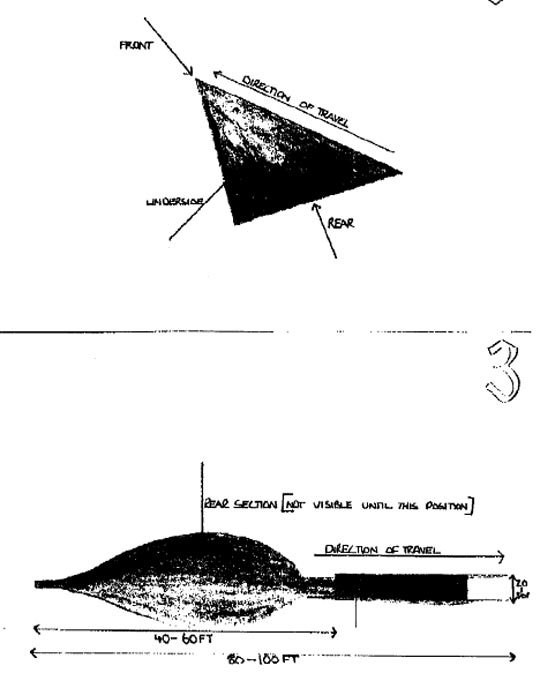
British Airways crew witness sketch of the object reported in the 1995 Manchester Airport airmiss
Authentic witness sketch from the British Airways crew, preserved in released UK Ministry of Defence UFO files. The drawing is direct case evidence — not an artist's reconstruction and not AI-generated. No photograph of the object is known.
18:48Reported encounter time on 6 January 1995.
4,000 FTBA5061 descending under Manchester radar vectors.
~2 SECONDSTotal cockpit sighting duration.
AIRMISS 2/95CAA finding: cause unassessable.

THE REAL CASE

This was not a UFO hotline call. It entered the aviation-safety system.

BA5061, a British Airways Boeing 737-200 inbound from Milan, was being vectored toward Manchester in darkness and good visibility when something passed the right side of the cockpit at high apparent speed in the opposite direction.

Captain Roger Wills and First Officer Mark Stuart both saw it. Stuart reacted instinctively by ducking.

The crew did what commercial pilots are trained to do after a potentially dangerous close approach: they reported it. That decision created a paper trail of crew statements, sketches, radio transcripts, controller evidence and radar review.

The core mystery: the CAA could not trace another aircraft or radar contact, yet two professional pilots were sufficiently convinced of a close encounter to file a formal airmiss.
THE APPROACH

The encounter lasted less time than it takes to read this sentence.

INBOUNDBA5061 was approaching Manchester from Milan with roughly 60 people aboard.
RADAR VECTORSThe Boeing was about 8–9 nautical miles southeast of the airport, descending through 4,000 feet at roughly 180–210 knots.
OBJECT PASSESA lighted object travelled down the aircraft's right side in the opposite direction. No evasive action by the object was reported.
IMMEDIATE CALLThe crew queried Manchester control. No matching traffic was known to the controller.

THE TWO PILOTS

They agreed something passed them. They did not describe it the same way.

Captain Roger Wills

Wills described a number of small white lights, memorably likened to a Christmas tree. The object appeared to pass rapidly in the opposite direction.

That luminous description is the strongest part of the later meteor/fireball interpretation.

First Officer Mark Stuart

Stuart reported a dark, solid wedge-like body, with what might have been a black stripe, apparently illuminated by the Boeing's own landing lights.

He was sufficiently convinced of a solid object that he instinctively ducked as it passed.

The difference matters. A case with two witnesses is not automatically stronger if the two witnesses perceived materially different things.

COMMERCIAL AIR TRANSPORT AIRMISS REPORT · NO. 2/95

DATE/TIME: 061848 JAN · NIGHT
POSITION: N5318 W0200
8 NM SE MANCHESTER AIRPORT
REPORTING AIRCRAFT: B737
ALTITUDE: 4,000 FT DESCENDING
VISIBILITY: 10 KM+
REPORTED AIRCRAFT: UNTRACED

CAUSE: UNASSESSABLE
DEGREE OF RISK: UNASSESSABLE

THE OFFICIAL FILE

The CAA could not match the object to traffic.

The Joint Airmiss Working Group reviewed the pilots' statements, air traffic control information and recorded radar data.

Its report states that despite extensive checks the reported object remained untraced. No other radar contact was seen near the 737 during the relevant part of the approach.

The investigators considered unauthorised military traffic, microlights, hang gliders, balloons, kites and model aircraft and found none satisfactory in the conditions described.

The case therefore ended not with an exotic conclusion, but with the regulator's more careful one: unassessable and unresolved.

THE RADAR PROBLEM

If a large solid craft passed that close, why did radar see nothing?

This is the strongest challenge to a literal reading of the encounter. Manchester's airspace was well covered. The CAA checked recorded radar and found no unidentified contact close to BA5061.

That does not prove there was no physical object. Radar coverage is not perfect, target geometry matters, and not every object produces a useful return.

But the absence becomes harder to ignore when combined with Stuart's apparent size estimates — tens of feet, possibly larger — and his impression of a close pass.

A large nearby solid object should be easier to reconcile with radar than this one is.

THE FIREBALL HYPOTHESIS

A bright meteor explains more of this case than many UFO retellings admit.

Why it fits

A bright fireball can last only seconds, move rapidly across the field of view, be silent, produce no aircraft wake and leave no conventional radar track.

Wills's cluster-of-lights or “Christmas tree” impression is compatible with a fragmented luminous meteor.

Why it does not fit cleanly

Stuart reported a dark structured body with an underside and apparent form, not merely a luminous streak. His reaction was that of someone who believed a solid mass had just passed close by.

No specific documented fireball at 18:48 on 6 January 1995 has been recovered in the source set used for this build.

The responsible position is not “fireball disproved” or “fireball solved it.” It is a strong conventional explanation for several features that still has to account for Stuart's solid-body perception.

THE DISTANCE TRAP

Two seconds is enough to see something. It is not much time to measure it.

RANGE

No measured separation

The crew's impression of proximity was visual. No radar range to the object was obtained.

SIZE

Sketch dimensions are estimates

Apparent dimensions of roughly 40–60 feet and 80–100 feet in the released sketch are witness reconstructions, not measured object dimensions.

SPEED

No independent object velocity

A rapid angular pass can look extreme when true distance is unknown.

TIME

About two seconds

Short duration increases uncertainty around structure, range and motion even for experienced observers.

LIGHTING

Darkness + landing lights

Stuart believed the body may have been illuminated by the aircraft's own lights, complicating shape perception.

STRESS

Near-collision perception

Duck reflex and apparent closure support sincerity; they do not independently measure actual miss distance.

THE MOD

No defence significance is not the same as an identification.

The Ministry of Defence was informed of the report. Later-released correspondence records that air-defence specialists found no evidence that UK air defences had been compromised and no defence significance requiring continued MoD interest.

That is an institutional scope decision. It does not turn the object into a known aircraft, meteor or hoax.

Separate MoD files covering the episode and the later press interest are now part of the public archival trail.

WHAT REMAINS

The case survives because the witnesses were good — and because good witnesses can still leave hard contradictions.

Manchester is not a case where radar and pilots tracked a craft together for minutes. It is almost the opposite: a fleeting cockpit event that became unusually well documented because the crew treated it as an aviation hazard.

The captain's luminous description sits comfortably beside a fireball hypothesis. The first officer's dark wedge does not. The CAA found no nearby traffic, no realistic microlight or balloon explanation and no radar target.

Something convinced two airline pilots that an object had just passed their aircraft. The investigation confirmed the report. It did not identify the cause.

SOURCE ROOM

Start with the airmiss, then test the fireball.