FABRICATION
Two boys invented it
Children can construct elaborate shared stories. The persistence of the account and early drawings are interesting but do not make fabrication impossible.

Masato Kono and Katsuhiro Yamahata were playing on roller skates when they saw orange lights over Kofu. One descended toward a vineyard. They followed it — and later described a silver craft, a small figure and a moment of physical contact.
On the evening of 23 February 1975, two elementary-school boys, Masato Kono and Katsuhiro Yamahata, were playing near the Kamicho housing area in Kofu, Yamanashi Prefecture. Contemporary and later accounts place them in the second grade, around seven or eight years old.
They said they saw two luminous orange objects in the sky. One eventually moved away. The other descended toward nearby vineyards. Curiosity overcame fear, and the boys went to investigate.
The resulting account is unusually detailed for a child-witness case: a landed silver object, rotating components, window-like panels, markings on the hull, a short humanoid, a second figure inside, and an alleged touch on one boy's shoulder.
That detail is both the attraction and the problem. The core evidence comes from two children. Their drawings and early interviews matter, but every later embellishment has to be checked against the earliest record.
Accounts collected from the boys describe two glowing objects approaching from the eastern sky while they were outdoors. One appeared larger than the other. At close angular range they reportedly saw circular forms and components beneath the objects.
One object moved away toward the north or northeast. The other descended in the direction of a vineyard. The boys initially hid in a nearby cemetery before later moving toward the reported landing area.
Those first minutes matter because they show that the landed-object story did not begin in isolation. The boys said they first watched aerial objects move and hover before one was encountered on the ground.
The boys notice two bright objects while playing outdoors.
They report visible underside detail and unusual sounds.
The larger object reportedly moves away while the smaller descends toward the vineyard.
At the vineyard, the boys said they found a silver, roughly disc- or dome-shaped object on the ground. Dimensions vary across retellings, but the scale was described as car-sized rather than enormous.
They described luminous or blue square window-like panels, a dome, three rounded supports or landing elements underneath, and unusual marks or characters on the exterior. Some accounts add a stair or doorway opening downward.
The boys reportedly spent several minutes close to the object. That makes Kofu more difficult to explain as a fleeting astronomical misidentification, but it does not remove the possibility of a constructed object, machinery, prank or distorted child perception.
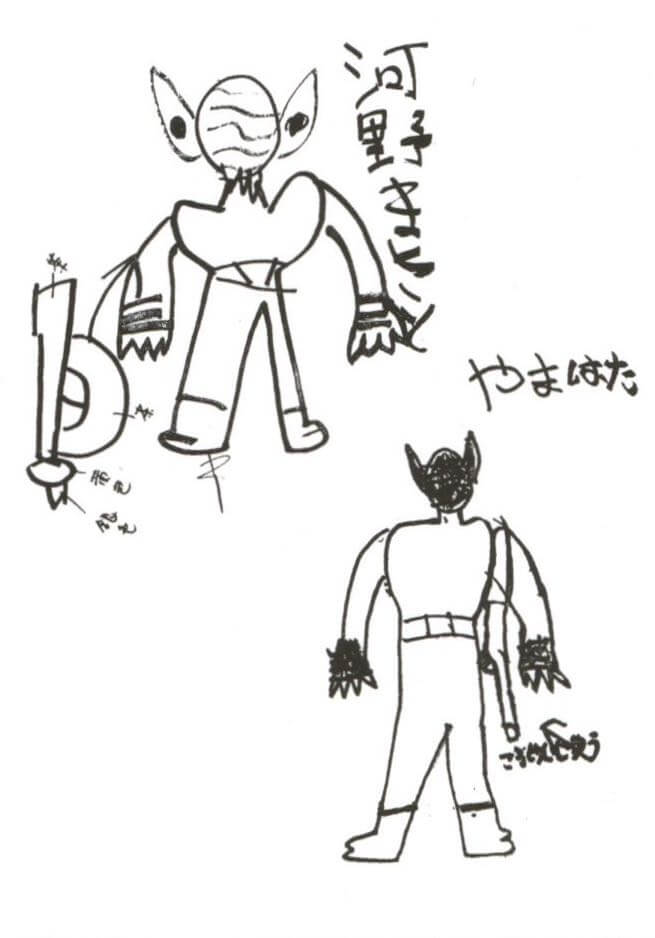
The boys described a short humanoid emerging from the object. The figure was said to be around 1.2 to 1.3 metres tall, wearing a silver one-piece garment, with dark brown or wrinkled skin and unusually pointed ears.
They said the face lacked normal human features and included three protruding fang- or tube-like elements around the mouth area. The figure carried or wore something the boys compared to a gun or trumpet-shaped device.
The most dramatic claim is physical contact. One boy said the figure came close and touched or patted him on the shoulder while making a strange vocal sound, sometimes compared with a tape recorder running oddly. The boy reportedly froze in fear and was pulled away by his companion.
A second, smaller figure was later described inside the craft. That detail is part of the witness account but has no independent corroboration.
Kofu should preserve the extraordinary testimony without converting it into a physical fact. The children unquestionably became known for this account. Whether the humanoid existed outside their perception is the central unresolved question.
After fleeing, the boys told family members what had happened. Later accounts say parents went with them toward the area and observed a glowing orange-red light near or above the vineyard before it disappeared.
This is potentially important corroboration because it places an unusual light in the same area after the boys' close encounter. But it does not independently confirm the landed craft or humanoid.
The evidential distinction is simple: adults may support “something luminous was still visible near the site”; only the boys support “a small being emerged and touched one of us.”
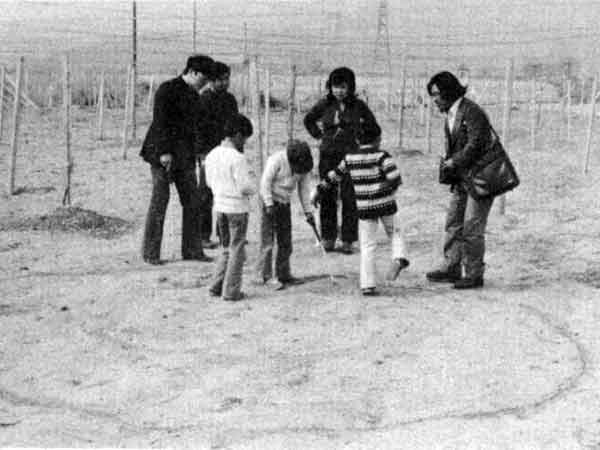
Investigators later photographed and described damage in the vineyard, including a broken concrete post, another post reportedly displaced or leaning, stretched overhead vine-support wire, and small holes or impressions in the ground.
These traces became a major part of the case. They are real enough to appear in historical photographs, but their cause was not established. Vineyard infrastructure can be damaged by agricultural work, weather, accumulated load or prior wear.
Later claims of elevated radiation at the site are more difficult. The chain of measurement, instrument calibration, background comparison and timing must be reconstructed carefully before any number is treated as evidence of an anomalous landing.
Recent Japanese re-analysis has also pointed out a geometrical problem: some published craft-size estimates do not fit comfortably between the vineyard support posts without producing more obvious damage. That does not disprove the boys' story, but it shows how later numerical reconstructions can conflict with the physical site.
Photographed vineyard damage existed, but causation was not established.
Overhead support wire was said to look as if loaded by weight.
Later associated with landing supports, but not forensically secured on the night.
Potentially interesting, but measurement provenance is weaker than the visual trace record.
Children can construct elaborate shared stories. The persistence of the account and early drawings are interesting but do not make fabrication impossible.
A small craft-like prop and costumed adult could theoretically reproduce parts of the account, though no demonstrated prank mechanism or perpetrator has emerged.
Lights, machinery, a person and fear could combine into an extraordinary child memory. The claimed close duration makes a simple one-object misidentification less comfortable.
If the boys' early account is substantially accurate, Kofu describes a physical object and humanoid presence at very close range.
Modern Japanese-language dossier separating the core testimony, physical-trace record and later claims.
OPEN JAPANESE DOSSIER →Detailed English-language reconstruction drawing heavily on Japanese publications, photographs, interviews and site material.
OPEN RECONSTRUCTION →Early English-language report preserving the humanoid description relatively close to the incident date.
OPEN APRO REPORT →Useful recent Japanese analysis testing vineyard geometry, support-wire damage and later physical-trace claims.
OPEN CRITICAL REVIEW →The case has the ingredients of folklore — children, a strange creature, an impossible machine — but it also has early drawings, a specific site, photographed damage and families who took the story seriously enough to investigate immediately. Kofu remains compelling because it sits exactly on the boundary between an extraordinary childhood story and an extraordinary physical encounter.