The Kelly-Hopkinsville Encounter

August 21, 1955 · Kelly, Christian County, Kentucky, USA

⭐ High Evidence Rating 👁️ Close Encounter aka Hopkinsville Goblins · Kelly Green Men · Case #14

On the night of August 21, 1955, a rural Kentucky farmhouse came under siege by small, goblin-like creatures with glowing yellow eyes, silver metallic skin, and clawed hands. When the family fired at them with a shotgun and .22 rifle, the bullets had no effect — the creatures simply flipped backward and re-approached. The siege lasted for hours. Police found the family genuinely terrified. The case became one of the most famous close encounters in UFO history, inspiring Pokémon, movies, and the term "little green men."

📍 Kelly, Christian County, Kentucky, USA 🧭 37.18°N, 87.28°W 📋 Case #14 📚 Research compiled 2026-07-31

📸 Photo Gallery

Six images — artist impressions of the Hopkinsville Goblins based on witness descriptions, a reconstitution diagram of the encounter scene, a great horned owl (the skeptical explanation), J. Allen Hynek and Jacques Vallée, and a Kentucky location map. Click any photo to view full size.

📖 The Full Story

The night goblin-like creatures besieged a Kentucky farmhouse for hours — bullets had no effect, police found genuine terror, and the case would inspire everything from Pokémon to Steven Spielberg.

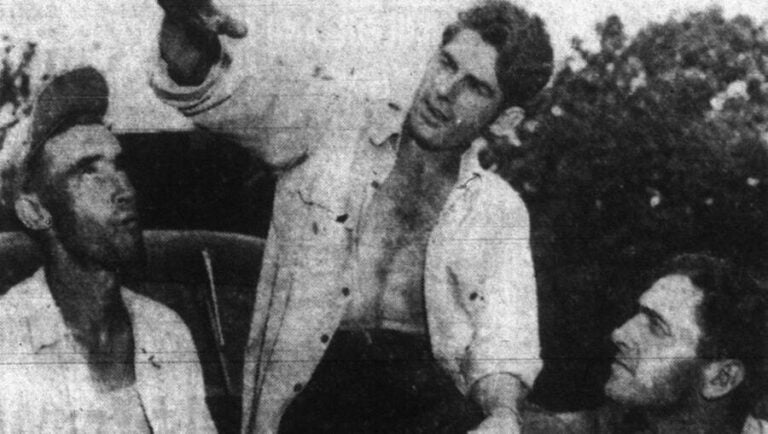
On the evening of August 21, 1955, Billy Ray Taylor was drawing water from the well behind the Sutton family farmhouse in Christian County, Kentucky, when he saw a bright light drop from the sky and settle into a gulley at the back of the property. He ran inside and told the family. The Suttons — eight people, including children — and Taylor, a visitor from out of state, were gathered at the house. Most of them shrugged. A few minutes later, the dog, which had been on the porch, began to bark and then retreated under the house, where it stayed for the rest of the night.

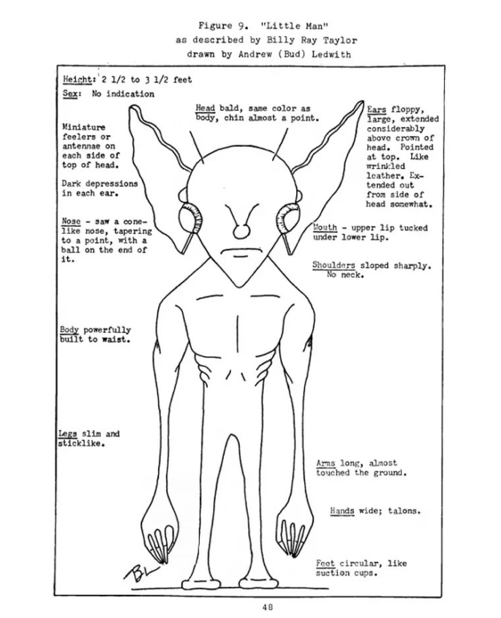
Then they saw the visitors. At the side door, on the porch, at the windows, came what the family described as small figures, perhaps three feet tall, with large heads, large eyes, long arms that reached nearly to the ground, and ears or protrusions on the sides of their heads. The figures moved jerkily and seemed to float rather than walk. They glowed faintly in the dark. Glennie Lankford, the mother of the household, said they had eyes that reflected light like a cat's.

Elmer Sutton and John Charley, both armed men, took shotguns. When one of the figures appeared at the window, Sutton fired. The blast, at close range, had no effect. The figure was knocked backward, the family said, but righted itself and moved away. Over the next several hours, the figures returned repeatedly — to the door, the windows, the roof. Each time, the men fired. Each time, the figures seemed unharmed. The family moved from room to room, blocking doors, keeping the children low. The figures did not enter.

At some point after midnight, the family fled. All eleven of them, including the children, ran to their cars and drove to the police station in the town of Kelly. They arrived in a state the officers on duty described as genuinely terrified. The police drove back to the farmhouse with them. A search of the property found no figures, no blood, no tracks, and no damage beyond the bullet holes the family had made themselves. But the officers noted the family's fear seemed real — one man had a pulse of 140 beats per minute. The police left. And then, the family said, the creatures came back.

The Kelly-Hopkinsville encounter became one of the most thoroughly investigated and debated close encounters in UFO history. Ufologist Isabel Davis, commissioned by J. Allen Hynek's Center for UFO Studies, conducted a near-200-page investigation in 1956 — interviewing witnesses and police separately, mapping the scene, and documenting every detail. Project Blue Book officially classified the case as a "hoax" with no further comment. Skeptics proposed great horned owls, meteors, and alcohol. But the family never sought fame, changed their story, or recanted. Geraldine Sutton Stith, Lucky Sutton's daughter, continues to defend the account today: "You could look at him and tell that something happened to them that night. They couldn't have made up something like that."

Sources: Project Blue Book files (1955); Isabel Davis & Ted Bloecher, "Close Encounters at Kelly and Others of 1955" (CUFOS, 1978); J. Allen Hynek investigation; Joe Nickell, Skeptical Inquirer (2006); Brian Dunning, Skeptoid Podcast #331 (2012); Jerome Clark, "Unexplained!" (1993); Kentucky New Era (August 22, 1955); Frontiers in Psychology — Schmaltz & Lilienfeld (2014); WBKO — "70 Years Later" (2025); Wikipedia — Kelly–Hopkinsville encounter
Share: 𝕏 Twitter 📘 Facebook 🔶 Reddit 💼 LinkedIn

⏱️ Timeline

From the flying saucer sighting at 7 PM, through the hours-long siege, the family's flight to the police station, the police search, the creatures' return, the first newspaper report, Isabel Davis's investigation, Project Blue Book's classification, the 50th anniversary festival, and the 2025 70th anniversary retrospective — the complete chronology of the Kelly-Hopkinsville Encounter.

August 21, 1955 ~7:00 PM

Billy Ray Taylor sees a "flying saucer." Billy Ray Taylor goes outside to the well to fetch water and sees a bright silvery object — "real bright, with an exhaust all the colors of the rainbow" — that comes silently toward the house, passes over it, stops in the air, and drops straight to the ground behind trees. He runs inside to tell the family. The family laughs off his UFO account and doesn't take him seriously.

August 21, 1955 ~8:00 PM

The creatures appear. The family dog begins barking incessantly. Lucky Sutton and Billy Ray Taylor go to the back door to investigate. They see a strange glow and a small humanoid creature — about 3.5 feet tall with an oversized round head, arms extending almost to the ground, taloned hands, and oversized eyes glowing with a yellowish light. Its body appears to be made of "silver metal."

August 21, 1955 ~8:15 PM

First shots fired — no effect. The two men grab a 20-gauge shotgun and a .22 rifle and fire at the creature. It does a "flip," scrambles upright, and flees into the darkness — seemingly impervious to bullets. Shortly after, a similar creature appears at a side window; they fire through the window screen. Again, the creature flips and disappears.

August 21, 1955 ~8:30 PM - 10:30 PM

The siege continues for hours. Creatures repeatedly pop up at doorways and windows in a "funhouse" manner. When shot, they float or flip backward, then re-approach. The men go through whole boxes of ammunition. Bullets striking the creatures sound like "shooting a tin can." Billy Ray Taylor steps outside under the overhanging roof; a claw-like hand reaches down and touches his hair. The group screams and pulls him back. Children are hidden under beds.

August 21, 1955 ~11:00 PM

Family flees to police station. Glennie Lankford calms the situation and suggests they drive to the police station. All five adults and seven children pile into cars and speed to the Hopkinsville police station, arriving highly agitated and visibly frightened. One man has a pulse of 140 beats per minute. They tell police: "We've been fighting them for nearly four hours."

August 21, 1955 ~11:30 PM

Police mobilize. Police Chief Russell Greenwell calls for backup. Four city police officers, five state troopers, three deputy sheriffs, and four military police officers from nearby Fort Campbell drive to the Sutton farmhouse. A photographer from the Kentucky New Era also accompanies them.

August 22, 1955 ~Midnight - 2:30 AM

Police search finds no creatures. Police search the farmhouse and surrounding area for about two and a half hours. They find shell casings, broken windows, and holes in screens — all consistent with gunfire — but no sign of the creatures. No footprints, no blood, no scratch marks on the roof, no evidence of a saucer landing. Police find no evidence of heavy drinking. One account mentions a luminous green glow near a fence, consistent with foxfire.

August 22, 1955 ~2:30 AM

Police leave. Police leave the farmhouse, finding no evidence of the creatures. The family remains at the house.

August 22, 1955 ~2:30 AM - 3:30 AM

The creatures return. After police leave, the creatures return. Glennie Lankford reports seeing a creature glowing repeatedly by her bedside window, its claw-like hand on the screen. The creatures scratch at the house and make noise walking on the roof. The grandmother screams: "They're back." The men defend the home again until morning.

August 22, 1955 Dawn

Creatures disappear at daybreak. The creatures allegedly disappear at daybreak, never to be seen again by the family or anyone else.

August 22, 1955 Morning

Family packs up and leaves. Two officers return to the farmhouse and find it empty. Neighbors inform them that the families had "packed up and left" to spend time in Evansville, Indiana, after reporting the creatures had returned around 3:30 AM.

August 22, 1955

First newspaper report published. The Kentucky New Era publishes "Story of Space-ship, 12 Little Men Probed Today" by reporter Joe Dorris. The story spreads to regional and national press, including The New York Times. The paper increased the number of creatures to "12 to 15," which became the most commonly reported number.

Days following August 22, 1955

Crowds descend on the farm. Hundreds of curiosity seekers descend on the farm, often ridiculing the Suttons. "No Trespassing" signs prove useless. The family tries charging admission: 50 cents to enter the grounds, $1 for information, $10 for pictures. Bud Ledwith, a local radio station employee, interviews witnesses and makes drawings.

1956

Isabel Davis investigates. Ufologist Isabel Davis conducts one of the most thorough investigations of the incident, interviewing Sutton family members and police investigators. Her nearly 200-page report, co-written with Ted Bloecher, is published decades later by CUFOS.

1955-1969

Project Blue Book classifies case as "hoax." Project Blue Book officially classifies the case as a "hoax" with no further comment. The Air Force team never officially pursued the matter beyond checking in with their Fort Campbell counterparts.

1978

Davis and Bloecher report published. Isabel Davis and Ted Bloecher's "Close Encounters at Kelly and Others of 1955" is published by the Center for UFO Studies (CUFOS), founded by J. Allen Hynek.

2005

50th anniversary festival. The town of Hopkinsville holds its 50-year anniversary "Little Green Men Festival." The Chamber of Commerce hires Joe Nickell to give a skeptical talk. The Kentucky New Era publishes a 12-page supplement, "It Came from Kelly."

2006

Joe Nickell proposes owl explanation. Joe Nickell publishes "Siege of Little Green Men: The 1955 Kelly, Kentucky, Incident" in the Skeptical Inquirer, proposing the great horned owl explanation.

2012

Brian Dunning's Skeptoid analysis. Brian Dunning publishes Skeptoid Podcast #331 analyzing the case, finding too many similarities between the creatures and great horned owls.

February 2020

Project Blue Book TV episode airs. The History Channel series "Project Blue Book" airs an episode dramatizing the Kelly-Hopkinsville encounter.

August 2025

70th anniversary retrospective. WBKO publishes "70 Years Later: Revisiting the Kelly-Hopkinsville Encounter," featuring interviews with Geraldine Sutton Stith, Lucky Sutton's daughter.

👁️ Key Witnesses

Twelve key figures — the Sutton and Taylor families who lived through the siege, Police Chief Greenwell who assessed their credibility, J. Allen Hynek whose organization investigated, Bud Ledwith who interviewed witnesses the day after, and Geraldine Sutton Stith who defends the family's account today.

Billy Ray Taylor

Family friend visiting from Pennsylvania; former carnival worker with Lucky Sutton · Age 21

What they witnessed: First saw the "flying saucer" — a bright silvery object with exhaust "all the colors of the rainbow" — while going to the well for water around 7 PM. It came silently toward the house, passed over it, stopped, and dropped straight to the ground. Later, he was one of two men who shot at the creatures. A claw-like hand reached down from the roof overhang and touched his hair while he was outside. His wife June, 18, was also present.

Elmer "Lucky" Sutton

Family patriarch; Glennie Lankford's grown son from a previous marriage

What they witnessed: One of the two men who shot at the creatures with a 20-gauge shotgun and .22 rifle. First saw the creatures with Billy Ray Taylor when their dog rushed past them hiding under the porch. Described them as having "huge ears, big glowing eyes, arms down to the ground." Shot at the creatures multiple times; they would flip backward and then re-approach.

Glennie Lankford

Matriarch of the family; 50-year-old widow who rented the farmhouse

What they witnessed: Described one creature as looking "like a five-gallon gasoline can with a head on top and small legs. It was a shimmering bright metal like on my refrigerator." She eventually calmed the situation and suggested they drive to the police station. After police left, she reported seeing a creature glowing repeatedly by her bedside window with its claw-like hand on the screen around 3:30 AM. Known as a somber, no-nonsense matriarch who abhorred the limelight.

John Charley "J.C." Sutton

Glennie Lankford's grown son from a previous marriage

What they witnessed: Present during the encounter. His wife Vera was also present. One of the armed men who fired at the creatures during the siege.

O.P. Baker

Alene Sutton's brother; family member at the farmhouse

What they witnessed: Present during the encounter. One of the adult family members who experienced the hours-long siege at the Sutton farmhouse.

June Taylor

Billy Ray Taylor's wife, age 18; visiting from Pennsylvania

What they witnessed: Present during the encounter. She and Billy Ray, Lucky, and Vera were reportedly itinerant carnival workers visiting the farmhouse.

Vera Sutton

Lucky Sutton's wife; itinerant carnival worker

What they witnessed: Present during the encounter as one of the adults in the farmhouse during the hours-long siege.

Alene Sutton

J.C. Sutton's wife

What they witnessed: Present during the encounter as one of the adult family members in the farmhouse.

Lonnie, Charlton, and Mary Lankford

Glennie Lankford's minor children (ages 12, 10, and 7)

What they witnessed: The children were hidden under beds during the shooting. They were present for the entire encounter. The youngest, Mary, was only 7 years old.

Russell Greenwell

Hopkinsville Police Chief

What they witnessed: Responded to the family's arrival at the police station. Later told investigators: "These aren't the kind of people who normally run to the police for help. What they do is reach for their guns." His observation that the family was genuinely terror-struck lent credibility to their account.

J. Allen Hynek

Astronomer; Project Blue Book's civilian scientific consultant; founder of CUFOS

What they witnessed: Did not personally visit the site at the time but his organization, CUFOS, commissioned and published Isabel Davis's definitive 1956 investigation report. Hynek initially said the case seemed "preposterous" and offensive to "common sense" but acknowledged it was interesting and many investigators considered it a solid example of a close encounter of the third kind. He later expressed more open-mindedness about UFO cases generally.

Bud Ledwith

Local radio station employee

What they witnessed: Interviewed the adult eyewitnesses the day after the incident and made drawings based on their accounts. According to Isabel Davis, he was impressed by their remarkable specificity and consistency, even though the men were away from the farmhouse all day, unable to coordinate with the others.

📂 Documents & Records

Nine key documents — Project Blue Book case files, the Blue Book Archive lecture reference, Fold3 digitized records, the first Kentucky New Era newspaper report, the 50th anniversary supplement, Isabel Davis's definitive CUFOS investigation report, the Evansville Press coverage, and an academic paper on pseudoscience and critical thinking.

📄

Project Blue Book Case File — Kelly-Hopkinsville

1955-1969 · U.S. Air Force / National Archives (NARA)

The official Project Blue Book files, permanently transferred to the National Archives. The Kelly-Hopkinsville case was listed as a "hoax" with no further comment. The files include Glennie Lankford's firsthand account of the encounter. Available through NARA Record Group 341.

Contains: Official USAF classification of the case, witness statements including Glennie Lankford's account, investigation notes

View source →
📄

Project Blue Book Archive — Lecture on the UFO Program

Undated · Project Blue Book Archive / NARA

Undated notes for a lecture on the Air Force's UFO program. Page 10 contains the only significant Blue Book reference to the Hopkinsville case, which Brian Dunning found through searching the online archive.

Contains: USAF lecture notes referencing the Kelly-Hopkinsville incident

View source →
📄

US, Project Blue Book — UFO Investigations, 1947-1969 (Fold3)

1947-1969 · Fold3 (Ancestry) / NARA T1206

Records and case files relating to investigations of sightings of unidentified flying objects (UFOs) from 1947-1969, including the Kelly-Hopkinsville case.

Contains: Digitized Project Blue Book case files searchable by date and location

View source →
📄

Kentucky New Era — "Story of Space-ship, 12 Little Men Probed Today"

August 22, 1955 · Kentucky New Era, reporter Joe Dorris

The first newspaper report on the Kelly-Hopkinsville encounter, published the day after the incident. The Kentucky New Era was the first paper to report the incident and increased the number of creatures to "12 to 15," which became the most commonly reported number.

Contains: First-hand contemporary newspaper reporting of the incident, the original witness claims

View source →
📄

Kentucky New Era — Archives Reprint of Original Article

August 20, 2017 · Kentucky New Era (archive reprint)

Archived reprint of the original August 22, 1955 Kentucky New Era article about the incident, republished during the 2017 eclipse period.

Contains: Historical newspaper archive of the original reporting

View source →
📄

It Came from Kelly — Kentucky New Era 50th Anniversary Supplement

August 15, 2005 · Kentucky New Era (12-page supplement)

A special 12-page supplement published for the town's 50-year anniversary of the event, containing all the paper's past reporting of the event along with retrospectives.

Contains: Complete historical newspaper archive of Kelly-Hopkinsville reporting from the Kentucky New Era

View source →
📄

Close Encounter at Kelly and Others of 1955 — Isabel Davis Report (PDF)

1956 investigation, published 1978 · Center for UFO Studies (CUFOS)

The definitive investigation report, nearly 200 pages, by Isabel Davis (with Ted Bloecher), first conducted in 1956. Includes detailed maps, drawings, documentary records, summaries of similar accounts around the world, and interviews with several Sutton family members and police investigators.

Contains: Detailed investigation report with maps, drawings, witness interviews, documentary records, and analysis

View source →
📄

Evansville Press — Kelly-Hopkinsville Goblin Story

1955 · Evansville Press (via Newspapers.com)

Newspaper article reporting that there were no new reports of little men from outer space who were reported to have landed near Hopkinsville, KY.

Contains: Contemporary newspaper coverage of the aftermath

View source →
📄

Hauntings, Homeopathy, and the Hopkinsville Goblins — Academic Paper

April 17, 2014 · Frontiers in Psychology, Schmaltz & Lilienfeld

Academic paper citing the Kelly-Hopkinsville incident as an example of pseudoscience and an "extraordinary claim" to help students develop critical thinking skills. The authors suggest intoxication may have played a part despite contemporary reports that there was no drinking involved.

Contains: Psychological analysis of the case as an example of pseudoscience, academic skepticism

View source →

⚖️ Skeptical Analysis

Seven skeptical explanations — great horned owls, a meteor misidentification, alcohol intoxication, mass hysteria, a hoax for financial gain, the lack of bullet damage, and foxfire (bioluminescent fungus). Each is presented with its counterarguments, showing why none has been universally accepted.

Great Horned Owls (misidentification)

Proposed by: Joe Nickell (Skeptical Inquirer, 2006); Brian Dunning (Skeptoid, 2012); Renaud Leclet (2008)

The family could have misidentified great horned owls, which are nocturnal, fly silently, have yellow eyes, and aggressively defend their nests. Dunning noted the owls stand about two-thirds of a meter (roughly 2 feet) tall, comparable to the lower end of the reported creature height range. Nickell noted that "heightened expectation prompted by the earlier flying-saucer sighting" caused the witnesses to mistake owls for "little men."

Counterarguments:

The witnesses described creatures with silver metallic skin, pointed ears, clawed hands, and arms reaching to the ground — features owls do not have. The creatures were reportedly shot at close range with a shotgun and flipped backward, then re-approached. Owls would be killed or driven off by gunfire, not return repeatedly. Multiple witnesses, including a 50-year-old matriarch and police officers, found the family genuinely terrified in ways that owl encounters would not produce.

Meteor sighting (misidentification of the "flying saucer")

Proposed by: Joe Nickell; Brian Dunning

Meteor sightings occurred at the time that could explain Billy Ray Taylor's claim that he saw a bright light streak across the sky and disappear beyond a tree line. The Kappa Cygnids meteor shower was taking place at that very time, part of the broader Perseids. Even Fort Campbell observers reported seeing the fireball.

Counterarguments:

While the meteor explanation is plausible for the initial "flying saucer" sighting, it does not explain the creatures that appeared an hour later and besieged the house for hours. In the original 1955 reporting, Billy Ray Taylor only told the Suttons he saw a bright shooting star; the story of a spaceship landing evolved in later retellings. But the creature encounter is the core of the case, not the light in the sky.

Alcohol intoxication

Proposed by: Rodney Schmaltz & Scott O. Lilienfeld (Frontiers in Psychology, 2014)

Although contemporary newspaper stories reported that "all officials appeared to agree that there was no drinking involved," and Glennie Lankford stated "liquor was not allowed in the farmhouse," Schmaltz and Lilienfeld suggest that intoxication may have played a part in the sighting. The young men (Lucky, J.C., Billy Ray, Vera) were itinerant carnival workers.

Counterarguments:

Police specifically looked for evidence of drinking and found none. Glennie Lankford, a no-nonsense matriarch, explicitly prohibited liquor in the house. Isabel Davis's investigation found no evidence of alcohol involvement. The family included a 50-year-old widow and children — not all witnesses were young carnival workers. The consistency of accounts across witnesses interviewed separately also argues against intoxication as the sole explanation.

Mass hysteria / group excitement

Proposed by: General skeptical consensus; referenced in Schmaltz & Lilienfeld (2014)

The reports were attributed to "the effects of excitement" — a form of mass hysteria among the family. After the initial suggestion of a "flying saucer" by Billy Ray Taylor, heightened expectation led the family to interpret normal nighttime phenomena (owls, shadows, sounds) as alien creatures. The fact that the number of creatures grew from "a few" to "12 to 15" supports the idea of embellishment over time.

Counterarguments:

The "12 to 15" figure came from the Kentucky New Era newspaper, not from the family's original account. Mass hysteria does not typically produce hours of sustained, coordinated behavior — loading weapons, moving children to safety, and fleeing to a police station. Police found the family's terror genuine, with one man's pulse at 140 bpm. The witnesses' accounts remained consistent when interviewed separately by Isabel Davis.

Hoax for attention / financial gain

Proposed by: Project Blue Book (USAF); various skeptics

Project Blue Book officially classified the case as a "hoax" with no further comment. The fact that the family later charged admission (50 cents to enter, $1 for information, $10 for pictures) led skeptics to blast them as "fortune-seeking fabulists."

Counterarguments:

Isabel Davis's investigation found that the family initially tried to avoid attention, put up "No Trespassing" signs first, and only started charging admission after curiosity seekers would not leave them alone. Davis's impression was that Glennie Lankford was a somber, no-nonsense matriarch who abhorred the limelight. The family fled to Evansville, Indiana — hardly the behavior of people seeking fame. The charging of admission was a last resort, not an initial plan.

No bullet damage as evidence of hoax

Proposed by: Various skeptics and investigators

Police found no physical evidence that the creatures existed — no footprints, no blood, no marks on the house from the bullets striking the beings. The only evidence of the encounter was broken windows, holes in screens, and spent shell casings — all of which could have been created by the family themselves. The creatures' reported imperviousness to bullets left no physical evidence.

Counterarguments:

The absence of physical evidence is consistent with the creatures being unknown entities that may not leave conventional traces. The bullet holes and shell casings corroborate that the family did fire weapons extensively. Police confirmed the family's genuine terror. The lack of evidence cuts both ways — it neither proves nor disproves the encounter, but the family's behavior and witness consistency argue against a simple hoax.

Foxfire (bioluminescent fungus) explanation for the "green glow"

Proposed by: Brian Dunning (Skeptoid, 2012)

Jerome Clark described "an odd luminous patch along a fence where one of the beings had been shot, and, in the woods beyond, a green light whose source could not be determined." Dunning noted this description was consistent with foxfire — the folk name for bioluminescent fungus on decaying wood — and therefore cannot be considered strong evidence of anything unusual.

Counterarguments:

While foxfire may explain the green glow, it does not address the core of the encounter — the creatures seen by multiple witnesses at close range over several hours. The glow was a minor detail, not the primary evidence. Even if the glow was foxfire, the creature sightings remain unexplained.

💔 Human Impact

The Kelly-Hopkinsville encounter transformed the Sutton family's lives forever — they became targets of ridicule, received death threats, and were labeled "fortune-seeking fabulists." Yet the case also inspired Pokémon's Sableye, Steven Spielberg's unproduced "Night Skies," the film "Critters," the History Channel's "Project Blue Book," and an annual Kentucky festival that still celebrates the "Little Green Men" today.

Local celebrities and targets of ridicule

The Sutton family became instant local celebrities — but also targets of intense ridicule. Hundreds of curiosity seekers descended on the farm in the days following the incident, often mocking the family as ignorant hillbillies or frauds. The family's experience illustrates how UFO witnesses can become pariahs in their own communities.

Never sought money or fame

Despite later accusations of being "fortune-seeking fabulists" after they began charging admission, the Suttons reportedly never sought money or fame. Isabel Davis's investigation found that the family initially tried to avoid attention, put up "No Trespassing" signs that proved useless, and only started charging admission (50 cents to enter, $1 for information, $10 for pictures) as a last resort to manage the uninvited crowds. Glennie Lankford was described as a somber, no-nonsense matriarch who abhorred the limelight.

The "Hopkinsville Goblins" became a pop culture phenomenon

The creatures from the encounter — dubbed "Hopkinsville Goblins" — became a lasting pop culture phenomenon, inspiring creatures in movies, TV shows, video games, and Pokémon. The design of Generation 3 Pokémon Sableye is directly inspired by the Hopkinsville Goblin description. The 1986 film "Critters" is loosely based on the event. Steven Spielberg used it as the basis for his unproduced film "Night Skies." A February 2020 episode of History Channel's "Project Blue Book" dramatized the encounter.

Death threats and harassment

The family reportedly received death threats and ongoing harassment in the aftermath of the incident. Historical accounts describe how the family was relentlessly pursued by curiosity seekers and skeptics alike, with the family unable to live in peace at their farmhouse.

Influence on Spielberg's "Close Encounters of the Third Kind"

In the late 1970s, Steven Spielberg used the Kelly-Hopkinsville event as the basis for "Night Skies," an unproduced science fiction horror film. Elements of the case influenced Spielberg's broader UFO mythology, including "Close Encounters of the Third Kind" and "E.T." The term "close encounter" itself was coined by J. Allen Hynek, whose organization investigated the Kelly case.

Some family members never spoke about it again

After the initial media frenzy, some family members never spoke about the incident again. The family eventually packed up and left the farmhouse, relocating to Evansville, Indiana. The trauma of the encounter — and the subsequent harassment — caused lasting damage to the family's peace and privacy.

Annual festival and community identity

The Kelly community now celebrates the event annually with the "Little Green Men Days Festival," turning the infamous encounter into a source of community pride and tourism. The town of Hopkinsville rebranded itself as "Eclipseville" for the 2017 solar eclipse, using its UFO history as a draw.

Ongoing family defense

Geraldine Sutton Stith (née Hawkins), Lucky Sutton's daughter, continues to defend her father's account decades later. In a 2002 interview she criticized that newspaper reports refer to her family as "a low-status group of people," adding: "You could look at him and tell that something happened to them that night. They couldn't have made up something like that." She has spoken in multiple documentaries and interviews, including WBKO's 2025 70th anniversary special.

Academic use as a teaching case

Psychologists Rodney Schmaltz and Scott O. Lilienfeld have used the incident as an academic example of pseudoscience to help students distinguish truth from fiction. The case is cited in Frontiers in Psychology as an "extraordinary claim" for developing critical thinking skills, demonstrating the incident's lasting impact beyond UFOlogy.

💡 Things You Didn't Know

Eighteen surprising facts about the Kelly-Hopkinsville encounter — from bullets that had no effect on the creatures, to their floating movement, the hours-long duration, the Pokémon Sableye inspiration, the heatwave with no air conditioning, the silver metallic skin, and the meteor shower that was taking place that same night.

  1. The creatures were described as 3-4 feet tall with glowing yellow eyes, clawed hands, pointed ears, and spindly legs. Their skin was silver-colored and seemed metallic — Glennie Lankford said one looked "like a five-gallon gasoline can with a head on top and small legs. It was a shimmering bright metal like on my refrigerator."
  2. The family shot at them with a 20-gauge shotgun and a .22 rifle — the bullets had no visible effect. When struck, the creatures would float or flip backward and then re-approach. The men went through whole boxes of ammunition. The sound of bullets striking the creatures resembled "bullets striking a metal bucket."
  3. When shot, the creatures would float or flip backward and then re-approach. They seemed to float rather than walk and could fly from tree to rooftop. One was shot out of a tree and "floated to the ground" before scurrying into the woods.
  4. The family fled to the Hopkinsville police station — and the creatures were still there when they returned. After police searched and left, the family reported the creatures returned around 3:30 AM, scratching at the house and walking on the roof. Glennie Lankford saw one glowing by her bedside window with its claw-like hand on the screen.
  5. Billy Ray Taylor first saw a "flying saucer" land in the gully — but the family laughed it off. He was a 21-year-old carnival worker from Pennsylvania visiting his friend Lucky Sutton. He saw a silvery object "real bright, with an exhaust all the colors of the rainbow" that came silently toward the house. The family didn't take him seriously — until the creatures appeared an hour later.
  6. The encounter lasted for HOURS — not a fleeting glimpse. The family estimated they fought off the creatures for nearly four hours before fleeing to the police. The creatures returned for another hour-plus after police left. The total encounter spanned from approximately 8 PM to dawn.
  7. J. Allen Hynek investigated through CUFOS but never personally visited the site in 1955. He said the case seemed "preposterous" and offensive to "common sense" — but acknowledged it was "interesting" and many investigators considered it "a solid example of a close encounter of the third kind." His organization commissioned and published Isabel Davis's definitive 200-page investigation report.
  8. The creatures had silver-colored skin and seemed to float rather than walk. Multiple witnesses described them as appearing to be made of "silver metal" or having a "shimmering bright metal" appearance. Jerome Clark wrote that they "floated" through the trees.
  9. The "Hopkinsville Goblins" inspired creatures in Pokémon (Sableye, Generation 3), The Simpsons, the 1986 film Critters, and Pathfinder Roleplaying Game (the "hobkins" gremlin in Bestiary 5). Steven Spielberg used the event as the basis for his unproduced film "Night Skies." A Chicago theater produced a musical "It Came From Kentucky" based on the event.
  10. The case happened during a heatwave — the family had no air conditioning and windows were open. The farmhouse was an unpainted three-room house without running water, telephone, radio, TV, or books. The hot August night meant windows and doors were open, making the family more vulnerable to seeing and hearing anything outside.
  11. Police found no evidence of the creatures — but the family showed genuine signs of terror. One man had a pulse of 140 beats per minute. Police Chief Russell Greenwell noted: "These aren't the kind of people who normally run to the police for help. What they do is reach for their guns." The family's genuine terror was noted by multiple independent observers.
  12. The Suttons were known as honest, hard-working people before the incident — not attention seekers. Isabel Davis's investigation found that none of the witnesses had any history of making "preposterous allegations." Glennie Lankford was described as a somber, no-nonsense matriarch who abhorred the limelight. Contemporary newspaper stories reported that "all officials appeared to agree that there was no drinking involved."
  13. The number of creatures grew over time. Initial reports from the family mentioned "a few" creatures. The Kentucky New Era newspaper increased the number to "12 to 15," which became the most commonly reported figure. Brian Dunning noted that the story "only grew" over time — a pattern seen in many famous UFO cases.
  14. A local radio employee, Bud Ledwith, interviewed witnesses and made drawings the day after. He was impressed by their remarkable specificity and consistency — even though the men were away from the farmhouse all day, unable to coordinate their stories with the others.
  15. The four military police who responded were from the US Army's Fort Campbell, NOT the Air Force. Brian Dunning found that claims of Air Force investigators showing up the next day at the farmhouse have been published multiple times but could find no corroborating evidence. The MP presence was Army, not Air Force.
  16. The family reportedly later charged admission to curiosity seekers: 50 cents to enter the grounds, $1 for information, $10 for taking pictures. This was only after "No Trespassing" signs proved useless — not an initial attempt to monetize the event.
  17. The Kappa Cygnids meteor shower was taking place the night of August 21, 1955, as part of the broader Perseids. This could explain Billy Ray Taylor's "flying saucer" sighting, which even Fort Campbell observers reported seeing as a fireball.
  18. Jerome Clark described a "luminous patch along a fence" where one of the beings had been shot, and a green light in the woods. Brian Dunning noted this was consistent with foxfire — bioluminescent fungus on decaying wood.

📚 Books

Nine books covering the Kelly-Hopkinsville encounter and its legacy — from Isabel Davis's definitive CUFOS investigation to Richard Dolan's national security chronology, Carl Sagan's analysis of pseudoscience, Jerome Clark's encyclopedias, and David Halperin's academic exploration of UFO mythology. Links support The UAP Map via Amazon Associates.

Close Encounters at Kelly and Others of 1955

Isabel Davis and Ted Bloecher · 1978 · Center for UFO Studies (CUFOS)

The definitive investigation of the Kelly-Hopkinsville encounter. Nearly 200 pages with detailed maps, drawings, documentary records, and interviews with witnesses and police. First conducted in 1956, published by CUFOS in 1978. The most thorough early investigation of the case.

View on Amazon →

UFOs and the National Security State: Chronology of a Cover-Up, 1941-1973

Richard M. Dolan · 2000 · Keyhole Publishing / Hampton Roads

A meticulously researched volume covering UFO incidents including the Kelly-Hopkinsville encounter. Discusses the case at page 259 in the context of 1950s UFO sightings and government response.

View on Amazon →

UFOs and the National Security State: The Cover-Up Exposed, 1973-1991

Richard M. Dolan · 2009 · Keyhole Publishing

Second volume of Dolan's comprehensive UFO history series, which references the Kelly-Hopkinsville encounter in the broader context of UFO phenomena and government response.

View on Amazon →

The Demon-Haunted World: Science as a Candle in the Dark

Carl Sagan · 1995 · Random House

Carl Sagan's landmark book on scientific thinking addresses pseudoscience and includes discussion of the Kelly-Hopkinsville encounter as an example of how extraordinary claims should be examined critically. Sagan used it as a case study in distinguishing science from pseudoscience.

View on Amazon →

Unexplained! 347 Strange Sightings, Incredible Occurrences, and Puzzling Physical Phenomena

Jerome Clark · 1993 · Visible Ink Press

Contains a detailed account of the Kelly-Hopkinsville encounter. Clark writes that the creatures "floated" through trees and bullets sounded like "striking a metal bucket." Also describes a luminous patch along a fence and a green light in the woods, consistent with foxfire.

View source →

The UFO Book: Encyclopedia of the Extraterrestrial

Jerome Clark (editor) · 1997 · Visible Ink Press

A comprehensive encyclopedia of UFO phenomena that includes a detailed entry on the Kelly-Hopkinsville encounter.

View on Amazon →

The Encyclopedia of UFOs

Allan Hendry (editor), Ronald Story · 1980 · Doubleday & Company

Contains Hendry's analysis of the Kelly-Hopkinsville case. Hendry wrote: "This case is distinguished by its duration and also by the number of witnesses involved."

View source →

The Mammoth Encyclopedia of Extraterrestrial Encounters

Ronald Story (editor) · 2001 · Carroll & Graf

A definitive illustrated A-Z guide to all things alien that includes an entry on the Kelly-Hopkinsville (Kentucky) goblins.

View source →

Intimate Alien: The Hidden Story of the UFO

David J. Halperin · 2020 · Stanford University Press

Academic exploration of UFO mythology that references the Kelly-Hopkinsville encounter and cites Richard Dolan's work on UFOs and the National Security State.

View on Amazon →

🎬 Documentaries & Videos

Nine videos — full documentaries about the encounter, podcast analyses, the History Channel's "Project Blue Book" dramatization, Brian Dunning's skeptical Skeptoid episode, WBKO's 70th anniversary retrospective, and the Kentucky State Police's "Seeing Stranger Things" series.

The Kelly-Hopkinsville Encounter Documentary

The Kelly-Hopkinsville Encounter | Documentary

YouTube (independent documentary) · 39 min

A full documentary about the Kelly-Hopkinsville Encounter, covering the events of August 21, 1955, with references to Davis & Bloecher's "Close Encounters at Kelly and Others of 1955," and Brian Dunning's Skeptoid analysis.

Watch on YouTube →
Kentucky Goblins! Kelly-Hopkinsville UFO Encounter

Kentucky Goblins! Kelly-Hopkinsville UFO Encounter

Jimmy Akin's Mysterious Universe · Podcast/Video

Jimmy Akin and Dom Bettinelli analyze the evidence, skeptical explanations, and paranormal possibilities of the Kelly-Hopkinsville encounter using faith and reason.

Watch on YouTube →
Hopkinsville - The Alien Goblins Full Documentary

Hopkinsville — The Alien Goblins | Full Documentary

YouTube · Full documentary

A full documentary about the family that fought off goblin-aliens in the mysterious encounter, exploring debates and investigations.

Watch on YouTube →
Night of the Little Green Men of Kelly, Kentucky 1955

Night of the Little Green Men of Kelly, Kentucky 1955

YouTube (Monsters of the UFO) · Excerpt

Excerpt from the "Monsters of the UFO" documentary, episode "Incident At Kelly," about the alleged UFO landing at Kelly, Kentucky on August 21, 1955.

Watch on YouTube →
The Hopkinsville Goblins: The Strangest Alien Encounter in History

The Hopkinsville Goblins: The Strangest Alien Encounter in History

YouTube · Video format

Documentary covering the night of August 21, 1955 when a rural farmhouse in Hopkinsville, Kentucky, became ground zero for one of the most bizarre alien encounters in history.

Watch on YouTube →
Project Blue Book TV Series Hopkinsville Episode

Project Blue Book TV Series — "Hopkinsville" Episode

History Channel · Season 2, February 2020

A February 2020 episode of the American television series "Project Blue Book" focused on the Kelly-Hopkinsville event, dramatizing the encounter and J. Allen Hynek's investigation.

View on IMDb →
Skeptoid Podcast The Kelly-Hopkinsville Encounter

Skeptoid Podcast #331: The Kelly-Hopkinsville Encounter

Skeptoid (Brian Dunning) · Podcast ~15 min · October 9, 2012

Brian Dunning's detailed skeptical analysis of the Kelly-Hopkinsville encounter. Examines the owl hypothesis, the meteor explanation, and critiques of the case.

Listen on Skeptoid →
70 Years Later Revisiting the Kelly-Hopkinsville Encounter

70 Years Later: Revisiting the Kelly-Hopkinsville Encounter

WBKO · August 21, 2025

WBKO's 70th anniversary retrospective featuring interviews with Geraldine Sutton Stith, daughter of witness Elmer "Lucky" Sutton, who describes the family's account of events.

Watch on WBKO →
Seeing Stranger Things Kentucky State Police series

Seeing Stranger Things — Kentucky State Police Series

Kentucky State Police · Video series

A three-part series by the Kentucky State Police exploring the Kelly-Hopkinsville Encounter, featuring historical analysis and witness family interviews.

Watch on Facebook →

📰 Latest UAP News

The latest developments in UAP — updated weekly. View all news →