Four contrasts cross together
This is not a single unresolved dot. Four bright areas move through the field in the same short interval.
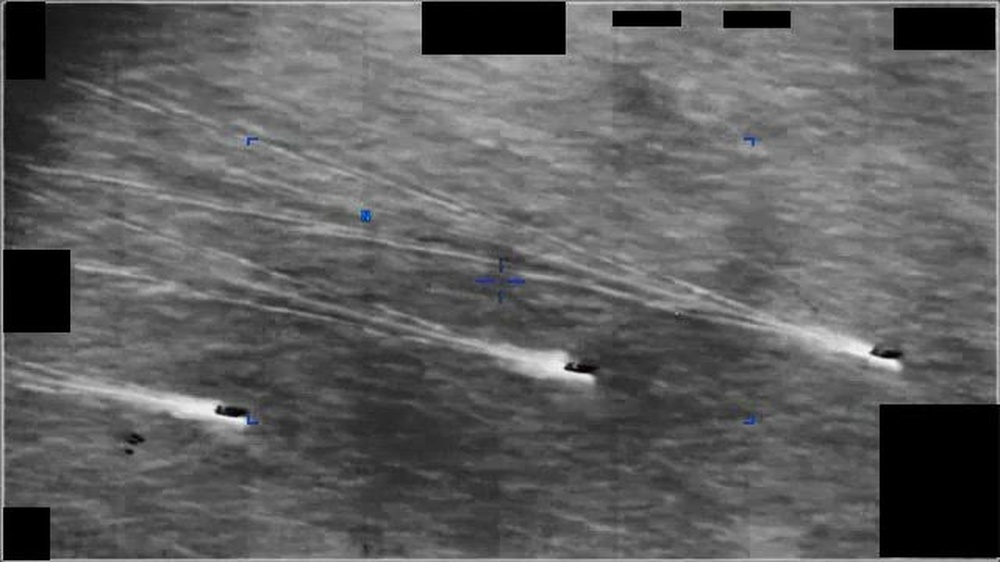
CENTCOM · NEAR IRAN · 26 AUGUST 2022 · PURSUE PR050
Four bright areas of contrast cross a U.S. military infrared sensor field together over water near Iran. Seconds later, a fifth enters from the upper-left. The geometry looks coordinated — but AARO's official wording stops at “four areas of contrast,” and the public record does not provide the range, spacing or platform motion needed to prove that four physical craft were flying in formation.
WATCH OFFICIAL PR050 VIDEO ↗The page uses the official government-released PR050 imagery. A public-domain copy of the released clip is also preserved on Wikimedia Commons, giving the case a second durable public access point beyond DVIDS.
THE FAST ANSWER
This is not a single unresolved dot. Four bright areas move through the field in the same short interval.
A separate area of contrast appears from the upper-left immediately after the first four leave.
Without range and platform geometry, apparent shared motion cannot be converted into proof of coordinated physical flight.
THE ACTUAL RELEASED IMAGE
The frame is compelling because the targets appear arranged together rather than randomly scattered. But an image-plane formation is not automatically a real-world formation: perspective, relative range and platform motion can compress unrelated objects into an apparently coherent group.
WHAT AARO ACTUALLY ESTABLISHES
AARO says PR050's uploader-defined title is “4 UAP Formation Iran 26 Aug 2022 over water [CALLSIGN]” and assesses the video is likely derived from an infrared sensor aboard a U.S. military platform operating in the CENTCOM area of responsibility in 2022.
A user uploaded the file to a classified network in June 2024. AARO also warns that many records in this collection lack a substantiated chain of custody. That makes the public release authoritative as an AARO/DVIDS record while leaving the original mission-to-archive chain incomplete.
The strongest version of this case is not “AARO verified four craft near Iran.” It is: AARO publicly released a short IR file that it assesses was likely derived from a U.S. military sensor, but the complete original custody trail is not publicly substantiated.
THE OFFICIAL TIMELINE
Four areas of contrast enter from the lower third of the left side and exit near the centre-bottom of the frame.
An additional area of contrast enters from the top-left corner after the first group has crossed.
AARO explicitly says this description is informational only and does not represent an analytical judgment, investigative conclusion or factual determination about the event's nature or significance.
THE RUNTIME WRINKLE
The public DVIDS clip is extremely short and contains the six-second sequence where the four contrasts cross and the fifth enters.
The underlying record is described with a longer source duration than the public-facing clip. The public page should not imply we possess the full original sequence.
This matters because a nine-second excerpt is too short to establish durable formation spacing, coordinated manoeuvring or real-world separation between the targets.
DOES THE VIDEO SHOW A REAL FORMATION?
Four points maintaining similar relative geometry across a short field-of-view crossing is suggestive. But a sensor image collapses three-dimensional space onto two dimensions. Objects at very different ranges can appear close together, and platform motion can make otherwise ordinary targets share apparent direction.
To demonstrate a real physical formation we would need range to each target, angular separation over time, platform position and attitude, sensor field of view, and enough frames to test whether relative spacing remains constant in real space rather than only on the screen.
WHAT PARALLAX COULD DO HERE
Targets separated by kilometres in depth can project into a tight cluster when the image removes depth information.
A moving aircraft can make unrelated targets appear to slide across the field in a similar direction even when they are not travelling together.
With only seconds of public footage, small differences in heading or spacing may never have time to become obvious.
Parallax does not prove the four contrasts were unrelated. It explains why apparent screen formation is weaker evidence than measured three-dimensional formation.
WHAT COULD IT HAVE BEEN?
| Candidate | Why it can fit | What is missing |
|---|---|---|
| Aircraft formation | Multiple aircraft can maintain spacing and appear as compact IR sources at distance. | Traffic data, range, altitude, heading and resolved structure. |
| Drones / UAS | Multiple small drones can fly together and appear as bright point targets. | Range, size, operating context and mission logs. |
| Birds | A small flock can produce multiple moving IR contrasts and naturally preserve rough grouping. | Scale, wingbeat-resolving imagery and range. |
| Balloons / drifting objects | Objects sharing wind flow can maintain apparent spacing over a short clip. | Wind data, altitude and range. |
| Parallax / mixed-depth targets | Objects at different distances can project into a compact apparent group as the sensor platform moves. | Platform track and target ranges. |
The public clip is too short and too geometrically sparse to select among these explanations. That is why the formation appearance should remain an observation, not a verdict.
THE FIFTH CONTRAST
The fifth area of contrast enters from a different part of the frame after the first four have crossed. That raises a useful test for the “coordinated formation” interpretation: was it part of the same event, an unrelated target, a bird, another aircraft, or simply another unresolved source crossing the field?
The released record gives no answer. But keeping the fifth target visible in the narrative prevents the first four from being over-packaged into a cleaner story than the footage actually provides. It is a useful reminder that the sensor scene may contain multiple unrelated or differently behaving objects, not one neat four-craft event.
COMPETITOR PASS
UAP Globe correctly foregrounds the four bright targets, the fifth later contrast, the 26 August 2022 date, the CENTCOM context and the authentic government imagery. It also treats the group as a formation appearance rather than proof of exotic craft.
The UAP Map's opportunity is to go further on the source chain, the uploader-defined-title caveat, the public-clip/runtime mismatch, the difference between screen geometry and real-world geometry, the parallax problem, and the evidential value of the fifth target. That gives readers more than a dramatic screenshot: it gives them the tools to judge what “formation” actually means.
SOURCE ROOM