Real military footage
INDOPACOM submitted nine seconds of infrared video to AARO. DVIDS and AARO publish the same description and identifiers.
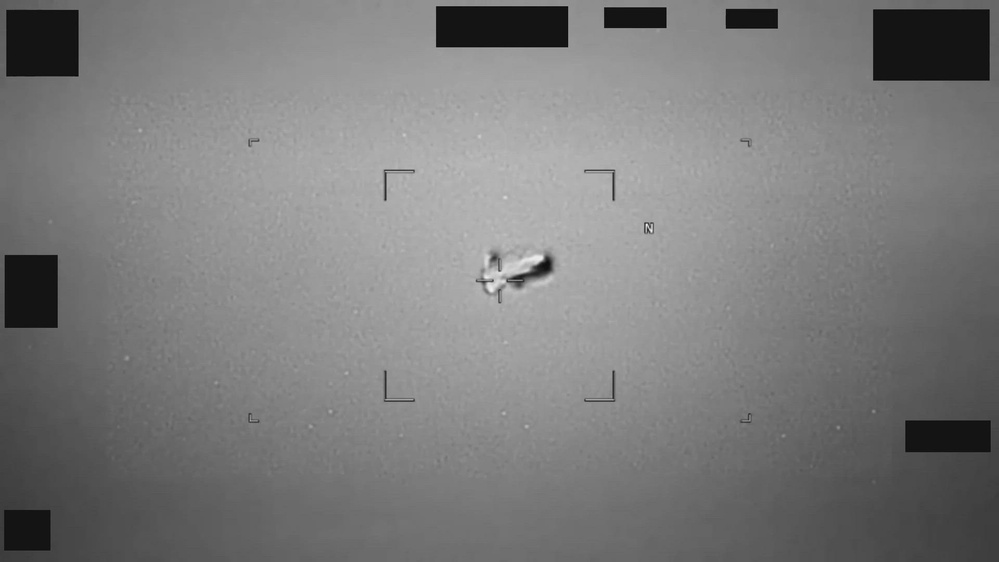
INDOPACOM · 2024 · NINE-SECOND INFRARED CLIP
For nine seconds, a U.S. military infrared sensor holds a sharply legible area of contrast near the centre of the frame. AARO describes it as football-shaped with three radial projections — one vertical and two angled downward. There is no witness statement, no range, no scale and no public analytical conclusion. The shape is striking; what it physically represents remains unresolved.
WATCH OFFICIAL PR46 VIDEO ↗THE FAST ANSWER
INDOPACOM submitted nine seconds of infrared video to AARO. DVIDS and AARO publish the same description and identifiers.
The released image really does resemble a football-shaped body with three projections. That appearance is visible in the case media.
No range, scale, witness narrative, rotation or second sensor establishes that the visible projections were literal appendages on a solid object.
“The sensor focuses on an area of contrast that resembles a football-shaped body with three radial projections.”
AARO / DVIDS NARRATIVE DESCRIPTION · PR46
THE ACTUAL RELEASED IMAGE
The official wording describes a football-shaped body with one projection rising vertically and two more angled downward by roughly 45 degrees relative to the body's major axis. That is a description of what the sensor image resembles — not proof that a physical object had those exact three appendages.
OPEN PRIMARY VIDEO ↗WHAT THE GOVERNMENT ACTUALLY RELEASED
U.S. Indo-Pacific Command submitted PR46 to AARO as an unidentified anomalous phenomenon report. The public DVIDS record says the material consists of nine seconds of infrared footage from a sensor aboard a U.S. military platform in 2024. DVIDS lists the media date as 01.01.2024, but with no accompanying witness narrative or precise event metadata, the page treats that as the public date-field rather than proof the incident literally occurred on New Year’s Day.
Crucially, AARO and DVIDS both state that the reporter supplied no oral or written description. So there is no published account of what anyone saw by eye, how long the observation lasted beyond the clip, whether the target moved unusually, whether radar tracked it, or what the crew thought it was at the time. This makes PR46 a media-first case rather than a witness-led encounter.
The Department nevertheless wrote an unusually specific frame description. That makes the visual morphology interesting — but it also makes disciplined wording essential.
WHY THE THREE “PRONGS” MATTER
The simplest literal reading is that the object really carried three fins, surfaces, tethers or projections around a compact main body.
A conventional manufactured object viewed head-on or tail-on could collapse into a body-plus-fins silhouette with ordinary wings or stabilisers hidden by angle and resolution.
Blooming, focus, compression, aperture effects and thermal contrast can make unresolved sources look more structured than their visible-light geometry really is.
The nine-second clip does not provide enough rotation, scale or independent imagery to determine which reading is correct.
THE LOCATION PROBLEM
DVIDS itself lists the location as undisclosed. The East China Sea label comes from the Department's PURSUE Release 01 manifest, which gives PR046 the alternate title “Unresolved UAP Report East China Sea, 2024.” UAP Globe uses that regional label prominently; our page keeps it, but makes the source of the label explicit so readers do not mistake it for a published coordinate or exact site.
That should be presented as the Department's own release metadata rather than a precise surveyed position. No coordinates are public, and the wider manifest contains some inconsistent location fields. The page therefore treats East China Sea as the best official regional label, not as exact geolocation.
THE STRONGEST ORDINARY CANDIDATES
| Candidate | Why it fits | What is missing |
|---|---|---|
| Aircraft / store | A body plus fins or stabilisers viewed at a compressed aspect can resemble the released shape. | Range, heading, platform geometry and higher-resolution frames. |
| Aerostat / balloon | A balloon or tethered aerostat with payload/rigging can create a bulbous body with projecting structures. | Deployment evidence, wind, exact location and scale. |
| Bird / biological target | IR imagery can produce deceptive silhouettes when a small target is distant or partially resolved. | Frame-to-frame motion, range and native sensor detail. |
| Optical / processing effect | Glare, blooming, focus and compression can create apparent appendages around a compact hot source. | Raw sensor data and enough orientation change to test whether the shape rotates with the target or remains camera-locked. |
No public explanation has demonstrated an identification for PR46. A resemblance to an aerostat or airframe is a hypothesis, not a solved case.
WHY AARO CAN LEAVE THIS UNRESOLVED
The clip is clear enough to support a shape description but too thin to close the identification. There is no published range, no angular-size solution, no rotation showing the object from another aspect, no witness narrative and no second independent sensor in the public record.
That is exactly the kind of case where “unresolved” should be read literally: the available release does not contain enough information to establish what produced the image. It is not a synonym for “exotic.”
COMPETITOR PASS
UAP Globe does several things well: it foregrounds the real frame, surfaces the redaction blocks, reconstructs the Release 01 provenance, notes that PR46 is one of the rare PURSUE clips with a specific shape description, and explores aerostat and optical-artefact possibilities in detail.
Where The UAP Map improves the presentation is by separating sensor morphology from physical geometry at every stage. UAP Globe is excellent at surfacing the dramatic silhouette and release provenance, but the phrase “three-pronged object” can easily become stronger in the reader’s mind than the underlying evidence. Our page uses that search language while repeatedly anchoring it to AARO’s exact phrase: an area of contrast that resembles a football-shaped body with three radial projections.
We also keep the East China Sea label on a short evidential leash: official manifest label, yes; exact location, no. And we avoid importing the separate PR102/PR103 East China Sea records into PR46 as though they are one event.
RELATED OFFICIAL RECORDS
PR46 should internally link to the separate East China Sea PR102/PR103 page, but the records must remain distinct. PR46 is a nine-second shaped-object clip from an earlier PURSUE release; PR102 and PR103 are longer featureless-contrast tracks released later. The public material does not establish that they document the same physical object or event.
SOURCE ROOM