A photograph can be genuine without telling you what it photographed.
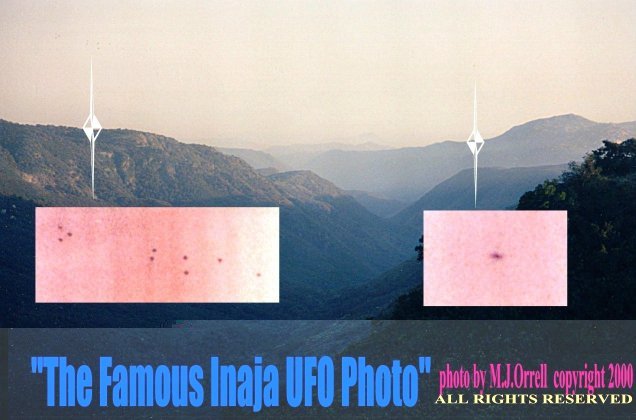
Michael Orrell took a landscape photograph near Inaja Memorial Picnic Grounds on 1 July 1990. After the film was developed, he noticed ten small dark marks — nine grouped on one side of the frame and one separated from them — and came to interpret them as a formation of unusual craft.
That is the intriguing part. The evidential problem is equally important: Orrell did not report seeing the objects in the sky when the shutter was released, there is no independent witness to their motion, and a single frame gives no reliable distance, speed or physical size.
The correct question is therefore not simply “is the photograph real?” It is: what can one exposure of tiny unresolved objects actually establish?
The best documented lab result validates the photograph — not the spacecraft interpretation.
In 2006, San Diego station KFMB News 8 arranged for Orrell's original negative to be examined at Chrome Photo in Sorrento Mesa. Technician Dennis Reiter said the negative itself was intact and showed no processing or machine damage that would explain the marks.
That is useful because it removes several trivial artefact explanations. It means the dark marks were recorded in the photographic image rather than simply painted onto a later print.
But Reiter stopped exactly where the evidence stopped. He accepted that the marks were unidentified objects in the literal sense while explicitly saying there was “absolutely no indication” they were alien spacecraft. That is the most important expert sentence in the case because it authenticates the negative without authenticating Orrell's interpretation.
The camera setup explains why the photograph is intriguing — and why it is so difficult to solve.
The earliest public reporting and Orrell's later interviews converge on a simple sequence. He was not tracking a UFO. He was making a landscape photograph.
Orrell said he set his Canon EOS 650 on a stone block, used the lens at maximum zoom and photographed across a hazy valley as the sun was getting lower in the western sky. He described deliberately steadying his breathing before making the exposure. No one in the group reported seeing the ten objects at that moment.
That geometry matters. A long-lens landscape frame compresses distance. Against bright haze, small distant objects can collapse into unresolved dark elements. A still photograph also freezes birds, insects, balloons or aircraft without showing the motion cues that would normally help identify them.
Why this matters: maximum zoom and haze make tiny distant subjects harder to classify, while a single still removes the motion/parallax information that would normally separate birds, insects, aircraft, balloons or truly unusual objects.
From landscape frame to UFO case
Ten objects — but almost no geometry
The count commonly associated with the photograph is ten: a group of nine dark marks and one separate mark. In enlargement, the marks can look pointed, triangular or compact. But apparent shape in a tiny image element is unstable; a handful of pixels or film-grain transitions can make ordinary distant targets look structured.
More importantly, the image does not tell us whether the objects were metres from the lens or kilometres away. Without range, there is no trustworthy size. Without sequential frames, there is no measured motion. Without a second viewpoint, there is no triangulation.
The original and the presentation are not the same thing
Many circulating versions are not simply the raw photograph. They include magnified insets, markings and graphic guides added later to help viewers find the tiny objects.
The full uncropped frame, the original negative, adjacent exposures from the same roll, camera/lens data and a documented scan made directly from first-generation material.
Annotated enlargements showing where the marks are located. They can help a reader see the claim, but they also magnify grain and encourage interpretation of shape.
View the published case photograph and annotated presentation
External media is placed here rather than beneath the hero so readers first receive the evidential context. The linked image is authentic case material, but publication rights and first-generation provenance still require clearance before production reuse.
What could leave marks like these?
Several ordinary mechanisms remain compatible with the evidence because none requires a known range or motion track.
Birds. A distant flock can become dark, wingless-looking specks when frozen in a single exposure, especially through haze.
Insects or small nearby objects. Anything close to the lens can occupy a surprisingly large angular size while losing detail.
Distant aircraft or balloons. At sufficient distance, familiar structure collapses into a compact silhouette.
Film or processing artefact. This remains a category to test against the original negative rather than a conclusion to assume. A high-quality negative examination is what can separate marks recorded in the scene from damage or contamination.
The mystery is not “ten alien craft.” It is ten unresolved image elements.
The Inaja photograph remains visually fascinating because a real landscape frame contains a pattern the photographer did not expect. But the photograph's strongest surviving lesson is methodological: unidentified in a photograph is not the same as extraordinary in the sky.
Recovering and independently examining the original negative could still improve the case. It may clarify whether the marks were physically recorded through the optical path, whether their edges are consistent across the frame, and whether grain structure or adjacent frames supply additional clues. What it cannot automatically provide is distance. That requires geometry the single frame does not contain.
What would change your mind?
If the original negative survived and a modern independent scan showed ten genuine in-scene silhouettes, would that be enough? Or would you still require motion, range and a second viewpoint before treating them as extraordinary objects?
And in the other direction: if birds, balloons or aircraft can reproduce the same angular shapes under comparable lens and haze conditions, how much mystery would remain?