ATMOSPHERIC
Unusual luminous phenomenon
A bright atmospheric or electrical event could account for some regional light reports, but not naturally for the jointly described humanoid at close range.
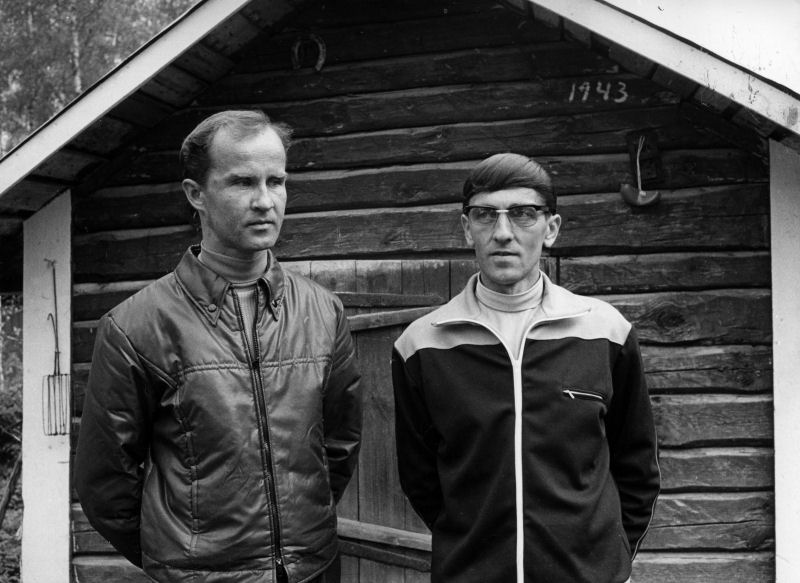
Aarno Heinonen and Esko Viljo were resting in a snowy forest clearing when they heard a buzzing sound and saw a bright object approach. They said a metallic craft descended into red-grey mist, projected a beam into the snow, and revealed a small humanoid holding a black box.
On 7 January 1970, Aarno Heinonen, 36, and Esko Viljo, 38, were skiing near Imjärvi, close to Heinola in southern Finland. Both were experienced skiers and knew the terrain. They stopped in a forest clearing during the late afternoon.
They then described a sequence that became one of Finland's best-known UFO cases: a bright approaching light, a buzzing sound, a metallic disc-like object wrapped in red-grey mist, a bright beam reaching the snow, a short humanoid within that illuminated area, coloured sparks, and an abrupt disappearance.
The men later reported significant physical symptoms and were seen by a doctor. Their account entered Finnish and Scandinavian UFO research quickly enough that it was being published and investigated during 1970–71 rather than emerging decades later.
That does not make every detail objective fact. The craft, being and beam remain witness testimony. But the correct starting point is two adult witnesses whose core story was collected close to the event.
Heinonen and Viljo said they had been skiing for roughly half an hour when they paused in a familiar clearing. It was late afternoon, cold and already growing dark.
They heard a buzzing or humming sound and saw a bright elongated light moving toward them. As it approached, they said they could make out a metallic circular or disc-like object several metres across, surrounded by reddish-grey mist.
The object descended to only a few metres above the ground. Accounts collected soon afterward put it close enough that Heinonen believed he could almost have reached it with a ski pole.
The buzzing stopped as the object hovered. That transition from a distant light to a close structured object is the evidential hinge of the case. If their distance perception was badly wrong, the entire encounter changes character. If it was broadly right, they were exceptionally close to something.
Both men notice a bright source and buzzing sound moving toward the clearing.
They describe a circular craft within reddish-grey mist descending low over the snow.
The source is reported stationary only metres away.
From an opening in the underside, Heinonen and Viljo said a bright light or luminous ball descended and formed a sharply lit circular area on the snow. Descriptions refer to a dark or black edge around the illuminated patch.
Red-grey mist thickened around the object. Coloured sparks — red, green and violet in later transcriptions — were described moving through the illuminated area.
This beam-and-mist sequence is unusual enough that it cannot be easily reduced to a generic “light in the sky.” It is also entirely testimonial: no photograph, film or preserved snow sample demonstrates it independently.

Both men described a humanoid figure roughly one metre tall standing in the illuminated area. The being was said to have thin limbs, a pale wax-like face, a hooked or unusual nose and a metallic conical helmet.
Its clothing was described as light green, with darker boots and light-coloured gauntlets. The figure held a black box or device with a pulsating yellow light directed toward Heinonen.
Heinonen later said he felt as if he were pulled backward or seized around the waist at about the moment he noticed the figure. Viljo described seeing the being for perhaps fifteen to twenty seconds.
The humanoid account is remarkable because both witnesses were present. But “two witnesses reported it” is still different from “a humanoid was independently verified.” No physical artefact, photograph or third observer confirms the being.
Heinonen later reported additional contacts, including a female “spacewoman.” Those claims emerged after the 1970 event and should remain separated from the jointly witnessed skiing encounter rather than being allowed to retroactively enlarge it.
Within minutes, Heinonen reportedly developed numbness and weakness in his right leg and had difficulty skiing. Viljo helped him back toward home. Heinonen later described nausea, vomiting, joint and back pain, headache and very dark urine.
Viljo developed facial redness or swelling, balance problems, headache and sensitivity to bright light. Both men sought medical attention. Dr Pauli Kajanoja later recalled that they appeared shocked and that Viljo was visibly red and somewhat swollen.
Kajanoja reportedly said some symptoms resembled those associated with radiation exposure, but he did not diagnose radiation injury. No dosimeter or immediate radiation survey was available, and later tests did not establish an anomalous dose.
The phrase “radiation sickness” therefore overstates the record. The safer statement is that both men reported acute physiological effects and received medical attention, while the cause remained undetermined.
Reported numbness and inability to support himself properly soon after the encounter.
Later reported vomiting, pain and unusually dark urine.
Doctor later recalled visible facial redness and swelling.
Symptoms were observed/reported; an exotic mechanism was not medically established.
Scandinavian investigators later recorded other people in nearby communities who said they saw an unusual bright light in the direction of Imjärvi around the time of the encounter. A Swedish UFO research review also preserves these regional reports.
Those sightings can support the possibility that an unusual luminous phenomenon was present in the wider area. They do not independently corroborate the close craft, beam or humanoid seen by Heinonen and Viljo.
That distinction keeps the case strong without artificially multiplying witnesses to the most extraordinary part.
A bright atmospheric or electrical event could account for some regional light reports, but not naturally for the jointly described humanoid at close range.
Two people can reinforce an interpretation under unusual conditions. The level of matching close detail is the main difficulty.
A coordinated story remains logically possible. The early investigation, medical follow-up and persistence of the joint account are the counterweights.
If the core testimony is substantially accurate, Imjärvi describes one of the closest two-witness humanoid encounters in European UFO history.
Finnish national-broadcaster archive identifies Heinonen and Viljo as the 1970 skiing witnesses and preserves a 1971 Heinonen interview.
OPEN YLE ARCHIVE →Near-contemporary UFO research account naming both men and documenting the early investigation.
OPEN EARLY ACCOUNT →Long-form Swedish case review covering medical follow-up, regional light reports and later developments.
OPEN CASE REVIEW →Concise directory preserving the classic two-witness chronology and humanoid description.
OPEN NICAP RECORD →Imjärvi is easy to sensationalise because the imagery is so vivid: red mist, coloured sparks, a small figure and a black box in a silent winter clearing. But the serious case is simpler and stronger. Two adult skiers reported the same extraordinary sequence, then both became unwell. That does not tell us what the object was. It does tell us the story cannot honestly be reduced to one man's imagination.