THE UAP MAP
REAL CASES. REAL EVIDENCE. YOUR JUDGEMENT.
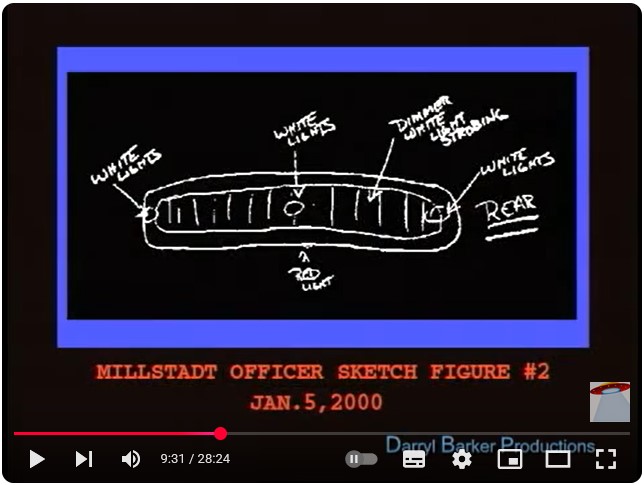
Contemporary police sketch associated with the January 2000 St. Clair County Illinois triangle sightings
FLAGSHIP CASE FILE · SOUTHWESTERN ILLINOIS · 5 JANUARY 2000

The St. Clair County police trianglemultiple officers. multiple towns. one real-time radio chain.

Before dawn, police officers across several Illinois towns began reporting a huge illuminated object moving through their jurisdictions. The case is remembered for its triangle shape — but its strongest evidence is the dispatch traffic recorded while the sightings were still happening.
AUTHENTIC WITNESS DOCUMENT · POLICE SKETCH FROM THE 5 JANUARY 2000 ILLINOIS TRIANGLE CASE. NOT AI GENERATED. NOT A MODERN RECONSTRUCTION. PUBLIC DEPLOYMENT STILL REQUIRES FINAL IMAGE-PROVENANCE / REPRODUCTION-RIGHTS CLEARANCE.
IMAGE PROVENANCE
Contemporary police-report sketch associated with the Millstadt/St. Clair County sighting sequence. It documents what an officer reported seeing; it is not a photograph of the object and should not be treated as measured geometry.
5 Jan 2000Pre-dawn Illinois
4+ police departmentsLebanon · Shiloh · Millstadt · Dupo
Real-time radioDispatch traffic preserved
No confirmed radarNo matched flight record either
01 / WHY THIS CASE MATTERS

The Illinois Triangle is not strong because police officers are infallible. It is strong because their observations unfolded across separate jurisdictions while dispatchers recorded the sequence in real time.

The first widely reported witness was civilian Melvern Noll near Highland, Illinois. His call helped trigger a police search for an unusual aerial object shortly after 4 a.m.

What followed was not one officer repeating another officer's story days later. Lebanon, Shiloh, Millstadt and Dupo personnel reported their own observations as the event was active.

The descriptions overlap — large size, bright white lights, slow movement, unusual shape and little or no sound — but they are not identical. Some officers described a triangle or arrowhead; another later viewed a high, distant light array through binoculars.

Those differences should remain visible. They are evidence, not an editorial inconvenience.

02 / THE RADIO CHAIN

The dispatch recording is the backbone of the case.

Melvern Noll reports a large illuminated object after seeing it near Highland. The report enters the regional law-enforcement system.

Lebanon Officer Ed Barton responds, initially treating the call lightly before locating a very bright object east/northeast of town.

Shiloh Officer David Martin reports seeing something unusual after being alerted by the radio traffic.

Millstadt Officer Craig Stevens reports the object in sight and tells dispatch, “It's huge.”

Dupo Officer Matt Jany observes a more distant light configuration through binoculars. His account differs in apparent altitude and distance.

A dispatch chain can correlate reports in time. It does not by itself prove that every witness saw the same physical object.
03 / OFFICER ED BARTON — LEBANON

The closest and most dramatic police account.

Barton reported two brilliant white lights that seemed to merge as he approached. He stopped his patrol car, shut down the engine and lights, and listened.

He placed the object at roughly 100 feet away and around 1,000 feet up, described a large narrow triangle with brilliant white lights at the corners and a smaller red flashing light toward the rear, and said its dark body obscured stars as it passed. His surviving sketch gives a length estimate of roughly 65–75 feet.

Barton said the object made little or no sound, pivoted without the banking expected of a conventional fixed-wing aircraft, and then accelerated toward the Shiloh area.

The preserved dispatch chronology is unusually tight: roughly 51 seconds separate Barton's report placing the object toward Shiloh and Officer David Martin's own sighting transmission at about 4:23:57 a.m.. That is strong temporal correlation, but it is still not radar proof that both officers were observing the identical physical object.

04 / OFFICER DAVID MARTIN — SHILOH

Martin reported an extra-wide triangle or arrowhead with three bright white lights and smaller red and green lights toward the rear. He placed it around 1,000 feet altitude and roughly a quarter mile away, and later estimated a width on the order of 75–100 yards.

He described the underside as irregular rather than perfectly flat, using comparisons to a battleship-like structure or visible “plumbing.” Those are witness metaphors, not measured engineering features.

Martin rolled down his window and reported hearing no engine sound. He described slow movement followed by rapid acceleration away.

Because Martin had already heard the regional radio traffic, expectation is a real factor. The value of his evidence comes from the specificity of his own account, not from pretending he observed in isolation.

05 / OFFICER CRAIG STEVENS — MILLSTADT

“It's huge.”

Stevens positioned himself near Liederkranz Park and reported a large V- or triangle-like object moving slowly at an apparent altitude of roughly 500–1,000 feet.

His description included a concave or recessed rear, a bank of white light, a red light beneath and a moving/strobing light. Unlike some other officers, Stevens reported a faint low buzz or hum.

He attempted to photograph the object with a Polaroid camera taken from his patrol car. The cold conditions and camera movement produced only a blurred light image rather than a useful structural photograph.

The failed image matters. It confirms an attempt to document the sighting, but it does not independently verify a triangular craft.

06 / OFFICER MATT JANY — DUPO

The Dupo observation is useful precisely because it does not fit perfectly.

Jany viewed a high, distant array of lights through binoculars and described white lights toward the ends with a red light nearer the middle.

His apparent altitude was much higher than the low, close descriptions from Barton, Martin and Stevens.

That could mean perspective uncertainty, a later stage of the same object's flight, or a different object entirely.

The page should not force the Dupo report into the low-flying triangle narrative just because doing so makes the story cleaner.

07 / LATER WITNESS LAYER

The core police chain was not the end of the reporting — but later sightings belong in a different evidential tier.

O'Fallon detective Mark Lopinot later described seeing a formation of roughly five synchronized amber lights spanning an area he judged wider than a 747, followed by a sharp directional change. His account is useful corroborative material, but it was not part of the same immediate dispatch sequence as Barton, Martin and Stevens.

Stephen Wonnacott also reported a later-morning observation around 6:50 a.m.. That extends the geographic and temporal footprint of the case, but it should not be retroactively fused into the pre-dawn police triangle unless independent evidence demonstrates continuity.

The distinction matters: the core case is the real-time law-enforcement chain; later witnesses are a secondary layer.

09 / WHAT WE ACTUALLY HAVE

Real-time dispatch

Police radio traffic anchors the sequence and shows officers reacting while events were still underway. Researcher Darryl Barker later obtained the CENCOM timecode material through an information request, and the chronology was reproduced in subsequent case reporting, giving the timeline a stronger documentary footing than memory alone.

Written reports and sketches

Named officers produced descriptions and drawings that can be compared rather than reconstructed solely from memory decades later.

A failed photograph

Craig Stevens attempted a Polaroid image, but the surviving result does not resolve a structured object.

No confirmed radar track

No publicly available radar record has been matched to the officers' reported object. Scott AFB and airport-related radar claims therefore have to be treated cautiously.

09 / THE POST-EVENT INVESTIGATION

The case attracted investigators because the witness chain was unusually good.

The National Institute for Discovery Science (NIDS) interviewed multiple witnesses, including police officers, and treated the case as one of the more substantial structured-craft reports of its period.

At one stage, investigators considered whether a classified or black-program platform might account for the event.

That idea was never demonstrated. NIDS later backed away from treating a covert military aircraft as an established solution.

The value of the NIDS work is not that it “proved” an exotic craft. It shows that a technically minded private investigation took the witness consistency seriously while still failing to establish a definitive platform.

11 / SCOTT AIR FORCE BASE

Nearby — but proximity is not proof of military origin.

The route reconstructed from the sightings passes through a region close to Scott Air Force Base. That has naturally fuelled speculation about an experimental or classified military platform.

Some witnesses themselves considered that possibility.

Publicly reported Air Force responses said there was no matching base activity and no confirming radar track. Some local officers later expressed doubt that nearby radar would simply have been inactive, creating an institutional tension in the retellings.

That tension is worth recording, but it is not evidence of concealment. No public radar record has surfaced tying Scott AFB to the object, and “near a military base” remains context rather than identification.

11 / THE BLIMP EXPLANATION

An advertising airship is the strongest ordinary candidate — but the historical match remains incomplete.

A large blimp can account for several otherwise striking features: apparent huge size, slow movement, bright external lights, a dark body at night and relatively low acoustic signature at distance.

The reconstructed Highland-to-Dupo corridor is on the order of 55 km over roughly an hour. A lighter-than-air craft cruising around 35–40 mph can fit that broad regional pace surprisingly well, and operating altitudes near 1,000 feet are not inherently inconsistent with several witness estimates.

The problem is documentary. No publicly produced flight log has conclusively placed a specific advertising blimp over the five-town sighting route at the relevant time.

And the closest officers described rapid acceleration, abrupt directional change and pivoting that do not fit ordinary blimp performance if their distance and timing estimates were substantially correct.

So the blimp remains the strongest physical candidate — but still a candidate rather than a matched historical identification.

The blimp hypothesis is physically plausible and should remain central. It is not the same thing as a matched historical identification.
12 / A SECOND ORDINARY POSSIBILITY

The radio network may have stitched multiple mundane objects into one apparent chase.

The assumption that one object moved from Highland through Lebanon, Shiloh, Millstadt and Dupo is a reconstruction. Dispatch chronology makes that reconstruction reasonable, but it does not prove single-object continuity.

More than one aircraft, blimp, distant light array or airport-related target could have been seen by different officers after they were primed to search the sky. Police officers are trained observers in many contexts, but they are not specialist aerial-identification analysts; professional status should improve the evidential weight of contemporaneous reporting, not make misidentification impossible.

This explanation becomes especially relevant where Jany's distant, high-altitude report differs sharply from the low, structured object described elsewhere.

13 / WHAT IS SECURE

Well supported

  • A civilian report triggered a regional police response before dawn on 5 January 2000.
  • Multiple on-duty officers in different towns independently reported unusual aerial lights or a structured object.
  • The dispatch traffic preserves their reactions in real time.
  • Barton, Martin and Stevens described a large triangle/arrowhead-like form at relatively close apparent range.
  • Police sketches survive.
  • Stevens attempted a Polaroid photograph, but it is not a useful structural image.

Not established

  • That every witness saw the same physical object.
  • A confirmed radar track tied to the sightings.
  • A measured altitude, size or speed.
  • A documented Scott AFB connection.
  • A matched advertising-blimp flight record.
  • An exotic or non-human origin.
14 / SOURCE ROOM
CONTEMPORARY WITNESS REPORT
NUFORC — January 2000 law-enforcement report
Early first-person narrative preserving the multi-department sequence, triangle description and failed photograph context.
LOCAL / HISTORICAL RECORD
Shiloh historical marker — 5 January 2000 police sighting
Local memorial record anchoring David Martin and the multi-department witness chain.
DISPATCH / FOIA CHAIN
CENCOM chronology / early witness material
Used to anchor the real-time sequence; later researchers obtained and reproduced timecoded dispatch material rather than relying solely on retrospective memory.
TECHNICAL CASE REVIEW
UAPRAD — Illinois Triangle
Modern evidence review separating dispatch evidence, witness differences, failed imagery, radar limitations and the blimp hypothesis.
COMPETITOR BENCHMARK
UAP Globe — St. Clair County Police Triangle
Strong current narrative benchmark used to identify coverage gaps; our synthesis remains independently structured around the underlying witness record.