The photograph is real. What it shows is the problem.
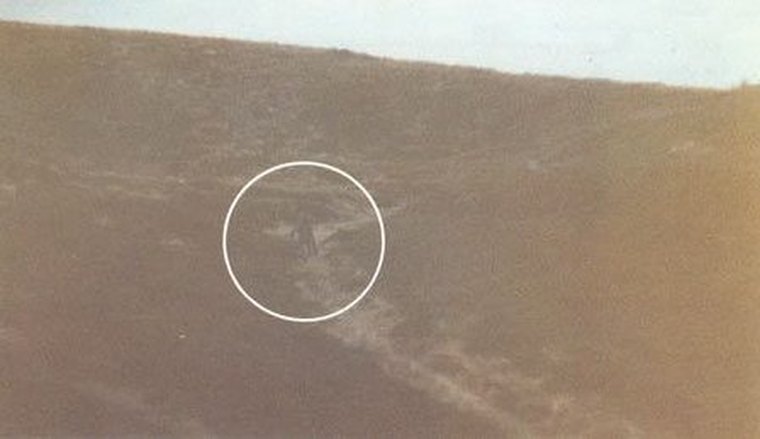
On the misty morning of 1 December 1987, a former police officer known in the literature only by the pseudonym “Philip Spencer” set out across Ilkley Moor toward East Morton. He carried a camera and a compass — ordinary equipment for a winter crossing in poor visibility — when he said he encountered a small humanoid figure near the rocks above White Wells. He raised the camera and took one photograph.
That single frame became one of Britain's most famous alleged entity photographs. Spencer then said he followed the figure and saw a domed object rise from the moor. He later reported missing time and an anomalous compass. Months afterwards, under regression hypnosis, the story expanded into a claimed abduction aboard the craft.
The evidential problem is unusually sharp: the camera captured something physically present in front of the lens, but the image is too poor to establish what that something was.
What Spencer said happened before the mythology grew.
Spencer was not publicly identified by his real name; investigators used a pseudonym. Later accounts describe him as a former police officer who had moved from London to West Yorkshire with his family. That background is relevant to witness context, but it does not make his perception infallible.
Spencer said he was walking toward East Morton carrying a camera and compass. The camera was loaded for poor-light conditions; the compass was a practical navigation aid in mist.
He described a roughly four-foot figure with an oversized head, long thin arms and unusual facial/ear features. Published retellings disagree on exact range, so the page does not convert later distance estimates into measured fact.
Spencer took a single frame of the figure. He said it gestured and moved away. The surviving photograph is small and grainy enough that those anatomical details cannot be independently read from the image.
Spencer said he followed and then saw a pale or silver domed object rise from the moor and disappear into cloud. No independent witness or photograph records the craft.
He reported that the compass now pointed south rather than north and that substantially more time had passed than he expected.
The abduction, medical examination and environmental-warning narrative emerged in substantially fuller form under hypnosis months after the conscious encounter.
The strongest object in the case is also the least informative.
Investigators reported that Kodak laboratory examination found no sign that the figure had been added later by double exposure or darkroom superimposition. That matters: the image is not simply a pasted-in figure. But it does not establish scale, species, distance or identity.
What the analysis can support
- The figure was recorded on the original exposure rather than added later in a darkroom.
- The image quality is too poor for reliable identification.
- Geoffrey Crawley and Bruce Maccabee were reportedly unable to extract decisive structural detail.
- No reliable physical size follows without a locked distance.
- A genuine first-generation exposure does not rule out a person, prop, model or staged subject physically present at the scene.
The decisive missing evidence is not another enlargement. It is original negative access, precise camera/lens data, site geometry and a defensible range to the photographed figure.
Three examinations strengthened the negative — but none identified the figure.
The photographic history is more interesting than the usual claim that “Kodak proved the alien photo was genuine.” What the examinations actually addressed was narrower: whether the surviving negative behaved like an original camera exposure and whether enhancement could recover enough information to identify the subject.
Peter Sutherst · Kodak, Hemel Hempstead
The negative was sent to Kodak's laboratory at Hemel Hempstead. Analyst Peter Sutherst reportedly judged it to be a first-exposure negative with no sign that the figure had been added later by darkroom superimposition. That is meaningful: it argues against one class of photographic trickery.
It does not rule out a posed person, model, cut-out or other real object being physically present when the shutter was pressed.
Geoffrey Crawley · photographic specialist
Geoffrey Crawley, long associated with the British Journal of Photography, attempted to extract more detail from enhanced prints. The grain and low-information image defeated the effort. The important result is negative: enhancement did not reveal the decisive anatomy that later retellings sometimes claim to see.
Bruce Maccabee · optical physicist
Bruce Maccabee also examined the material. His published position was essentially that the photograph was too grainy for a proper discriminating test. That is not an endorsement of an alien subject and not a debunking; it is a statement about the information limit of the image.
The rest of the roll
Investigator accounts say only five frames on the roll had been exposed. That is consistent with a brief outing rather than an obviously elaborate studio sequence, but it is weak contextual support rather than proof of spontaneity. The single entity frame still stands or falls on what the camera actually captured.
Best-supported conclusion: the historical photograph appears to derive from an original camera exposure. The surviving image quality is too poor to establish whether the subject was an unusual humanoid, a person, a model or some other object.
The anomaly was tested — and the experiment cuts both ways.
Spencer said the compass he carried afterwards pointed south rather than north. Researchers did not simply leave that as folklore. Through Dr Raymond Leonard at the University of Manchester Institute of Science and Technology, they arranged a January 1988 examination with Dr Spooner of UMIST's electrical engineering and electronics department.
The most revealing detail is that the laboratory experiments did not rely solely on Spencer's compass. Arthur Tomlinson brought a second, unrelated compass whose polarity had also reversed during ordinary ownership. That control matters because it shows that a reversed compass, by itself, is not unique to an anomalous encounter.
Tests reportedly found that a strong steady magnet could deflect the needle but did not permanently reverse it once removed. A rapidly applied or pulsed magnetic field could reverse the needle under controlled conditions. Spooner also demonstrated that a crude high-current coil could produce a reversal without exotic equipment — albeit dangerously.
So the experiment supports two conclusions at once: permanent reversal is a physically real effect requiring magnetisation in the opposite direction, but nothing in the compass establishes what produced that field in Spencer's case. The missing links remain pre-event calibration, immediate independent testing and continuous custody.
No government file closed this case. The documentary trail is civilian.
Ilkley Moor is sometimes described as though British authorities investigated an alien encounter. The surviving case history is different. Spencer did not generate a formal Ministry of Defence or police investigation of record; the serious follow-up was conducted by civilian UFO researchers.
Spencer initially contacted researcher Jenny Randles. The case was passed into the civilian investigation network rather than becoming an official government inquiry.
Peter Hough became the principal investigator, working with veteran Manchester researcher Arthur Tomlinson. Their notes and later books form much of the documentary backbone now repeated online.
Investigators revisited the claimed location with Spencer. Site visits can test route and terrain, but by then the scene was more than a month removed from the event.
The reversed-compass mechanism was experimentally investigated. The laboratory could reproduce polarity reversal but could not reconstruct how Spencer's compass had changed.
The most elaborate abduction material entered the record only after this later memory-recovery procedure.
The investigation is substantial by civilian UFO-case standards, but its limitations are important: there is no independent encounter witness, no official instrument record, no continuous chain on the compass and no first-generation photographic data sufficient to identify the figure.
The most dramatic part of the story is also the least independent.
In March 1988 Spencer underwent regression hypnosis with psychologist Jim Singleton. During that session, the narrative expanded into an abduction: immobilisation, being taken aboard, a medical-style examination and imagery interpreted as a warning about environmental destruction.
That material is culturally memorable — but regression hypnosis is a major contamination point. It can increase confidence and vividness without guaranteeing historical accuracy. For that reason, the abduction sequence should be treated as later recovered testimony, not as equivalent to the photograph or Spencer's first conscious recollection.
What remains before hypnosis
- Single witness on Ilkley Moor.
- One photograph of a dark figure.
- Claimed craft departure.
- Reported compass anomaly.
- Reported time discrepancy.
What emerges through hypnosis
- Immobilisation and levitation.
- Interior of the craft.
- Medical procedures.
- Environmental/apocalyptic imagery.
- More elaborate encounter sequencing.
A staged or misidentified figure remains viable.
Ilkley Moor is often presented as though Kodak “authenticated an alien.” It did not. At most, the reported laboratory finding supports that the figure existed in front of the camera when the photograph was made. A distant person, prop, model or deliberately staged subject remains compatible with that finding.
Person
A human figure at uncertain distance can change apparent proportions dramatically in a grainy frame.
Prop or model
A physical prop would also appear on an untampered negative. Film authenticity does not defeat staging.
No second witness
Nothing in the published record independently confirms the entity, craft or missing-time sequence.
The often-repeated “insurance salesman in a blue anorak” story is not, on the source trail currently available, a demonstrated identification. It should not be substituted for a proper reconstruction.