Nearly five minutes of military IR footage
AARO says the file is likely from a U.S. military platform operating inside the CENTCOM area of responsibility in 2020.
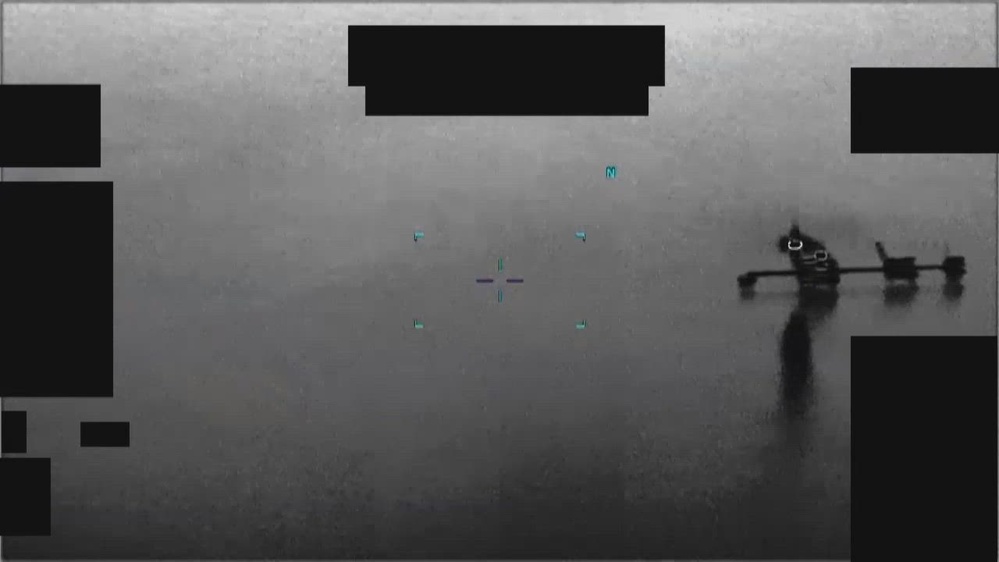
CENTCOM AOR · 1 JUNE 2020 · PURSUE PR059
For almost five minutes, a U.S. military infrared sensor follows a bright upright area of contrast against a featureless thermal background. It looks uncannily human-shaped, and a small “2m” annotation beside the target has fuelled claims that the sensor was tracking a two-metre figure. Late in the clip the return leaves the frame and the sensor pans before centring on a bright return again. The imagery is real. The humanoid, two-metre and “teleport” interpretations are not official findings.
WATCH OFFICIAL PR059 VIDEO ↗THE FAST ANSWER
AARO says the file is likely from a U.S. military platform operating inside the CENTCOM area of responsibility in 2020.
The released image genuinely looks taller than it is wide, with a rounded upper area. That appearance is real; its physical anatomy is unknown.
The “2m” overlay is undefined publicly, and no range is released. That blocks a defensible public height, speed or acceleration calculation.
THE FRAME THAT DRIVES THE CASE
The bright return is taller than it is wide, with a rounded upper portion and narrower lower body. Human vision naturally reads that arrangement as head-and-torso anatomy. But the clip contains no visible-light confirmation, no horizon, no reliable scale and no disclosed range.
OPEN PRIMARY VIDEO ↗THE RELEASE CHAIN
DVIDS lists 06.01.2020 and the file title says “NAG UAP 1 Jun 20.” The precise original mission record is not public.
AARO says a user uploaded this video to a classified network four years after the stated event date.
AARO/DVIDS published PR059 while warning that many responsive materials in the wider collection lack a substantiated chain of custody.
AARO assesses the clip is likely derived from an infrared sensor aboard a U.S. military platform. That is strong provenance language, but it is still deliberately qualified.
WHAT AARO ACTUALLY KNOWS
AARO says the uploader-defined title is “NAG UAP 1 Jun 20” and assesses the video as likely derived from an infrared sensor aboard a U.S. military platform operating within the CENTCOM area of responsibility in 2020. A user uploaded it to a classified network in June 2024.
That last point matters. The video is genuinely held and released by the U.S. government, but AARO also says many of the 51 potentially UAP-related records requested by Congress lacked a substantiated chain of custody. The public release does not identify the platform, crew, original mission, sensor model or the person who first recorded PR059.
So this is not the same evidential situation as a directly logged event with named operators and contemporaneous mission records.
THE OFFICIAL TIMELINE
An area of contrast appears. The sensor zooms and pans to keep it in view.
The sensor continues panning while a reticle highlights the area of contrast.
The contrast exits through the bottom-left quarter of the field of view.
The sensor zooms out, pans, then zooms in and cycles magnification to keep an area of contrast in view.
The official timeline describes sensor behaviour. It does not say the object teleported, accelerated extraordinarily or changed shape.
WHY IT LOOKS HUMAN
The bright upper lobe is easy to read as a head when viewed above a narrower lower return.
A tall, narrow contrast naturally reads as a standing body even when the sensor cannot resolve surface detail.
With no horizon, ground, nearby object or disclosed range, the eye has no reliable physical-size reference.
Low-detail thermal imagery can merge a small source into smooth lobes that look more anatomical than the source really is.
This does not “debunk” the humanoid appearance. It explains why appearance alone cannot establish humanoid structure.
THE “2M” QUESTION
A small cyan “2m” annotation is visible beside the target in released imagery. Viewers understandably read that as “two metres,” and that interpretation is central to the humanoid narrative.
But the public release does not define the field, explain whether it is a range-derived dimension, an operator annotation, a gate/box scale, a sensor setting or something else. Without a disclosed sensor manual and geometry, treating “2m” as a confirmed physical height would be too strong.
If it really were a validated two-metre object holding position aloft with no visible lift or propulsion, the case would become much harder to explain conventionally. At present, however, the public release does not tell us what “2m” measures. The correct treatment is therefore: provocative overlay, unknown meaning.
THE “TELEPORT” / 600-G CLAIM
Coverage after release focused on the moment around 03:38 when the tracked return exits and the sensor pans before settling on another bright return. One widely circulated third-party analysis claimed the apparent relocation implied acceleration above 600 g and possible shape change.
That calculation cannot be established from the public file because the true range is unknown. Angular motion across a sensor display does not become linear velocity until distance, platform motion and viewing geometry are known. The reacquired return also has to be proven to be the same physical object before any “jump” can be measured.
The strongest defensible wording is: the sensor loses one tracked contrast and later centres on a bright return elsewhere in the field. Anything beyond that is interpretation.
Native sensor video, range data, platform position and attitude, the sensor manual defining the “2m” field, original mission records, operator notes and confirmation that the reacquired return is the same target.
THE OTHER “HUMANOID” COMPARISON
After PR059 was released, researchers began comparing it with a much-discussed 2015 California clip showing another upright, apparently humanoid form aloft. Some commentators interpret that older footage as a balloon or inflatable-type object.
The resemblance is useful because it shows that upright “figure” morphology can occur in airborne imagery without establishing a literal person-shaped craft or entity. But there is no official document connecting the two events, and a visual look-alike does not identify PR059.
WHAT COULD IT HAVE BEEN?
| Candidate | Why it can fit | What is missing |
|---|---|---|
| Balloon / cluster | A slowly drifting warm or reflective target can appear nearly stationary and unresolved in infrared. | Wind, range, altitude and visible-light imagery. |
| Aircraft / drone | A distant target on a near-radial course can show little lateral motion while remaining trackable. | Traffic data, range and platform geometry. |
| Biological target | Low-resolution IR can smear a small warm target into an upright-looking blob. | Range, wingbeat-scale frames and native-resolution data. |
| Sensor / tracking effect | Loss of lock, panning, magnification changes and reacquisition can produce dramatic apparent jumps. | Raw metadata and proof that the reacquired return is the same target. |
COMPETITOR PASS
UAP Globe does an excellent job surfacing the nearly five-minute duration, the upright appearance, the “2m” annotation, the chain-of-custody caveat and the later extreme-acceleration claims. It also correctly labels the humanoid reading as public interpretation rather than official terminology.
The UAP Map's advantage is to make the hierarchy even harder to blur: official file provenance first; release-chain caveat second; sensor appearance third; the undefined “2m” overlay fourth; third-party acceleration claims last. We also explain why the shape reads as humanoid, surface the 2015 balloon/inflatable comparison without treating it as an identification, keep the CENTCOM geography straight and reject the unsupported “Florida” placement.
SOURCE ROOM