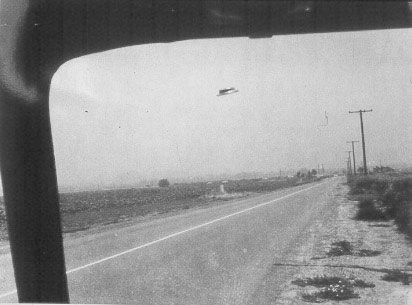
Few classic UFO photographs come with a sequence, a named occupational witness, an Air Force file, civilian photo analysis and original prints that later re-entered the evidence chain.
Rex Heflin, then 38, worked for the Orange County Road Department as a highway/traffic investigator. His job required photographic documentation of roadway obstructions and hazards, so the Polaroid camera was normal work equipment rather than something carried for UFO hunting.
On 3 August 1965 he was near Myford Road and Walnut Avenue, roughly half a mile north of Marine Corps Air Station El Toro, reportedly preparing to photograph a railroad-crossing sign partly obscured by branches. Heflin said he then noticed a metallic, disc-like object crossing the area and took three photographs from inside his vehicle. After it departed, he drove toward a dark ring-like formation and took a fourth photograph outside the van.
The case became famous because the first three images show an apparently structured object changing position against a real landscape. But photographs do not explain themselves. The distance, size and physical nature of the object were never independently measured.
The central question is therefore not “are these famous UFO photos?” They plainly are. The useful question is what can the original sequence, its custody history and the competing analyses actually establish?
The sequence is stronger than a single image — but each frame carries different evidential weight.
Heflin said he took the first frame through the front windshield. The object appears above the road landscape while the camera remains inside the work vehicle.
As the object moved, Heflin shifted to the passenger window. He later described a darker underside and a rotating greenish-white light or beam beneath it.
The third frame shows the object farther across the scene. It is often used in geometry and string/model arguments because vehicle structure and the side mirror provide foreground reference.
After the object disappeared, Heflin photographed a dark ring-like formation in the sky. Its connection to the object was his interpretation, not an independently demonstrated physical link.
Heflin signed a written statement on 18 September 1965, giving a contemporary account of the sighting and photography sequence. That statement matters because it fixes key details before later books, documentaries and internet retellings could reshape the narrative.
The Santa Ana Register subsequently published the first three photographs on 20 September. Local reporting also sought comment from Marine Corps Air Station El Toro, whose officials reportedly said they had no corresponding sighting and denied that the object was one of their aircraft.
Case histories also distinguish an early, identifiable military contact from the later mystery-men episode: Marine Corps intelligence personnel reportedly interviewed Heflin and temporarily obtained the first three photographs for copying before returning them.
That episode should not be conflated with the later men who allegedly represented themselves as government or NORAD personnel and removed original photographs from Heflin's possession. One is an identifiable military-investigation episode in the case record; the other is an unresolved custody story with disputed identities.
Case investigators identify the camera as a Polaroid Model 101 using Type 107 black-and-white film rated around ASA 3000. The camera used a roughly 114 mm lens and an automatic light-metering system.
Those details matter because depth of field, focus, exposure and motion blur are central to arguments about whether the object was a small nearby model or a more distant object.
The first three photographs were taken from inside the vehicle, while the fourth was taken outdoors. That difference changes how an automatic meter renders the sky and became important when investigators argued over why cloud structure appeared different between the object frames and the smoke-ring frame.
Camera specifications can constrain interpretations. They do not supply a missing range measurement.
The U.S. National Archives catalogs a Heflin image from a scientific study of UFO photographs and describes it as Santa Ana photo No. 1, looking north-northeast down Myford Road through the front windshield of Heflin's truck.
That archive record is important for provenance: the Heflin photograph entered a formal U.S. documentary collection. It does not mean the National Archives authenticated an extraterrestrial craft. The same scientific-study series also includes deliberately fabricated comparison images used to test photographic interpretation.
The government record and the civilian investigation did not converge on the same interpretation.
Physicist William K. Hartmann, working within the University of Colorado UFO study later associated with the Condon Report, treated the Heflin photographs as a serious photographic problem rather than dismissing them out of hand.
Hartmann experimented with a small object — commonly described in case literature as a Leica lens cap suspended on fine thread roughly two feet from the camera — and found that the resulting image could resemble Heflin's Photo 2. His work strengthened the argument that a nearby small object could imitate a distant craft.
The key technical point is depth of field. Tests with the Polaroid work camera indicated that even with the camera focused at or near infinity, sufficiently small nearby objects could still appear acceptably sharp. That directly undercuts a simplistic argument that “the object is in focus, therefore it must be distant.”
Hartmann's reconstruction remains one of the strongest skeptical elements in the entire case. But resemblance is not identity. His experiment showed a feasible mechanism; it did not recover the alleged model, thread, launch setup or a witness to fabrication.
According to the long-established case history, three original object photographs left Heflin's possession in September 1965 after men claiming government or NORAD affiliation obtained them. NORAD later reportedly denied knowledge of the men or the photographs.
That story is historically important but should be described precisely: the identity and authority of the men were never established publicly. It is therefore evidence of a custody break, not proof of an official confiscation programme.
For years, investigators worked from first-generation prints, negatives made from the originals and other copies. Later summaries disagree on the exact date of return: some case histories place the mysterious return of the originals in 1993, while NICAP's directory places it in 1997. Rather than silently choose one date, this page preserves the discrepancy.
What is secure is that original Polaroid material was back in investigator hands before the published 2000 reanalysis. That materially improved the forensic situation because claims tied to copying, enlargement, contrast enhancement or alleged support lines could be tested against original media.
A suspended or thrown model is the central skeptical challenge because it can reproduce the basic visual form without exotic technology.
William Spaulding of Ground Saucer Watch later argued that enlarged copies showed a thin linear feature above the object, consistent with a support thread and therefore a small suspended model. That claim became one of the most frequently repeated “proof of hoax” arguments attached to the Heflin photographs.
Project Blue Book's short-range tray experiment and Hartmann's later lens-cap/thread reconstruction point in the same broad direction: a small nearby object is physically capable of producing a Heflin-like image. Because no range was measured, that possibility cannot be dismissed.
In 1993, photographic analyst Jeffrey Sainio re-examined Spaulding's string claim and argued that the apparent line was not persuasive evidence of a physical support. The later original-Polaroid work by Druffel, Wood and Kelson likewise reported no string on the original images and treated the suspicious feature as more consistent with copy-generation or enhancement artifacts.
That rebuttal directly weakens the narrow claim that a visible support line is physically present on the original photographs. It does not eliminate every model hypothesis: a thrown object, support outside the photographed area, a line too fine to resolve, or another setup remain conceptually possible.
A 2000 paper in the Journal of Scientific Exploration by Ann Druffel, Robert M. Wood and Eric Kelson re-examined the Heflin photographs using the original images and modern digital techniques.
The authors reported no support for the proposed suspension line, argued that cloud and image details across the sequence were consistent with the witness chronology, and treated several previously suspicious features as copy-generation artifacts rather than evidence of fakery.
Those are the authors' findings, not a universal scientific verdict. Their work is valuable because it reintroduced original media into an argument that had depended heavily on copies. But it cannot recover a missing range, an independent direct witness or a physical sample of the photographed object.
The strongest information gain is therefore procedural: some skeptical claims became testable against originals, while the core identity question remained open.
Heflin reported that his work radio failed during the sighting and operated again after the object had gone.
NICAP and James McDonald investigated the radio-interference story and reported that Heflin's supervisor, Herm Kimmel, described abnormal radio behaviour in the same general period. Later case literature treats this as possible electromagnetic corroboration.
The public record does not provide a preserved instrument log proving that a field from the photographed object caused the outage. Radio malfunction is therefore a relevant associated report, not a calibrated sensor detection.
Heflin reports seeing a disc-like object near Myford Road while working for Orange County and takes three Polaroids from his vehicle, followed by a fourth image of a dark ring in the sky.
Heflin signs a written statement describing the encounter and photography sequence.
The Santa Ana Register publishes the first three images. Local reporting contacts El Toro; officials reportedly deny that the object was one of their aircraft and report no matching sighting.
NICAP, military investigators and several photographic analysts examine the case. Project Blue Book ultimately lists it as a hoax, while civilian investigators dispute that conclusion.
James E. McDonald and William Hartmann revisit the case; Robert Nathan carries out unofficial enhancement work using JPL equipment.
Model/string and image-artifact arguments become central as researchers work largely from copies rather than the original three object Polaroids.
Later case histories disagree on the exact return date of the missing originals: some place the return in 1993, while NICAP's directory gives 1997. The discrepancy is preserved rather than silently harmonized.
Druffel, Wood and Kelson publish a reanalysis in the Journal of Scientific Exploration using original images and modern digital techniques.
Were the Heflin photos proven fake?
No single public analysis has produced a universally accepted demonstration of how the sequence was fabricated. Project Blue Book classified the case as a hoax, and model/string hypotheses remain material counterarguments.
Were the original photos lost?
Three object Polaroids left Heflin's custody in 1965 and were unavailable to researchers for decades. Original material later returned in the 1990s and was used in later analysis.
What camera did Heflin use?
A Polaroid Model 101 using very fast black-and-white Type 107 film, commonly cited as ASA 3000.
Did JPL authenticate the UFO?
No. Robert Nathan used JPL equipment for analysis, but his work was unofficial and should not be represented as a Jet Propulsion Laboratory institutional finding.
Was a string found above the object?
Some later copies were interpreted as showing a support line. Analysts with access to original Polaroids later disputed that interpretation.
How big was the object?
There is no secure range measurement, so physical size estimates depend on assumptions about distance.
The strongest Heflin page has to show the custody chain and the disagreement, not just reproduce the famous pictures.