Months before Kenneth Arnold made “flying discs” a household phrase, Swedish civilians, pilots and military personnel were reporting rocket-, cigar- and fireball-like objects crossing Scandinavia. The Swedish state investigated. Lakes were searched. Radar reports entered the file. U.S. intelligence sent a Top Secret assessment to President Truman. Many sightings were probably meteors or other ordinary phenomena. A smaller residue remained harder to dismiss.
PRE-1947 WAVE · SWEDISH DEFENCE STAFF · RADAR CLAIMS · LAKE IMPACT SEARCHES · U.S. INTELLIGENCE · VANDENBERG MEMO · METEOR EXPLANATIONS · NO VERIFIED RECOVERED MISSILE
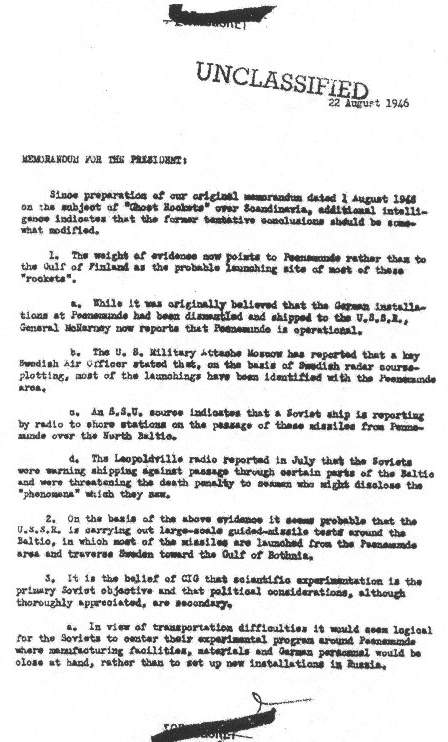
“Memorandum for the President” · 22 August 1946 · Central Intelligence Group / U.S. government · declassified. Genuine case document recording the contemporary U.S. assessment that the weight of evidence then pointed toward guided-missile testing from the Peenemünde area. The memo records an intelligence judgement, not proof of Soviet responsibility.
1946A months-long Scandinavian wave rather than one single sighting.
~1,000 FILEDSwedish Defence Staff eventually accumulated a very large case corpus.
19 JULLake Kölmjärv became the best-known reported impact search.
22–23 AUGVandenberg's intelligence assessment was forwarded to President Truman.
THE WAVE
Sweden started receiving reports before the “flying saucer” era existed.
During the spring and summer of 1946, unusual aerial reports began accumulating across Sweden and neighbouring Scandinavia.
Witnesses used the vocabulary available to them.
They described rockets, bombs, fireballs, glowing cigars and missile-like objects.
The Swedish press popularised the term spökraketer — ghost rockets.
This was a category, not one object. The reports varied too widely in shape, speed, altitude, sound and behaviour to assume a single cause.
THE REPORTING SYSTEM
The Swedish military formalised the investigation.
On 12 June 1946, the Swedish Defence Staff instructed military units to report unusual aerial phenomena upward through official channels.
By July, a standing inter-agency committee had been established involving defence, air, naval, research and signals-intelligence bodies.
The surviving Swedish archive eventually grew to an enormous documentary record.
That institutional response is genuine evidence of concern.
It shows that officials believed the reports deserved investigation. It does not show that they had identified an exotic technology.
10 JULY 1946
A standing committee
The Swedish response was not an improvised press exercise. A standing committee drew together the Defence Staff, Aviation Staff, Naval Administration, Air Administration, Defence Research Institution and Defence Radio Institution, with officers dispatched to assess stronger cases.
ARCHIVE SCALE
997 registered observations
Later archive work places the Swedish Defence Staff total at about 997 observations, including roughly 225 daylight reports. That scale is useful, but it must not be converted into 997 sightings of one craft or one technology.
THE PEAK DAYS
Some of the biggest “waves” may have been celestial.
Swedish investigators noted major national peaks on 9 July and 11 August.
Those are exactly the kinds of clustered mass reports that can result from bright meteors or bolides being seen across huge areas.
The 11 August wave also falls close to the annual Perseid meteor maximum.
Many observers themselves concluded that what they had seen was probably astronomical.
A nationwide witness surge can strengthen a natural explanation. One bright bolide can be seen from hundreds of kilometres away and described differently from every viewing angle.
9 JULY CLUSTER
One event, many descriptions.
Reports arrived across central Sweden within a compressed daytime window. Witnesses described comet-like, oblong, cigar- and sugarloaf-shaped phenomena, including apparent descents toward lakes. The near-simultaneous geography is exactly why a major daylight bolide remains a powerful explanation for much of that cluster.
11 AUGUST · BERGENDORFF LETTER
A dramatic sighting — whose witness favoured a meteor.
P. Bergendorff reported a glowing bar-like object over Stockholm, coloured from red-orange at the front through green toward the rear. His letter survives in the Defence Staff file. Importantly, Bergendorff himself argued that what he had seen was probably a meteor.
Why this matters: a large witness count can make a wave look stronger while actually strengthening a natural explanation when many observers are describing the same astronomical event from widely separated locations.
THE REPORTS THAT DID NOT LOOK LIKE METEORS
Low, dark and apparently structured observations remained.
Not every report was a fleeting light.
Some witnesses described dark or metallic cigar-shaped forms, low-altitude objects, apparent wings and sustained horizontal flight.
A Swedish Air Force pilot on 14 August reported a dark cigar-like object in daylight, without visible wings or exhaust, moving below or near his flight level.
That kind of report is much harder to fold neatly into a meteor shower.
The wave becomes interesting only after the obvious celestial cases are stripped away.
14 AUGUST · SWEDISH AIR FORCE
The strongest daylight residual.
At about 10:00 a.m., a Swedish Air Force pilot reported a dark cigar-shaped object while flying over central Sweden. The later U.S. intelligence review gives the reported object as about 50 ft long and 3 ft in diameter, roughly 200 ft above the aircraft and about 6,500 ft away, moving at an estimated 400 mph, with no visible wings, rudder, projecting parts, flame or light.
THE BUILT-IN DOUBT
The report also contained its own problem.
The pilot said the object kept a constant height above the terrain. The 1947 War Department analyst specifically questioned that detail, arguing that an apparently wingless missile should not have been able to contour hilly terrain in that way. The best residual report was therefore also challenged by the official analyst who highlighted it.
THE RADAR CLAIMS
Radar entered the story — but the raw evidence needs discipline.
Later summaries state that Swedish military radar tracked some ghost-rocket targets and that course plotting influenced the belief that launches might originate near Peenemünde.
The 22 August U.S. memorandum explicitly cites a Swedish air officer saying radar course plots pointed toward that area.
That makes radar part of the historical intelligence record.
But the complete raw plots, instrument settings and event-by-event correlations are not yet reconstructed in this production pass.
Do not turn “radar was discussed in intelligence reporting” into “every major sighting had radar confirmation.”
The Swedish committee's closing record said information had come from visual observations, radar trackings, radio observations and special sources. That establishes radar as a real investigative lane. It does not establish that every famous sighting had a matching radar track, and surviving public material still does not provide a complete event-by-event raw radar reconstruction.
KÖLMJÄRV
Two witnesses said something went into the lake.
On 19 July 1946, witnesses at Lake Kölmjärv in northern Sweden reported a grey, rocket-like object descending into the water.
A large splash or water column was seen.
The Swedish military mounted a serious search using personnel and equipment over the following weeks.
The lake bottom was investigated and disturbed areas were reported.
No verified missile, craft or substantial technological debris was recovered.
The search was real. The recovered rocket was not.
THE SEARCH
This was not a token inspection.
Lieutenant Karl-Gösta Bartoll's team searched for weeks. Later archival accounts describe a non-metallic raft designed not to interfere with instruments, systematic lake-bed work and tens of thousands of core samples. Disturbed sediment and a bottom feature were reported.
THE RESULT
No metal. No confirmed projectile.
Despite the seriousness of the operation, the search did not recover a verified rocket or technological body. Bartoll later remained convinced that a physical object had entered the lake, but that retrospective belief must be kept separate from what the search physically produced.
THE IMPACT PROBLEM
Dozens of alleged crashes produced no secure projectile.
The Swedish investigation received many impact reports.
Fragments were recovered from a number of sites and examined by defence researchers.
The final committee record did not establish that any of those fragments came from a rocket or exotic aerial vehicle.
That absence weighs heavily against the idea of hundreds of physical missiles repeatedly crashing across Scandinavia.
A reported impact is not physical evidence until the recovered material is tied to the object.
The closing Swedish review referred to roughly 100 reported impacts, with material recovered from around 30. Defence researchers examined the fragments, but no sample was established as coming from a projectile or rocket. Some publicly discussed material proved to be ordinary coke or slag.
WASHINGTON TAKES NOTICE
The Ghost Rockets reached President Truman's desk.
On 22 August 1946, Director of Central Intelligence Hoyt S. Vandenberg signed a memorandum for President Harry Truman.
Admiral William D. Leahy forwarded it the following day.
The memorandum states that the “weight of evidence” then pointed toward the Peenemünde area as the probable origin of most of the reported missiles.
It proposed large-scale Soviet guided-missile experimentation around the Baltic.
This is powerful evidence that U.S. intelligence took the problem seriously. It is not powerful evidence that the Soviet missile theory was correct.
Hoyt S. Vandenberg's memorandum said the weight of evidence then pointed toward Peenemünde as the probable origin of most reported missiles, based partly on Swedish intelligence reporting and radar-course claims. This was a live intelligence judgement during the wave.
9 JANUARY 1947 · WAR DEPARTMENT
The later intelligence review was more cautious.
The Secret War Department review later released as DOW-UAP-D099 did not simply endorse Sweden's private Peenemünde belief. It explicitly noted that Swedish officials had not produced evidence proving that claim and that U.S. personnel in Sweden had seen no fragments, impact points or other direct proof of guided missiles.
WHY PEENEMÜNDE?
The explanation made Cold War sense.
Peenemünde had been the centre of Nazi Germany's V-weapon programme.
After the war, Soviet forces controlled the region and had access to German personnel, records and technology.
To intelligence officers in 1946, an improved V-1 or other guided weapon being tested over the Baltic was a plausible security threat.
Reports of rocket-like forms, long-range flight and apparent controlled turns seemed to reinforce the theory.
The 1947 U.S. review considered the missile hypothesis seriously but did not treat Peenemünde as proven. It discussed alternative Baltic launch areas and argued that a V-1-type weapon stripped of a warhead and fitted with an improved motor might theoretically reach about 500 miles. Three witnesses reportedly described a sound like an outboard motor — suggestive of a pulse-jet — while many other reports were silent. The missile model could fit a small subset far better than the whole wave.
THE RANGE PROBLEM
The hardware did not fit every report.
The standard V-1 had nowhere near the range needed to explain ghost-rocket reports deep into northern Sweden if launched from Peenemünde.
That does not rule out every possible experimental missile.
It does weaken claims that known captured German V-1 technology neatly explains the whole Scandinavian wave.
Likewise, no verified launch programme has been tied to the full reported chronology.
A Cold War intelligence hypothesis can be reasonable at the time and still turn out not to be demonstrated.
WAR DEPARTMENT ESTIMATE
Only a handful were judged potentially “real” missiles.
The 1947 intelligence review's conclusion was modest: the best evidence suggested only two or three real low-flying V-1-type missile incidents — perhaps as many as five or ten. It assigned the high-altitude reports mainly to meteors or fireworks.
WHAT THAT MEANS
The missile theory was never a wave-wide solution.
Even the U.S. intelligence document most sympathetic to experimental missiles effectively divided the case into different populations. That supports the page's central thesis: “ghost rockets” was a reporting category, not necessarily one phenomenon.
THE SWEDISH CONCLUSION
Most could be ordinary. Not all could simply be waved away.
By the end of 1946, Swedish investigators had concluded that a large proportion of the luminous reports could be astronomical or otherwise conventional.
At the same time, the committee stated that it could not dismiss every residual observation as public imagination.
That is a much more careful position than either extreme often applied later.
“Mostly explained” and “completely explained” are not the same finding.
23 DECEMBER 1946
No proof of rocket testing.
After fifteen committee meetings and months of work, the Swedish closing assessment said the investigation had produced no actual proof that rocket-projectile testing had taken place over Sweden.
BUT NOT TOTAL DISMISSAL
A residual remained.
The same review said the committee could not reduce every remaining fact to public imagination. That is the useful historical position: a large explained component, a failed physical-recovery trail, and a smaller unresolved residue.
WHAT THE WAVE MAY HAVE CONTAINED
LIKELY MANY
Meteors / bolides
Mass simultaneous luminous reports, especially near known meteor activity, fit this class well.
LIKELY SOME
Aircraft
Post-war military and civilian traffic can account for portions of a heterogeneous national wave.
POSSIBLE
Experimental missiles
Cold War weapon testing was a serious contemporary hypothesis, but no complete launch programme has been proven for the residual cases.
UNCERTAIN
Radar targets
Some radar claims are historically documented, but event-level instrument evidence still needs reconstruction.
UNCERTAIN
Impact cases
Lake and ground searches were real, but no verified craft or missile was recovered.
RESIDUE
Low structured objects
A minority of daylight/low-altitude reports remain the hardest to explain as simple celestial events.
THE PHOTOGRAPH PROBLEM
The famous “ghost rocket” photograph is not secure event proof.
A well-known 1946 Swedish photograph attributed to Erik Reuterswärd is often reproduced as an image of an actual ghost rocket.
Its interpretation is contested, and Reuterswärd himself has been reported as suspecting that the image showed a meteor.
No photograph of a ghost rocket has been authenticated strongly enough in the current production pass to use as unquestioned object evidence.
That is why this page leads with a genuine government document rather than a disputed object photograph.
The Erik Reuterswärd image from 9 July 1946 is historically important but evidentially awkward: it is often reproduced as a ghost-rocket photograph, yet Reuterswärd himself was reported to have suspected a meteor. No image should be presented here as a confirmed photograph of a technological “ghost rocket.”
WHY THIS CASE STILL MATTERS
It predates the flying-disc narrative.
Ghost Rockets complicates the idea that modern UFO reporting began only after the press popularised Kenneth Arnold's 1947 sighting.
Scandinavia had already experienced a major anomalous-aerial wave.
Military officials had created reporting systems.
Scientists were involved.
Radar and impact claims were being discussed.
And U.S. intelligence was sending Top Secret assessments to the President.
Whatever the objects were, the institutional history is unquestionably real.
WHAT REMAINS
The wave was real. “The Ghost Rockets” may never have been one thing.
The strongest reading of 1946 is not that Sweden was invaded by one mysterious technology.
It is that a genuine national reporting wave mixed meteors, ordinary aerial phenomena, Cold War fears, possible experimental activity and a smaller group of observations that resisted easy classification.
No verified rocket was recovered.
No single explanation cleanly accounts for every report.
The governments were right to investigate. That is not the same as saying they found the answer.
SOURCE ROOM
Follow the intelligence trail and the Swedish archive.