Huge, low and structured
Many witnesses interpreted separate lights and debris as a single enormous craft, sometimes triangular and apparently close to the ground.
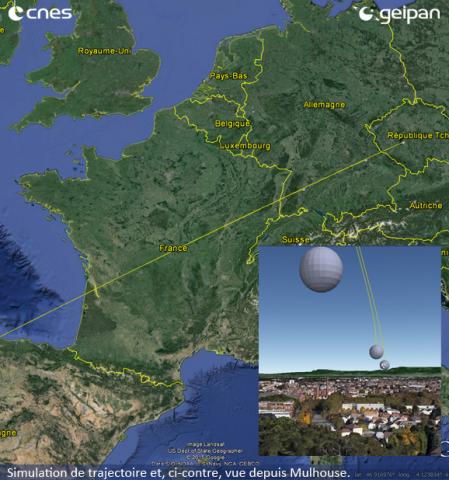
FRANCE · 5 NOVEMBER 1990 · MASS SIGHTING
From the Bay of Biscay to Alsace, witnesses described an immense luminous structure: triangles, beams, hovering impressions, road illumination and an object that seemed frighteningly low. GEIPAN later classified the national event Category A — an identified Soviet Proton third-stage re-entry. The challenge is not choosing between “the witnesses” and “the rocket.” It is explaining why a known re-entry produced testimony this strange.
THE FAST ANSWER
Many witnesses interpreted separate lights and debris as a single enormous craft, sometimes triangular and apparently close to the ground.
GEIPAN identifies the source as the atmospheric re-entry of the third stage of a Soviet Proton launch vehicle.
Because the real source is unusually well constrained, the case shows how badly distance, altitude, size and structure can be misread at night.
WHAT WITNESSES ACTUALLY REPORTED
Many witnesses mentally joined the luminous points into one enormous structured craft rather than seeing them as independent fragments.
Some reports placed the phenomenon close to rooftops, roads or the ground even though GEIPAN’s reconstructed debris cloud was tens of kilometres high.
Ufological case collections include apparent stationary phases, light beams and illumination effects that sound unlike a simple textbook re-entry.
Those reports are not inconvenient details to delete. They are the reason this case is so useful: the source is unusually well constrained, yet the human descriptions still spread into apparently exotic territory. The page now shows both an official trajectory visual and a genuine witness drawing so the reader can see that tension directly.
OPEN GEIPAN GENDARMERIE / WITNESS DOCUMENT CORPUS ↗WHAT HAPPENED
Gendarmerie units and CNES receive calls describing a strange luminous phenomenon crossing the country.
A specialist observer alerts SEPRA that the event matches orbital object 1990-094C.
NASA identifies the 5 November re-entry of object 20925 / 1990-094C.
CNES orbit specialists confirm the cross-France trajectory and release the explanation to press agencies.
THE UFO INVESTIGATORS’ COUNTER-CASE
French UFO investigators gathered close-range and apparently non-ballistic reports involving low altitude, stationary phases and trajectories they believed did not match the re-entry track.
A large compilation argued that a subset of the night’s observations represented separate unidentified phenomena even while accepting that the Proton re-entry also occurred.
GEIPAN’s later response is that when the full body of testimony is analysed together, the extreme descriptions sit at the tails of an otherwise coherent distribution of direction, timing, apparent altitude and appearance. In other words, unusual witness accounts are expected at the edges of a very large sample observing one rare and visually confusing event.
That is the argument worth testing: not “the witnesses were wrong,” but whether a single known stimulus can naturally generate a minority of very strange reports when more than a thousand people see it from different locations.
WHY DID IT LOOK LIKE A CRAFT?
A fragmented rocket stage does not enter as one neat point. GEIPAN says the debris cloud could stretch across tens of kilometres, with many incandescent pieces and trails moving together across the sky.
At night, with no familiar scale reference, the brain can connect those lights into a single structured object. That is how a high-altitude debris field can become an apparently solid, enormous triangle moving slowly at low altitude.
The witnesses did not have to be careless or unreliable. They were making a normal perceptual inference from an extremely unusual visual scene.
THE 100-METRE / 90-KILOMETRE PROBLEM
Some witnesses placed the phenomenon extremely close because it looked bright, large and structured against a dark sky.
GEIPAN’s 2015 reconstruction estimates fragmentation beginning at roughly 94 km altitude over the Bay of Biscay.
The luminous debris cloud then crossed France while descending through tens of kilometres of altitude.
Brightness provides a powerful but unreliable subconscious distance cue when the observer has no known object, horizon reference or depth information.
This is why the event is such a powerful control case: the physical source can be reconstructed independently, letting us compare known geometry with what witnesses believed they were seeing.
THE OFFICIAL IDENTIFICATION
| Evidence | What it adds |
|---|---|
| NASA re-entry record | NASA reported the 5 November re-entry of 20925 / 1990-094C, associated with the Gorizont 21 launch. |
| CNES orbitography | CNES confirmed a trajectory crossing France from the Bay of Biscay toward Alsace; GEIPAN’s later simulation estimates fragmentation beginning at roughly 94 km altitude over the Bay of Biscay. |
| Timing | The known re-entry coincided with the national wave of observations. |
| Appearance | A fragmented metallic stage can generate numerous luminous pieces and trails spread over a very large area. |
| GEIPAN classification | The national case is classified A — explained without ambiguity. |
BUT WHAT ABOUT THE OUTLIERS?
Ufological investigations collected reports of apparently stationary objects, very low altitude, beams illuminating roads, different directions of travel and other details that do not sound like a simple textbook re-entry.
GEIPAN's later position is that these reports should not be discarded — but they also should not be isolated from the full witness distribution. Its argument is that extreme descriptions sit at the tails of a much larger population of accounts produced by one exceptionally bright, extended and unfamiliar event.
That is an important distinction. The explanation does not require pretending every witness described exactly the same thing. It asks whether the variation is larger than we should expect from hundreds of independent night-time observations of the same extraordinary stimulus.
WHY THIS CASE MATTERS TO UFO RESEARCH
Most famous mass sightings begin with an unknown cause and remain debated. Here, the external event is unusually well anchored by orbital data, national investigative files, gendarmerie reports and later CNES modelling.
That makes 5 November 1990 valuable even to readers who remain open to extraordinary UAP explanations elsewhere. It shows that multiple witnesses, structured-shape reports, low-altitude impressions and apparently impossible scale can all emerge from an event whose physical origin is independently known.
A strong conventional identification in one case is not a verdict on other cases. It is a calibration point for how we weigh eyewitness geometry and apparent structure.
FIRST COMPETITOR POSITION
The page should preserve what made the event feel extraordinary to witnesses while also giving the Proton-stage identification the strength of evidence it deserves. V2 now does what the strongest competitor pages only partly do: it gives the close-range, beam, hovering and “separate UFO” counter-case real space, then answers it with GEIPAN’s statistical-distribution argument and a concrete 100-metre-versus-90-kilometre perception explainer.
SOURCE ROOM