Line-of-sight failure
The Scouts could not clearly see the alleged close-range event from the road during the reenactment.
MILITARY TRAIL, PALM BEACH COUNTY · 19 AUGUST 1952
Scoutmaster D.S. “Sonny” DesVergers said a dark circular object hovered above him in a palmetto clearing and engulfed him in a red flare-like mist. He emerged frightened, singed and burned. Project Blue Book flew investigators to Florida, examined his clothing, machete and the site — and eventually concluded the case was a hoax. The awkward part: they never demonstrated exactly how it was done.
THE LIGHTS
On the night of 19 August 1952, thirty-year-old scoutmaster D.S. “Sonny” DesVergers was driving three Boy Scouts home along Military Trail near West Palm Beach.
He noticed unusual lights toward the palmetto and pine country beside the road.
At least one of the boys also reported seeing lights, and DesVergers turned back.
He parked and told the Scouts to stay with the car while he went into the brush to investigate what he thought might be a downed aircraft or fire.
Critical witness correction: the Scouts did not independently accompany DesVergers to the claimed close-range object. Their strongest evidential role is the lights before he entered the grove and his condition after he came back.
THE CLEARING
After pushing through thick palmetto, DesVergers said he entered a clearing and noticed heat, a pungent smell and the feeling that he was being watched.
Looking up, he said a large dark circular object was hovering above him.
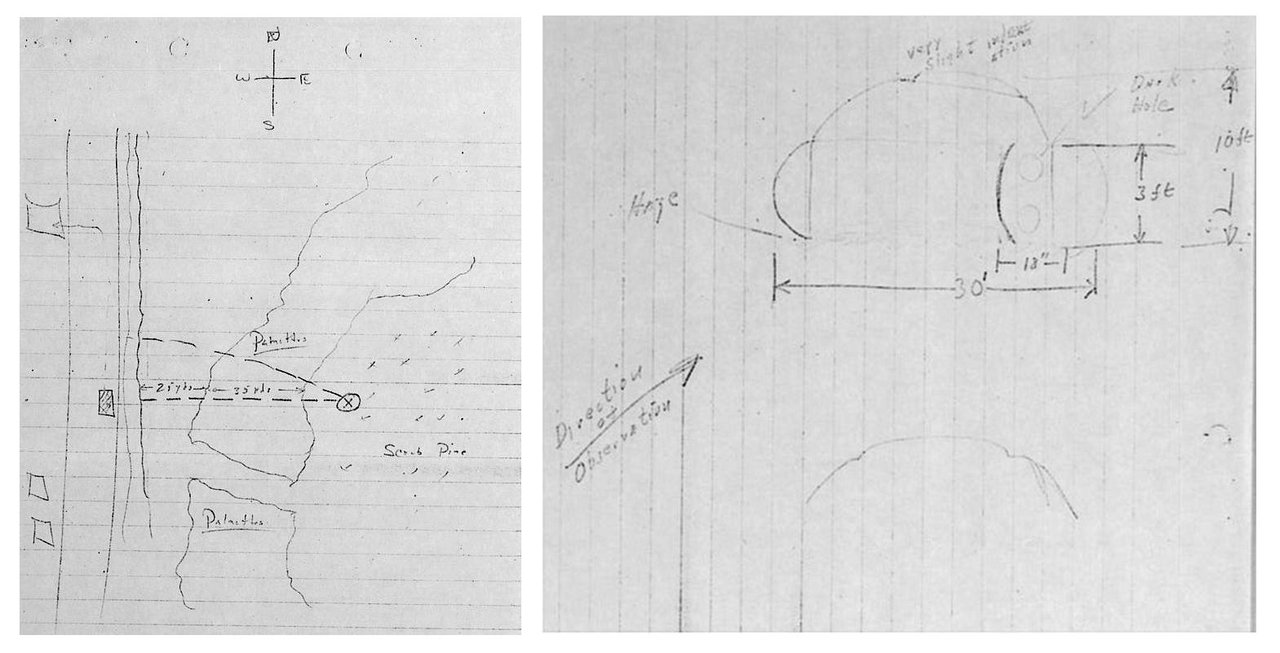
He described a round body roughly thirty feet across, with a dome or turret and a rim carrying evenly spaced vane-like structures.
That shape was later preserved in sketches prepared during the official investigation.
The sketches are genuine case evidence. They tell us what DesVergers said he saw — not what was actually above the clearing.
THE RED MIST
DesVergers said he heard something like a hatch opening.
A small red flare-like object appeared and moved toward him, expanding into a red mist or fiery cloud.
He covered his face and said he lost consciousness.
When he returned toward the road, his eyes burned, his arms and face were affected and his cap showed scorch damage.
Local officers saw a visibly distressed man.
WHAT THE SCOUTS ACTUALLY SAW
The boys had remained at the car.
They reported seeing lights in the grove and later described a red light near the area where DesVergers had gone.
Some later versions present them as watching the red fireball strike him.
But Blue Book returned to the site and reenacted the geometry.
Investigators concluded that vegetation and distance made it impossible to see DesVergers clearly at the claimed point in the clearing — even from on top of the car.
The Scouts were not accused of participating in a hoax. Ruppelt's view was that they had become convinced by the event and may have interpreted distant lights through the story unfolding around them.
BLUE BOOK ARRIVES
Project Blue Book chief Captain Edward J. Ruppelt treated the report seriously enough to fly to Florida with an Air Force team.
Investigators interviewed DesVergers repeatedly, examined the site and collected physical material.
Ruppelt later wrote that the witness initially passed their consistency questioning extremely well.
The case therefore did not begin as an Air Force dismissal.
Blue Book went to Florida trying to find out what happened — not merely to stamp “hoax” on the paperwork.
THE BURNS
DesVergers' arm hair was singed and he had minor skin effects described as comparable to a light sunburn.
A flight surgeon examining him did not find injuries requiring an exotic heat source.
Ruppelt later wrote that the surgeon demonstrated similar superficial singeing with an ordinary cigarette lighter.
That does not explain DesVergers' entire story.
It does remove the burns as proof of extraordinary technology.
THE CAP
The Air Force sent DesVergers' cap for examination.
An FBI memorandum dated 29 August 1952 records that no residue was found that could identify the source of the burns.
The singeing was non-uniform.
The front edge of the bill was more heavily singed than expected if one overhead flash had caused the damage.
Most damagingly, cloth protected beneath a fold had escaped singeing — suggesting the hat may have been lying flat rather than being worn when at least some of the scorching occurred.
The hat was physical evidence. It did not behave the way the simple “overhead blast” story predicted.
READ THE 29 AUGUST 1952 FBI MEMORANDUM ↗THE MACHETE
The machete DesVergers carried into the grove was sent to Wright-Patterson for testing.
It did not produce an exotic material result.
It was not shown to be radioactive, unusually heated or otherwise altered in a way that supported a technological encounter.
The fact that a physical object was tested is important. The test itself did not support the extraordinary claim.
THE GRASS
Grass and soil samples were taken from the clearing.
Later Blue Book-linked accounts describe an unusual pattern in which root structures were charred or thermally affected while upper vegetation was less obviously burned.
This feature has often been cited as the strongest residual anomaly in the case.
But the present research record warns that the full original laboratory chain and exact site-sampling documentation still need to be audited before the grass is treated as decisive physical evidence.
Altered vegetation is not automatically a UFO trace. The evidential question is whether the original samples, controls, chain of custody and laboratory method support a genuinely unexplained thermal effect.
THE CREDIBILITY TURN
The Air Force received increasingly damaging information about DesVergers' background and reputation.
Ruppelt's later account describes an other-than-honourable Marine discharge, an automobile-theft history and repeated reports from local people that DesVergers was prone to tall stories.
His post-event publicity also troubled investigators: dramatic claims about government secrecy, press attention and eventual commercialisation of the story.
Witness credibility is not a substitute for evidence.
But when the extraordinary event depends mainly on one person, credibility becomes part of the evidential structure.
THE HOAX ASSESSMENT
The Scouts could not clearly see the alleged close-range event from the road during the reenactment.
The scorch pattern raised the possibility that the cap was not on DesVergers' head when some damage occurred.
The medical effects did not require exotic heat.
Investigators uncovered serious contradictions and a reputation for fabrication.
No confession, recovered apparatus or fully proven staging method closed the event.
The grass/root findings remain the part most in need of original-file verification.
THE IMPORTANT DISTINCTION
Blue Book's case against DesVergers became strong.
But Ruppelt was also candid that investigators had not proved how the event was staged.
They could imagine methods.
They could show that some evidence did not fit the story.
They could undermine the witness.
What they never recovered was the complete mechanism.
The Air Force's conclusion may be right. The missing step is showing exactly how the hoax worked.
WHAT REMAINS
The Florida Scoutmaster encounter is unusual because official scrutiny did not simply dismiss the claim — it changed the shape of the evidence.
The Scouts became contextual rather than close-range witnesses.
The burns became less exotic.
The hat became more suspicious.
The machete yielded nothing remarkable.
DesVergers' credibility deteriorated badly.
Yet the investigators still stopped short of demonstrating a complete hoax method.
The Air Force took it seriously — then the evidence began to turn against the story.
SOURCE ROOM