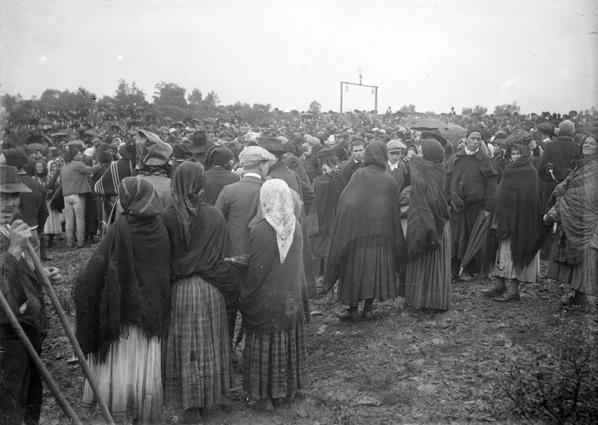
The Fatima Mass Sighting

October 13, 1917 Β· FΓ‘tima, Portugal

⭐ High Evidence Rating πŸ‘οΈ Mass Sighting aka "The Miracle of the Sun"

Between May and October 1917, three shepherd children in FΓ‘tima, Portugal reported six apparitions of a luminous figure. The events culminated on October 13, when an estimated 30,000–70,000 people gathered at the Cova da Iria and witnessed the sun appear to change colors, spin, and plunge toward Earth. Reported by major secular newspapers including O SΓ©culo and O Dia, declared "worthy of belief" by the Catholic Church in 1930, and reinterpreted by UAP researchers like Jacques VallΓ©e as a potential mass UFO sighting with entity contact β€” Fatima remains one of the most extraordinary and best-documented mass sighting events in history.

πŸ“ FΓ‘tima, Portugal 🧭 39.63Β°N, 8.67Β°W πŸ“‹ Case #1 πŸ“š Research compiled 2026-07-28

πŸ“Έ Photo Gallery

Thirty images documenting the shepherd children, the Cova da Iria site, contemporary newspaper coverage of the Miracle of the Sun, the development of the Fatima shrine, and key figures in the case. Click any photo to view full size.

πŸ“– The Full Story

What happened at the Cova da Iria on October 13, 1917 β€” drawn from the case file on The UAP Map.

Avelino de Almeida, a reporter for the secular Lisbon newspaper O SΓ©culo, stood in a muddy field in central Portugal on the morning of October 13, 1917, surrounded by an estimated 70,000 people. He had come to debunk. For months, three shepherd children β€” LΓΊcia Santos, 10, and her cousins Francisco and Jacinta Marto, 9 and 7 β€” had insisted the Virgin Mary was appearing to them on the 13th of each month, and had promised a public miracle on this day. Skeptics, priests, government officials, and journalists came to watch nothing happen. It had rained for hours. The crowd was soaked.

Then, according to de Almeida's front-page dispatch the next day, the clouds parted and "the sun trembled, made movements never seen before." Witnesses described the sun as a silver disc, dull-edged and clear enough to stare at, spinning and throwing off rays of changing color β€” red, blue, yellow, violet β€” that swept across the sky and the faces of the crowd. Then it appeared to detach from the sky and plunge toward the earth. People fell to their knees. Some screamed. Some wept. After roughly ten minutes, the sun returned to its place. The rain-soaked clothes of the crowd were suddenly dry, and the muddy ground had hardened.

The children had predicted the time and the broad nature of the event, and they had done so publicly, months in advance. What the crowd reported was recorded not only by O SΓ©culo but by the Catholic press, by O Dia, by correspondents from other papers, and by photographs that captured the enormous gathering, though not the solar phenomenon itself. Witness accounts varied in their details β€” as one would expect from tens of thousands of people β€” but the core elements were consistent: a luminous, spinning, descending solar display, followed by the rapid drying of clothing and ground.

The Catholic Church, after a lengthy investigation, declared the event "worthy of belief" in 1930. Secular investigators have proposed atmospheric optics β€” sundogs, a parhelion, retinal after-images from staring at the sun, mass suggestion, or a dust-induced optical phenomenon. Astronomers have noted that the sun did not actually move, since such a movement would have been visible worldwide and would have disrupted the solar system; therefore the event, whatever it was, was local and atmospheric.

What keeps the case open is not the religious framing but the documentary residue. A skeptical reporter filed a story confirming the crowd saw something. Dozens of independent witnesses described the same sequence. And the physical effect β€” clothes and ground drying within minutes after hours of rain β€” was reported by people who had no shared interest in confirming a miracle. No atmospheric explanation yet offered accounts cleanly for all of the reported elements at once.

Sources: Vatican canonical inquiry (1930); O SΓ©culo newspaper archives (1917); John De Marchi, 'The True Story of Fatima' (1947). Evidence types include mass eyewitness testimony (70,000+), photographs taken at the scene, secular press coverage (O SΓ©culo), and an official Vatican investigation spanning 13 years.

⏱️ Timeline

From the angelic pre-apparitions of 1916 through the canonization of the shepherd children in 2017 β€” a century of events.

Spring 1916

The three children (Lucia, Francisco, Jacinta) reported being visited by an 'Angel of Peace' (Angel of Portugal) three times while tending sheep near Fatima. These angelic apparitions preceded the 1917 Marian apparitions.

Establishes the pre-history of the main events and the children's prior experience with reported anomalous phenomena.

May 13, 1917

First apparition. The three children reported seeing a 'flash of light' followed by the appearance of a luminous woman above a holm oak tree at the Cova da Iria. The figure reportedly told them to return on the 13th of each month for six months. Lucia was 10, Francisco 9, Jacinta 7.

The beginning of the six monthly apparitions. The figure was described as 'a lady dressed in white, more brilliant than the sun.'

June 13, 1917

Second apparition. About 50 people were present, though only the children reported seeing the figure. The apparition reportedly urged the children to pray the rosary daily and said Francisco and Jacinta would be taken to heaven soon.

The crowd begins to grow. The figure reportedly predicted the early deaths of Francisco and Jacinta, which both occurred (1919 and 1920).

July 13, 1917

Third apparition. Approximately 2,000-4,000 people present. The apparition reportedly revealed the Three Secrets of Fatima: (1) A vision of Hell, (2) A prediction of WWII and the spread of Communism in Russia, (3) A Third Secret that was kept confidential until 2000.

The most theologically significant apparition, containing the famous 'prophecies' including the prediction of a future war and the conversion of Russia.

August 13, 1917

Fourth apparition (scheduled date). The children were arrested and jailed by the provincial administrator, Artur de Oliveira Santos, who interrogated them and threatened them with death to reveal the 'secret.' The children refused. The apparition reportedly occurred on August 19 instead, at Valinhos.

The children's detention by civil authorities demonstrates the political tension between the secular republican government and the Catholic population. The children's refusal to recant despite threats is cited as evidence of their sincerity.

August 19, 1917

Fourth apparition (actual date). After being released from jail, the children reported the apparition occurred at a different location (Valinhos) four days late. The apparition reportedly urged continued prayer and penance.

The disruption by civil authorities and the delayed apparition adds complexity to the timeline.

September 13, 1917

Fifth apparition. An estimated 30,000 people gathered. Witnesses reported seeing a luminous globe moving across the sky and a shower of white petals falling from the sky that dissolved before reaching the ground.

The crowd grows dramatically. The reports of a luminous globe in the sky are particularly significant from a UAP perspective, as they describe a physical aerial phenomenon witnessed by thousands, not just the children.

October 13, 1917

Sixth and final apparition - The Miracle of the Sun. An estimated 30,000-70,000 people gathered at Cova da Iria in heavy rain. After the rain stopped, witnesses reported the sun appeared to change colors, spin like a wheel, and plunge toward Earth. The event lasted approximately 10 minutes. Secular newspapers O Seculo and O Dia published front-page reports.

The culminating event and the most significant mass sighting in the Fatima narrative. This is the event that elevated Fatima from a local curiosity to an internationally recognized phenomenon.

October 15, 1917

O Seculo publishes Avelino de Almeida's article about the October 13 event, reporting the crowd witnessing the sun 'dancing' and changing colors.

The first published account of the Miracle of the Sun, from a secular anti-clerical newspaper, lending significant credibility to the event.

October 29, 1917

Ilustracao Portuguesa publishes a special edition with photographs of the crowd at Cova da Iria on October 13.

Provides the most widely reproduced visual record of the event.

November 1917

Bishop of Leiria opens a canonical investigation into the apparitions. Canon Formigao is appointed to lead the inquiry.

The beginning of the formal Church investigation that would last 13 years.

April 4, 1919

Francisco Marto dies of the Spanish influenza at age 10.

Fulfills the prediction attributed to the apparition that Francisco would be taken to heaven soon.

February 20, 1920

Jacinta Marto dies of the Spanish influenza at age 9.

Fulfills the prediction attributed to the apparition that Jacinta would be taken to heaven soon. Both children died of the 1918-1919 influenza pandemic.

1921-1922

A serious investigation by Canon Formigao, establishing the canonical process. Bishop da Silva opens formal canonical inquiry.

The formal investigation phase, gathering testimony from surviving witnesses.

1925

Lucia enters the Carmelite convent at Tuy, Spain, becoming Sister Lucia.

Lucia withdraws from public life to a cloistered convent, where she would remain until her death in 2005.

October 13, 1930

Bishop Jose Alves Correia da Silva of Leiria-Fatima officially declares the Fatima apparitions 'worthy of belief' and permits public devotion to Our Lady of Fatima, following the 13-year canonical inquiry.

The official Church approval that transformed Fatima from a local phenomenon into an authorized Catholic devotion.

1942

Pope Pius XII consecrates the world to the Immaculate Heart of Mary, in partial fulfillment of one of the reported requests of the Fatima apparition.

The first papal action connected to Fatima. Pius XII had a particular devotion to Fatima.

May 13, 1946

Sister Lucia visits Fatima for a rare public appearance.

Lucia's visit is documented in photographs and represents one of her few returns to the site of the apparitions.

1947

William Thomas Walsh publishes 'Our Lady of Fatima,' a widely-read historical account based on interviews with Lucia and other witnesses.

Brings the Fatima story to a wide English-speaking audience.

1952

Father John De Marchi publishes 'The True Story of Fatima,' based on years of research and witness interviews at the site.

Becomes a standard reference for both religious and skeptical researchers.

1969

Jacques Vallee publishes 'Passport to Magonia,' cataloguing Fatima as Case 142 and proposing the UFO/control-system interpretation.

The first major academic argument that Fatima should be understood as a UFO event rather than a religious miracle.

1970

John Keel publishes 'Operation Trojan Horse,' connecting Fatima to a broader pattern of ultraterrestrial phenomena throughout history.

Establishes the 'ultraterrestrial' framework for understanding religious apparitions including Fatima.

May 13, 1967

Pope Paul VI visits Fatima - the first pope to visit the shrine - on the 50th anniversary of the first apparition.

Marks the growing official Church recognition of Fatima at the highest level.

1995

Joaquim Fernandes and Fina d'Armada publish the Portuguese original of 'Heavenly Lights' (Extraterrestre em Fatima), based on original archival testimony.

The first scholarly work by Portuguese historians to access the original Fatima testimony and argue for a UFO interpretation.

May 13, 1982

Pope John Paul II visits Fatima, one year after surviving an assassination attempt on May 13, 1981 - the anniversary of the first Fatima apparition.

John Paul II credited Our Lady of Fatima with saving his life and later revealed that the Third Secret of Fatima referred to the assassination attempt.

May 13, 2000

Pope John Paul II beatifies Francisco and Jacinta Marto and announces that the Third Secret of Fatima will be revealed.

The beatification of the two youngest children and the announcement of the Third Secret's release.

June 26, 2000

The Vatican publishes the full text of the Third Secret of Fatima, with theological commentary by Cardinal Ratzinger. The text describes a vision of a 'bishop in white' being shot by soldiers - interpreted as the 1981 assassination attempt on Pope John Paul II.

The release of the Third Secret ends decades of speculation, though some controversy persists about whether the full text was published.

February 13, 2005

Sister Lucia dies at the Carmelite convent in Coimbra, Portugal, at age 97.

The death of the last surviving witness of the Fatima apparitions.

May 13, 2017

Pope Francis canonizes Francisco and Jacinta Marto as saints at the Sanctuary of Fatima, on the centennial of the first apparition. They become the youngest non-martyr saints in Catholic history.

The highest level of Church recognition for two of the three children, on the 100th anniversary of the first apparition.

πŸ‘οΈ Key Witnesses

Eleven key witnesses β€” from the three shepherd children who reported the apparitions, to the skeptical journalist who came to debunk, to the priest who led the canonical investigation.

Lucia dos Santos (Lucia de Jesus Rosa dos Santos)

Age 10 at time of event

Primary visionary - the eldest of the three children and the only one who reported hearing and seeing the apparition fully (March 22, 1907 – February 13, 2005)

Lucia reported seeing and conversing with a luminous figure described as 'a lady dressed in white, more brilliant than the sun.' She was the primary communicant and later wrote detailed memoirs (1935, 1941) describing the events. She reported receiving three 'secrets' from the apparition. Lucia became a Carmelite nun (Sister Lucia) and lived until 2005, dying at age 97. She wrote multiple accounts over the decades, and revealed the Third Secret in 1944.

Significance: The central witness of the Fatima events. Her later memoirs are the primary source for the details of the apparitions and the Three Secrets.

Francisco Marto

Age 9 at time of event

One of the three shepherd children - Lucia's cousin (June 11, 1908 – April 4, 1919)

Francisco reported seeing the apparition but, according to Lucia, could not hear what it said. He was described as a quiet, contemplative child who spent long periods in prayer after the events. He died of the Spanish flu on April 4, 1919, at age 10.

Significance: One of the three primary witnesses. Canonized as a saint by Pope Francis on May 13, 2017 - the centennial of the first apparition. One of the youngest non-martyr saints in Catholic history.

Jacinta Marto

Age 7 at time of event

One of the three shepherd children - Lucia's cousin and Francisco's sister (March 11, 1910 – February 20, 1920)

Jacinta reported both seeing and hearing the apparition. According to Lucia, she was particularly affected by the vision of Hell shown during the July 13 apparition (the Second Secret). She became deeply religious and spoke frequently about the apparitions. She died of the Spanish flu on February 20, 1920, at age 9, after suffering greatly.

Significance: One of the three primary witnesses. Canonized as a saint by Pope Francis on May 13, 2017. She and Francisco are the youngest non-martyr saints in Catholic history.

Avelino de Almeida

Age Adult at time of event

Journalist for O Seculo, a major Lisbon secular/anti-clerical newspaper

De Almeida was present at the Cova da Iria on October 13, 1917 as a skeptical journalist. He had previously written satirical articles about the Fatima events. His October 15, 1917 article in O Seculo reported: 'The sun, at one moment surrounded with crimson flame, at another aureoled in yellow and deep purple, seemed to be in an exceedingly fast and dizzying whirl, projecting a beam of light of pink and blue in all directions.' He estimated the crowd at 30,000-100,000. His account is significant because it came from a secular, anti-religious publication and was published before any Church involvement or investigation.

Significance: The most important independent contemporary witness. His skeptical background makes his report particularly significant in both religious and skeptical analyses.

Ti Marto (Manuel Marto)

Age Adult at time of event

Father of Francisco and Jacinta Marto, uncle of Lucia

Ti Marto was present on October 13 and left a brief account of the event. He reported: 'The sun painted the world in different colors, moved and danced in the sky.' He was initially skeptical of the children's claims but became a believer after witnessing the October 13 event.

Significance: A close family member of two of the three children and an eyewitness to the October 13 miracle. His account is one of the few from a parent of the children.

Maria Rosa (Maria Rosa da Piedade)

Age Adult at time of event

Mother of Lucia dos Santos

Initially skeptical and harsh with Lucia about her claims, Maria Rosa eventually came to believe after the October 13 event. Her initial skepticism is noted in the canonical inquiry records.

Significance: As the mother of the primary visionary, her journey from skepticism to belief is documented in the inquiry records and adds credibility to the narrative from the Church's perspective.

Domingos Pinto Coelho

Age Adult at time of event

Catholic lawyer and witness at Fatima on October 13, 1917

Coelho approached the phenomenon from a skeptical lens. On October 17, 1917, he wrote that he had experienced a similar solar phenomenon in Lisbon - seeing the same motions and color changes in the sun a few days later. He asked whether what they saw was 'an exceptional thing' or could be 'reproduced in analogous circumstances.'

Significance: His testimony is notable for the skeptical perspective - he reported reproducing the same visual effect by staring at the sun in different conditions, supporting the retinal after-image explanation.

Joaquim Gregorio Tavares

Age Adult at time of event

Witness present at Fatima on October 13, 1917

Tavares stated: 'We must declare that, although we admit the possibility of some miraculous fact, we were there while having in mind conversations we had earlier with cool-headed persons who were anticipating some changes of colour in the Sun.'

Significance: His testimony suggests that some witnesses were primed to expect a solar phenomenon, supporting the mass suggestion hypothesis.

Maria do Carmo

Age Adult at time of event

Witness present at Fatima on October 13, 1917

According to her account, 'It was anticipated that the miracle would involve the stars.' This suggests witnesses were expecting an astronomical phenomenon before the event occurred.

Significance: Her testimony, along with Tavares', indicates that some witnesses were expecting a specific type of miracle, which skeptics argue influenced their perception.

Father Manuel Nunes Formigao

Age Adult at time of event

Priest appointed to conduct the canonical investigation of the Fatima apparitions

Formigao interviewed the children extensively from 1917 onward. His meticulous notes form the backbone of the Church's investigation. He noted both consistencies and inconsistencies in the children's accounts but ultimately became convinced of the events' authenticity.

Significance: The primary Church investigator. His records are preserved in the Fatima archives and are considered the most thorough contemporary documentation of the children's testimony.

Dr. Jose Galamba de Oliveira

Age Adult at time of event

Professor and investigator who documented the Fatima events

A key figure in the investigation of Fatima who collected witness testimonies and supported the canonical process. He was among the educated lay witnesses who documented the events.

Significance: His involvement helped establish the intellectual framework for the Church's investigation and eventual approval of the apparitions.

πŸ“‚ Historical Documents

The Bishop's 1930 declaration, contemporary newspaper reports, canonical inquiry records, Vatican documents, and academic analysis β€” the primary source record of the Fatima events.

πŸ“„

Bishop da Silva's Declaration - 'Worthy of Belief' (October 13, 1930)

October 13, 1930 Β· Church Declaration

The official declaration by Jose Alves Correia da Silva, Bishop of Leiria-Fatima, following a canonical inquiry into the apparitions. The declaration states: '1. We declare worthy of belief, the visions of the shepherd children in the Cova da Iria, parish of Fatima, in this diocese, from the 13th May to 13th October, 1917. 2. Permit officially the cult of Our Lady of Fatima.' This is the foundational Church document approving the Fatima apparitions.

View document β†’
πŸ“„

O Seculo - 'Astounding Things! How the Midday Sun Danced at Fatima' (October 15, 1917)

October 15, 1917 Β· Contemporary Newspaper Report

Firsthand account by Avelino de Almeida, published in O Seculo on October 15, 1917 - just two days after the Miracle of the Sun. De Almeida was a secular, anti-clerical journalist who had previously mocked the events. His article reports the crowd of 30,000-100,000 witnessing the sun 'dancing' and changing colors. Notably, his article was published before the Church had any stance on the events, making it a key independent contemporary source.

View document β†’
πŸ“„

O Dia newspaper coverage (October 17, 1917)

October 17, 1917 Β· Contemporary Newspaper Report

Coverage in O Dia newspaper, which like O Seculo was a Lisbon-based secular newspaper that reported on the October 13 events. These secular newspaper accounts are significant because they came from non-religious publications and were written before any Church involvement.

View document β†’
πŸ“„

Ilustracao Portuguesa (October 29, 1917) - Special Edition on Fatima

October 29, 1917 Β· Contemporary Newspaper/Magazine

Special edition of the Portuguese illustrated newspaper Ilustracao Portuguesa, published October 29, 1917, featuring photographs and coverage of the October 13 event at Cova da Iria. This edition contains the most widely reproduced contemporary photograph of the crowd at Fatima.

View document β†’
πŸ“„

Critical Documentation of Fatima - Selection of Documents (1917-1930)

1917-1930 Β· Compilation of Primary Source Documents

A collection of primary source documents from the canonical process (1917-1930), including the initial inquiry letter from November 3, 1917, witness statements, and early Church correspondence about the apparitions. This is a critical compilation of the original investigative documents.

View document β†’
πŸ“„

The Message of Fatima - Vatican Document (June 26, 2000)

June 26, 2000 Β· Vatican Official Document

Official Vatican document published June 26, 2000, containing the full text of the Third Secret of Fatima as written by Sister Lucia, with theological commentary by Cardinal Joseph Ratzinger (later Pope Benedict XVI). This document includes a scanned reproduction of Lucia's handwritten original text.

View document β†’
πŸ“„

Shrine of Fatima - Archive and Library (Arquivo de Fatima)

Ongoing Β· Archive

The official archive of the Shrine of Fatima, which houses the original documentation of the apparitions, including the children's testimony, canonical inquiry records, and historical documents related to the events from 1916 onward. The archive's mission is to document the everyday life and history of the Shrine.

View document β†’
πŸ“„

The Interrogations of the Children by Father Manuel Ferreira (1917)

June-October 1917 Β· Canonical Inquiry Testimony

Records of the interrogations of the three children by their local parish priest, Father Manuel Ferreira, conducted after each of the apparitions from June to October 1917. These are among the earliest recorded testimonies of the children's experiences.

View document β†’
πŸ“„

Fatima Pictures and Testimonials: In-Depth Analysis (Scientia et Fides, 2021)

2021 Β· Academic Paper

Academic paper by Philippe Dalleur (2021), published in the journal Scientia et Fides, using photographs and testimonials to analyze details of the 'miracle of the spinning sun' on October 13, 1917, at solar noon near Fatima. Cited by 7 subsequent works.

View document β†’
πŸ“„

Canon Formigao's Inquiry Notes (1917-1924)

1917-1924 Β· Canonical Inquiry Documents

Monsignor Manuel Nunes Formigao was the priest appointed to conduct the initial canonical investigation of the Fatima apparitions. He interviewed the children multiple times between 1917 and 1924, and his meticulous notes form the backbone of the Church's investigation. His records are preserved in the Fatima archives.

View document β†’

βš–οΈ Skeptical Analysis

Eight skeptical arguments examining the Fatima events β€” from retinal after-images and sundogs to mass suggestion, dust clouds, and the inconsistency of witness accounts. Each is presented fairly with the evidence cited.

Retinal After-Images and Optical Effects from Sun Gazing

Proposed by: Auguste Meessen (Professor of Physics)

Meessen presented his analysis at the International Symposium 'Science, Religion and Conscience' in 2003. He argued that the reported 'dancing sun' effects were optical phenomena caused by prolonged staring at the sun. Retinal after-images produced after brief periods of sun gazing create the illusion of movement. The color changes were attributed to the bleaching of photosensitive retinal cells. Meessen acknowledged that witnesses were 'honestly experiencing what they report' but argued these were subjective optical effects, not objective phenomena. He noted that similar 'sun miracles' have been witnessed at many locations where religiously charged pilgrims stare at the sun, citing the apparitions at Heroldsbach, Germany (1949) where over 10,000 people reported similar observations.

Evidence cited:

Laboratory demonstration of retinal after-images; parallel 'sun miracle' events at other pilgrimage sites; the fact that the phenomenon was only seen by those looking directly at the sun, not by distant observers or astronomical observatories.

Source: Auguste Meessen, International Symposium 'Science, Religion and Conscience' (2003); Wikipedia: Miracle of the Sun

Sundog / Atmospheric Optical Phenomenon (Parhelion)

Proposed by: Joe Nickell (Skeptical investigator, CSICOP/CSI)

Joe Nickell wrote that the 'dancing sun' effects could have been caused by a sundog (parhelion) - a relatively common atmospheric optical phenomenon where ice crystals in the atmosphere create the appearance of a luminous object near the sun. Nickell suggested a combination of factors: the sun seen through thin clouds (cirrostratus) causing it to appear as a silver disc; changes in cloud density causing the sun's image to alternately brighten and dim, creating the illusion of advancing and receding; and dust or moisture droplets refracting sunlight to impart various colors. He also suggested temporary retinal distortion from staring at intense light.

Evidence cited:

Sundogs are well-documented atmospheric phenomena; the weather conditions on October 13 included rain and then clearing, consistent with cloud formations that produce sundogs; the color changes (yellow, blue, violet) are consistent with atmospheric refraction.

Source: Joe Nickell, CSICOP (Committee for the Scientific Investigation of Claims of the Paranormal); Wikipedia: Miracle of the Sun

Mass Suggestion and Expectation

Proposed by: Benjamin Radford (Skeptical investigator) and others

Radford argued that 'No one suggests that those who reported seeing the Miracle of the Sun are lying or hoaxing. Instead, they very likely experienced what they claimed to, though that experience took place mostly in their minds.' He noted that staring at the sun for extended periods causes eye muscle fatigue, producing the illusion of movement. The fact that witnesses expected a miracle - the children had predicted it - created a context ripe for mass suggestion. Schwebel noted 'not only did all those present not see the phenomenon, but also there are considerable inconsistencies among witnesses as to what they did see.' Witness Joaquim Gregorio Tavares confirmed they were 'anticipating some changes of colour in the Sun.'

Evidence cited:

Inconsistent witness accounts; evidence that witnesses expected a solar miracle; the fact that not all witnesses reported seeing the phenomenon; psychological research on suggestibility and group dynamics in religious contexts.

Source: Benjamin Radford; Schwebel (2014); Witness testimony from canonical inquiry records

Stratospheric Dust / Saharan Dust Cloud

Proposed by: Steuart Campbell (Journal of Meteorology, 1989) and Paul Simons

Campbell postulated in the Journal of Meteorology (1989) that a cloud of stratospheric dust changed the appearance of the sun on October 13, making it easy to look at, and causing it to appear to be yellow, blue, and violet, and to spin. Paul Simons, in an article 'Weather Secrets of Miracle at Fatima,' suggested that the optical effects may have been caused by a cloud of dust from the Sahara Desert, which can affect atmospheric conditions in Portugal.

Evidence cited:

Saharan dust storms are known to affect Portugal's atmosphere; stratospheric dust can alter solar appearance; the weather pattern on October 13 (rain followed by sudden clearing) is consistent with dust cloud dissipation.

Source: Steuart Campbell, Journal of Meteorology (1989); Paul Simons, 'Weather Secrets of Miracle at Fatima'

Inconsistency of Witness Accounts

Proposed by: McClure, Schwebel, and others

McClure wrote that 'the accounts of the miracle, of the dance of the sun, are simply not consistent.' Schwebel states, 'Not only did all those present not see the phenomenon, but also there are considerable inconsistencies among witnesses as to what they did see.' Different witnesses reported different colors, different durations, and different types of movement. Some witnesses at the same location reported nothing unusual at all. The crowd size itself is disputed - estimates range from 30,000 to 70,000 to 100,000.

Evidence cited:

Comparison of individual witness testimonies from the canonical inquiry records; the wide range of crowd size estimates; the fact that some witnesses reported no phenomenon at all.

Source: McClure; Schwebel (2014); De Marchi's collected testimonies

No Astronomical Observatory Detection

Proposed by: Various skeptics, including Father Pio Scatizzi's critics

If the sun had actually moved or changed in the way described by Fatima witnesses, it would have been detected by astronomical observatories worldwide. No such observations were recorded. The sun did not actually move - if it had, the Earth would have been destroyed. This argument is countered by believers who say the phenomenon was localized or that divine intervention prevented wider detection, but skeptics note this is an unfalsifiable claim.

Evidence cited:

Absence of any astronomical observation of solar anomalies on October 13, 1917; the physical impossibility of the sun actually moving in the manner described.

Source: Various skeptical analyses; Father Pio Scatizzi's theological response and its critics

Reproducibility - The Domingos Coelho Testimony

Proposed by: Domingos Pinto Coelho (Catholic lawyer, 1917) and later skeptics

Domingos Pinto Coelho, a witness at Fatima on October 13, reported on October 17, 1917 that he had experienced the exact same solar phenomenon (motions and color changes) a few days later in Lisbon, by staring at the sun through thin clouds. He explicitly questioned whether the Fatima phenomenon was 'an exceptional thing' or could be 'reproduced in analogous circumstances.' This suggests the visual effects were reproducible by staring at the sun in similar weather conditions.

Evidence cited:

Coelho's own published testimony from October 17, 1917, reporting reproduction of the same visual effects by staring at the sun in Lisbon.

Source: Domingos Pinto Coelho, October 17, 1917; Wikipedia: Miracle of the Sun

Brian Dunning's Skeptoid Analysis

Proposed by: Brian Dunning (Skeptoid podcast)

Dunning analyzed the photographic evidence, noting that the commonly reproduced 'photograph of the sun miracle' actually 'shows a lot of dark rain clouds behind some trees and the sun poking through' - i.e., it shows nothing anomalous. He argued that the event was a combination of optical effects, expectation, and confirmation bias. He noted that the crowd was primed by the children's prediction and by months of buildup.

Evidence cited:

Analysis of the actual photographs from October 13, which show normal atmospheric conditions; the psychology of expectation and confirmation bias in mass gatherings.

Source: Brian Dunning, Skeptoid episode 'Illuminating the Fatima Miracle of the Sun' (skeptoid.com/episodes/110)

πŸ›Έ UAP Perspective

How Jacques VallΓ©e, John Keel, and other UAP researchers interpret the Fatima events β€” not as a religious miracle, but as a potential mass UFO sighting with entity contact, consistent with a broader pattern of phenomena throughout history.

Jacques Vallee - Fatima as Case 142 in the Magonia Catalog

Jacques Vallee catalogued the Fatima apparitions as Case 142 in his Magonia catalog of historical UFO-like events, published in 'Passport to Magonia' (1969). Vallee was one of the first to publicly speculate that the 'solar dance' at Fatima was a UFO event. He argued that religious apparitions, fairy encounters, and modern UFO sightings share common structural elements - luminous aerial phenomena, entity contact, messages/prophecies, and physical effects on the environment. Vallee's broader thesis is that UFOs and related phenomena function as a 'control system' shaping human beliefs and culture across millennia, with Fatima being a prime example of this mechanism operating through a religious framework.

Key points:

  • Fatima shares the structural elements of UFO encounters: luminous aerial object, entity contact, communication of predictions/secrets, physical effects (drying of wet clothes/ground).
  • The apparition appeared in a form culturally appropriate to rural Portuguese Catholic children in 1917 - the same phenomenon might appear differently in other cultural contexts.
  • The September 13 luminous globe observed by thousands is particularly UFO-like in description.
  • The 'dancing sun' may have been an actual luminous object/aerial phenomenon rather than the sun itself - witnesses at distant locations reported seeing a 'silver sun' at the azimuth of Fatima, not the real sun.
  • Vallee argues UFOs function as a 'control system' for shaping human beliefs, with Fatima as a paradigmatic case of this mechanism.

Source: Jacques Vallee, 'Passport to Magonia' (1969); Wikipedia: Jacques Vallee

The Entities as UFO Occupants

UAP researchers, particularly Fernandes and d'Armada in 'Heavenly Lights,' argue that the entity encountered by the children was not the Virgin Mary but a UFO occupant/anomalous entity. They accessed the original canonical inquiry testimony and found the children's descriptions were notably different from the later sanitized Church version. The original testimony describes a small (approximately one meter tall), luminous entity of uncertain form - not the idealized young woman of later devotion. The entity was described as emitting light, appearing in a 'haze' or luminous cloud, and communicating silently or telepathically. These descriptions are consistent with modern UFO entity reports.

Key points:

  • The original testimony (preserved in canonical inquiry records) describes a small, luminous entity - not the idealized Virgin Mary of later Church art.
  • Fernandes and d'Armada found that the canonical inquiry testimony was sanitized over time, with later Church-approved descriptions differing from the children's original accounts.
  • The entity's communication method (silent/telepathic to some witnesses, audible only to Lucia) resembles entity contact reports in UFO cases.
  • The entity's predictions about war, political events, and the children's deaths are consistent with the prophetic/foretelling element common in UFO entity encounters.
  • The physical effects - drying of wet clothes and ground, luminous phenomena seen by crowds - are consistent with physical traces in UFO cases.

Source: Joaquim Fernandes and Fina d'Armada, 'Heavenly Lights' (2007 English edition, 1995 Portuguese original)

The September 13 Luminous Globe - A Mass UFO Sighting

On September 13, 1917, approximately 30,000 people gathered at Cova da Iria. Multiple witnesses reported seeing a luminous globe or sphere moving across the sky, and a shower of white 'petals' (or flakes) falling from the sky that dissolved before reaching the ground. From a UAP perspective, this is particularly significant because it describes a physical aerial phenomenon witnessed by thousands - not just the children. The luminous globe is consistent with UFO descriptions throughout the 20th century, and the falling 'petals' resemble the 'angel hair' or 'silvery threads' reported in many UFO cases.

Key points:

  • The luminous globe was seen by thousands, not just the children - making it a mass UFO sighting independent of the children's testimony.
  • The 'angel hair' phenomenon (falling white flakes that dissolve) is reported in numerous UFO cases worldwide, including the 1954 Florence UFO sighting.
  • The September event demonstrates that anomalous aerial phenomena were observed at Fatima independent of the children's claims of Marian apparitions.
  • This event is less well-known than the October 13 Miracle of the Sun but may be more significant from a UAP perspective because it describes a discrete aerial object rather than a solar phenomenon.

Source: De Marchi's collected testimonies; Fernandes and d'Armada, 'Heavenly Lights'

John Keel - The Ultraterrestrial Hypothesis

In 'Operation Trojan Horse' (1970), John Keel argued that 'ultraterrestrial' entities have been interacting with humanity throughout history, manifesting in culturally appropriate forms. Fatima is discussed as a key example: entities appeared as the Virgin Mary to rural Portuguese children because that was the cultural framework the witnesses could understand. Keel argued the same entities might appear as aliens to 20th-century Americans, as fairies to medieval Europeans, or as angels in biblical times. Keel's framework explains why UFO/entity encounters consistently adapt to the cultural expectations of the witnesses.

Key points:

  • The 'ultraterrestrial' hypothesis explains why entity encounters consistently match the cultural framework of the witnesses.
  • Fatima's timing - during WWI, in a deeply Catholic rural community - is consistent with Keel's observation that these phenomena occur at times and places of social stress.
  • The predictions/prophecies at Fatima (war, peace, Russia) are consistent with Keel's observation that ultraterrestrial communications often contain politically relevant but ambiguous predictions.
  • Keel noted that the manipulation of human belief systems through these encounters appears deliberate - the entities provide just enough evidence to be compelling but never enough to be conclusive.

Source: John Keel, 'Operation Trojan Horse' (1970, revised 1996)

Parallels with Other Mass Sighting Cases

UAP researchers draw parallels between Fatima and other mass UFO sighting cases throughout history. These parallels include: (1) The 1561 celestial phenomenon over Nuremberg, Germany - mass sighting of aerial objects; (2) The 1917 Fatima apparitions - mass sighting of solar/aerial phenomena; (3) The 1942 Battle of Los Angeles - mass sighting/anti-aircraft response to aerial phenomenon; (4) The 1954 Florence, Italy UFO sighting - mass sighting with 'angel hair' falling, paralleling the September 13 Fatima 'petals'; (5) The 1986 Trans-Airlines flight encounter over the Arctic; (6) The 1997 Phoenix Lights - mass sighting by thousands. Fatima stands out as one of the earliest and best-documented mass sightings, with the added element of entity contact.

Key points:

  • Fatima shares the 'angel hair' phenomenon with the 1954 Florence sighting - both involved thousands of witnesses and falling white flakes.
  • The prediction of a specific date for the October 13 miracle is unusual in UFO cases but parallels some prophetic UFO events like the 1959 Boas case.
  • The physical effects (drying of wet clothes/ground) are consistent with reported physical effects in many UFO close-encounter cases.
  • Fatima is unique among mass sightings for its extended duration (six months) and the entity contact element, making it one of the most complex UFO cases on record.
  • The combination of mass witness aerial phenomena AND entity contact at Fatima makes it a uniquely rich case in UAP research.

Source: Vallee, 'Passport to Magonia'; Fernandes and d'Armada, 'Heavenly Lights'; various UAP case catalogs

The Predictions and Their Accuracy

The Fatima apparition reportedly made several predictions that UAP researchers analyze for accuracy and consistency with UFO-associated predictions. (1) The early deaths of Francisco and Jacinta - fulfilled (1919, 1920). (2) The end of WWI - fulfilled (November 1918, though the war was already drawing to a close). (3) The prediction of a future war (WWII) if people did not change - fulfilled (1939), though skeptics note this was made during wartime and was not a specific prediction. (4) The spread of Communism from Russia - fulfilled, though this was a common political concern in 1917. (5) The Third Secret - revealed in 2000, describing a 'bishop in white' being shot, interpreted as the 1981 assassination attempt on Pope John Paul II. UAP researchers note that the pattern of predictions - some vague enough to be fulfilled by historical inevitability, others specific enough to be impressive - is characteristic of UFO-associated prophecies and the 'control system' Vallee describes.

Key points:

  • The prediction of WWII in 1917, during WWI, is notable but skeptics argue it was a reasonable extrapolation.
  • The children's deaths were predicted before the Spanish flu pandemic, but the flu was already spreading in 1917.
  • The Third Secret's connection to the 1981 assassination attempt (64 years later) is the most impressive prediction but is a post-hoc interpretation.
  • Vallee's control-system hypothesis suggests these predictions are designed to maintain belief and engagement, not to genuinely foretell the future.
  • The pattern of partially-fulfilled, retroactively-interpreted predictions is consistent across UFO entity contact cases.

Source: Vallee, 'Passport to Magonia'; Three Secrets of Fatima; Vatican 2000 document

πŸ’” Human Impact

The Fatima apparitions reshaped the lives of everyone they touched β€” from the children who saw the Lady to the journalist who reported it.

Avelino de Almeida

Secular journalist, O SΓ©culo

The journalist who came to mock and stayed to report. His career was defined by that one article. The Church co-opted his reporting for religious purposes β€” he never got credit as a journalist for documenting a mass anomaly.

Lucia dos Santos

Eldest seer, later Carmelite nun

Spent her entire life β€” 88 years after the event β€” as a nun, writing about and reliving the apparitions. She was forbidden from speaking publicly for decades. She died in 2005, still being asked about the Third Secret.

Francisco and Jacinta Marto

Two of the three shepherd children

Both died young β€” Francisco at 10 (1919, Spanish flu), Jacinta at 9 (1920, pleurisy). Lucia said the children had been told they would die young. They were canonized as saints by Pope Francis in 2017.

The children's families

Parents and relatives of the seers

Were ostracized by their community, interrogated by the local administrator (who jailed the children for three days), and pressured by both Church and state. The social and economic consequences lasted for years.

πŸ’‘ Things You Didn't Know

Surprising facts about Fatima that go beyond the familiar religious narrative.

  1. The children were jailed for three days in August 1917 by the local administrator to stop them from attending the apparition.
  2. Avelino de Almeida, the journalist who reported the "dancing sun," had previously written satirical articles mocking the children.
  3. 70,000 people's rain-soaked clothes and muddy ground dried within minutes β€” even skeptics acknowledge this happened.
  4. The Third Secret was kept classified by the Vatican for 83 years (1917–2000).
  5. The apparitions occurred during World War I, in 1917 β€” the same year the Russian Revolution began, which the children allegedly predicted.
  6. Francisco and Jacinta Marto died as children β€” in 1919 and 1920 respectively. They were canonized as saints in 2017.
  7. The "Lady" the children described was about 3 feet tall, not the tall figure shown in later religious statues.

πŸ“š Books

Seven books covering Fatima β€” from Portuguese historians who accessed the original archives to Jacques VallΓ©e's control-system hypothesis and the classic Church-affiliated accounts. Links support The UAP Map via Amazon Associates.

Heavenly Lights: The Apparitions of Fatima and the UFO Phenomenon

Joaquim Fernandes and Fina d'Armada Β· 2007 (English), 1995 (Portuguese original: Extraterrestre em Fatima) Β· Anomalist Books

The first history of Fatima to be written by Portuguese historians based on the original documents from the Fatima archives. Fernandes and d'Armada accessed the original canonical inquiry testimony and found that the children's descriptions of the apparition were notably different from the later sanitized Church version. They describe a small, luminous entity of uncertain form - not the idealized Virgin Mary of later devotion. The authors argue the events are better understood as a UFO/UAP encounter than a Marian apparition. This is the key text for the UAP interpretation of Fatima, and is considered a direct application of Vallee's Passport to Magonia theory to the Fatima case.

Essential reading for the UAP perspective. Written by Portuguese researchers with direct access to original archival testimony.

View on Amazon β†’

Passport to Magonia: From Folklore to Flying Saucers

Jacques Vallee Β· 1969 Β· Contemporary Books (1969); Anomalist Books (reprint)

Vallee's seminal work that catalogs historical UFO-like events, including the Fatima apparitions. Vallee included Fatima as Case 142 in his catalog, arguing that religious apparitions, fairy encounters, and modern UFO sightings share common structural elements. He was one of the first to publicly speculate that the 'solar dance' at Fatima may have been a UFO event. Vallee's broader thesis is that UFOs and related phenomena function as a 'control system' shaping human beliefs and culture across millennia - with Fatima being a prime example of this mechanism.

The foundational text for the interdimensional/control-system hypothesis of UFOs, with Fatima as a key case study.

View on Amazon β†’

Operation Trojan Horse

John Keel Β· 1970 (revised 1996) Β· Putnam (1970); Illuminet Press (1996)

Keel's groundbreaking work on UFO phenomena, which connects modern UFO reports to historical religious apparitions and paranormal events. Keel argued that 'ultraterrestrial' entities have been interacting with humanity throughout history, manifesting in culturally appropriate forms - as angels, demons, the Virgin Mary, or extraterrestrials depending on the era. Fatima is discussed as a key example of this phenomenon, where entities appeared in a form that matched the cultural expectations of rural Portuguese children in 1917.

Keel's ultraterrestrial hypothesis provides a framework for understanding Fatima as part of a broader, ongoing phenomenon rather than an isolated religious event.

View on Amazon β†’

Our Lady of Fatima

William Thomas Walsh Β· 1947 Β· Doubleday

A classic and widely read historical account of the Fatima apparitions, written by the historian William Thomas Walsh who interviewed witnesses including Lucia herself. Walsh provides a detailed narrative of the events from a pro-Church perspective, covering the apparitions, the Miracle of the Sun, and the subsequent history. This is one of the most influential English-language books on Fatima.

The standard historical narrative of Fatima for the English-speaking world, based on direct interviews with surviving witnesses.

View on Amazon β†’

Dimensions: A Casebook of Alien Contact

Jacques Vallee Β· 1989 (Alien Contact Trilogy, with Revelations and Confrontations) Β· Contemporary Books; Anomalist Books

Part of Vallee's Alien Contact Trilogy, this book develops the interdimensional hypothesis for UFO contact, building on the framework established in Passport to Magonia. Vallee discusses Marian apparitions including Fatima as examples of entity contact that have been culturally interpreted through a religious lens. He argues these events represent the same underlying phenomenon as modern UFO encounters.

Further develops the interdimensional hypothesis with Fatima as a supporting case.

View on Amazon β†’

The True Story of Fatima

John De Marchi Β· 1952 Β· Missionaries of the Immaculate Heart

Written by Father John De Marchi, a priest who spent years at Fatima interviewing witnesses and documenting the events. This is one of the most detailed accounts from a Church-affiliated source, based on extensive primary research including interviews with the children and witnesses of the October 13 miracle. De Marchi's work is frequently cited in both religious and skeptical analyses of Fatima.

A primary source document based on direct witness interviews, used as a reference by both believers and skeptics.

View on Amazon β†’

Meet Me at the Baoba: The Portuguese Orbs and Other Anomalies

Joaquim Fernandes Β· 2005 Β· Unknown

By one of the co-authors of Heavenly Lights, this book further explores the UFO/anomalous phenomena in Portugal, including additional context on Fatima and related events in Portuguese history.

Additional Portuguese research on anomalous aerial phenomena including Fatima.

View on Amazon β†’

🎬 Documentaries & Videos

Documentaries, skeptical analyses, and interviews β€” including Jacques VallΓ©e discussing the connection between UFOs and religious apparitions, and Brian Dunning's Skeptoid analysis of the Miracle of the Sun.

The Miracle of the Sun In Fatima (October 13, 1917)
β–Ά

The Miracle of the Sun In Fatima (October 13, 1917)

Unknown

Video about the great Miracle of the Sun performed on October 13, 1917 in Fatima, Portugal, when the sun reportedly danced in the sky before tens of thousands of witnesses.

Fatima: The Miracle of the Sun Was a Warning
β–Ά

Fatima: The Miracle of the Sun Was a Warning

Unknown

Documentary exploring how more than 70,000 people witnessed the Miracle of the Sun at Fatima, framing the event as a warning rather than a spectacle.

Fatima 1917: The Miracle of the Sun and the Third Secret
β–Ά

Fatima 1917: The Miracle of the Sun and the Third Secret

Unknown

Documentary examining the full story of Our Lady of Fatima, the three shepherd children, the Miracle of the Sun, and the controversial Third Secret of Fatima.

A Skeptical Analysis of the 1917 Marian Apparitions and Miracle of the Sun
β–Ά

A Skeptical Analysis of the 1917 Marian Apparitions and Miracle of the Sun

Unknown

Skeptical analysis of both the Marian apparitions at Fatima and the subsequent Miracle of the Sun, examining the events from a critical, scientific perspective.

The Miracle Witnessed by 70,000 People
β–Ά

The Miracle Witnessed by 70,000 People

Unknown

Explores the mystery of the Miracle of the Sun at Fatima in 1917, examining the phenomenon witnessed by tens of thousands and its implications.

The Best Kept Secret in UFOlogy with Jacques Vallee
β–Ά

The Best Kept Secret in UFOlogy with Jacques Vallee

Unknown

Interview with Jacques Vallee discussing his UFO research, including the connection between UFOs, religious apparitions like Fatima, and his control system hypothesis. Vallee discusses how events like Fatima fit into the broader pattern of UFO phenomena.

Passport to Magonia: UFOs, Folklore, and Parallel Worlds
β–Ά

Passport to Magonia: UFOs, Folklore, and Parallel Worlds

Unknown

Video exploring Jacques Vallee's seminal work Passport to Magonia, which connects UFO phenomena with folklore and includes the Fatima apparitions as a key case study.

🎧
Listen

Illuminating the Fatima Miracle of the Sun

Skeptoid (Brian Dunning)

Brian Dunning's skeptical analysis of the Fatima Miracle of the Sun, examining the evidence and proposing natural explanations including retinal after-images and optical effects. Part of the Skeptoid podcast series.

Listen here β†’
The Atheist Journalist's Words at Fatima | The Document No One Was Supposed to Read
β–Ά

The Atheist Journalist's Words at Fatima | The Document No One Was Supposed to Read

Unknown

Explores the historical account of Avelino de Almeida, the atheist journalist who covered the Fatima events for O Seculo, and his October 15, 1917 article - cited by the official Shrine of Fatima in Documentacao Critica de Fatima.

May 13 - Our Lady of Fatima and the MIRACLE of the Sun
β–Ά

May 13 - Our Lady of Fatima and the MIRACLE of the Sun

Unknown

Covers the story of Our Lady of Fatima appearing to three shepherd children at Cova da Iria on May 13, 1917, and the subsequent Miracle of the Sun on October 13.

πŸ”— Related Deep Dives

πŸ‡¬πŸ‡§
Rendlesham Forest
1980 Β· Suffolk, UK
✈️
WWII Foo Fighters
1944 Β· WWII Theaters
πŸ‡ΊπŸ‡Έ
Roswell UFO Incident
1947 Β· New Mexico
πŸ‡ΊπŸ‡Έ
Phoenix Lights
1997 Β· Arizona
πŸ›Έ
Nimitz Tic Tac
2004 Β· Pacific Ocean
πŸ‡ΏπŸ‡Ό
Ariel School
1994 Β· Zimbabwe

πŸ“° Latest UAP News

The latest developments in UAP β€” updated weekly. View all news β†’