Too strong.
Canadian authorities investigated the case. That is not an extraterrestrial conclusion.

Stefan Michalak said two glowing objects descended near him in the Manitoba wilderness. One remained. He approached it. Minutes later, his clothing was on fire and a grid of burns was forming across his body. Then the official investigation began.
On 20 May 1967, Stefan Michalak was prospecting in the bush near Falcon Lake, Manitoba. According to the account preserved in Canadian government records, he was working a quartz vein when frightened geese drew his attention upward.
Two glowing objects were descending. One reportedly moved away. The other remained nearby.
Michalak reportedly believed the object might be a conventional craft in difficulty. He approached, shouted toward it and inspected it. He described a highly polished, steel-like exterior and said he touched the surface with a gloved hand.
His glove was reportedly damaged by the heat.
This is one-witness testimony. It stays vivid — but the page does not stop here.
Michalak said the object began rotating and rising. A blast of hot gas or exhaust struck him in the chest. His outer shirt caught fire. He tore at his clothing and stamped out the flames.
Within a short period he began feeling ill.
Photographs show patterned injuries across Michalak's chest and abdomen. They are one of the most recognisable physical elements in any Canadian UFO case.
The important claim is not “alien exhaust made these marks.” The important claim is narrower: the injuries existed, were photographed and became part of the medical and investigative record.
Schematic only: the dot grid above is a design abstraction of the reported pattern, not a medical reconstruction or measurement.
The burned and damaged clothing became part of the case record. The University of Manitoba's Falcon Lake collection includes surviving clothing and related physical artefacts associated with Michalak, including items carrying RCMP laboratory tags.
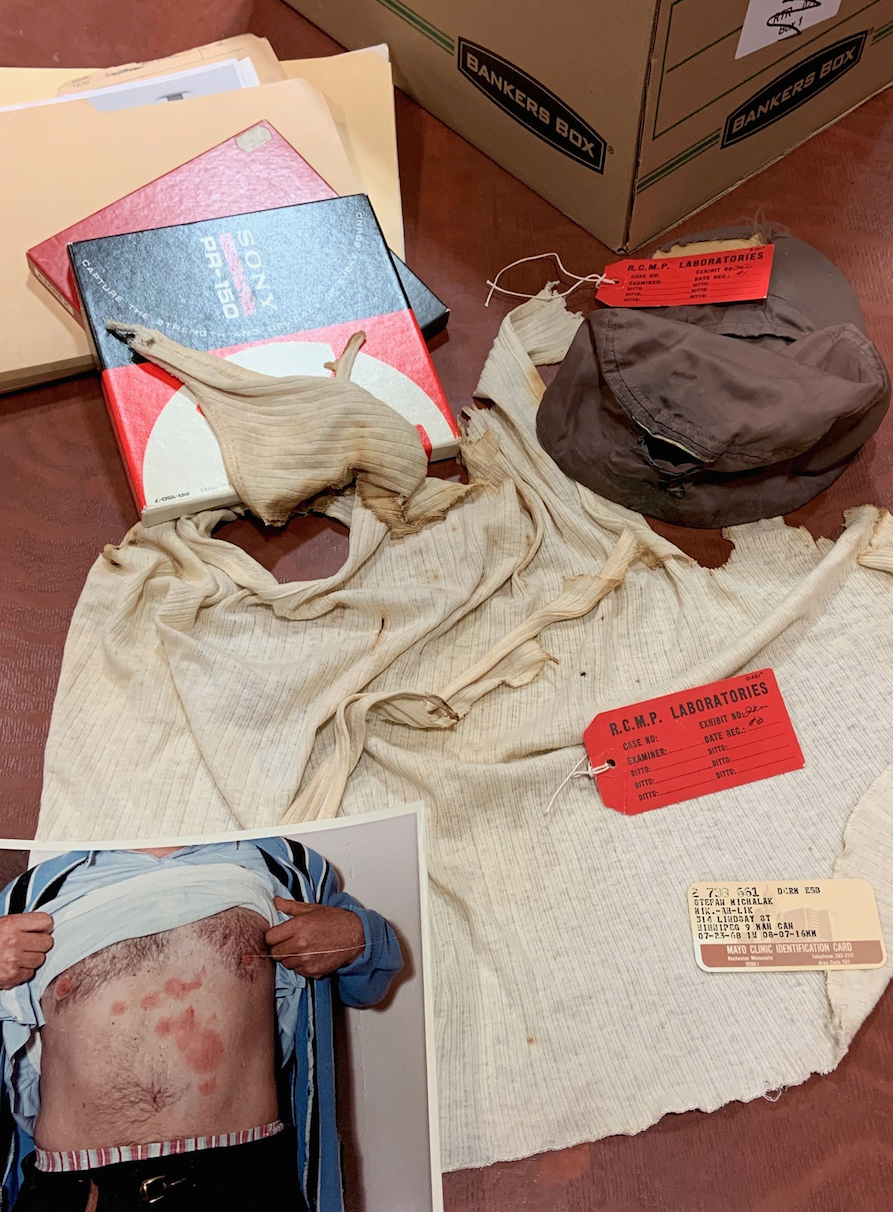
Michalak returned to Winnipeg and received medical treatment. The surviving record describes first-degree burns and a period of illness after the incident. Later reports also describe recurring physical symptoms and reappearance of the marks.
Every later medical detail should be tied to its source. But the basic point is strong: this was not simply a man telling a strange story and then going home unchanged.
Constable G.A. Solotki described Michalak as confused, frantic and appearing like someone who had been drinking. That observation belongs on the page.
So does the next part: the officer explicitly reported that he could not smell alcohol on Michalak.
That does not prove a UFO injury. It makes the contemporaneous observation more interesting than either side's simplified version.
Officers interviewed Michalak repeatedly and investigated the physical aftermath.
Royal Canadian Air Force / Canadian military investigators became involved in the case.
Medical and radiation concerns drew additional official attention.
The wider scientific UFO investigation also examined aspects of the case.
The alleged site became an important second physical strand. Investigators described a visible circular area and recovered or examined material associated with the location.
But the chain of custody is not clean enough to treat every later sample claim as equally strong. Michalak revisited the site before the formal RCMP/RCAF visit and removed material, which complicates later evidence handling.
Canadian archival discussion records radioactive contamination associated with some rock/soil material from the alleged site.
That conclusion requires a secure chain of custody, exact laboratory findings and exclusion of alternative contamination sources.
Metallic material and other samples have become part of Falcon Lake lore. The right way to present them is item by item: who recovered each sample, when, where, who handled it, which laboratory tested it, and what the report actually said.
Without that chain, “radioactive metal from a UFO” is a headline rather than an evidential conclusion.
Falcon Lake has inconsistencies: timing, site access, sample handling and details that shift between police documents and later retellings. Those should not be hidden.
They also should not be used as an excuse to pretend the burns, medical treatment and official investigation never happened.
Source criticism is not demolition. It is how the page earns trust.
Canadian authorities investigated the case. That is not an extraterrestrial conclusion.
The injuries are physical evidence of injury, not proof of the identity of the source.
Sample provenance and contamination history matter.
One officer said he appeared drunk/confused but explicitly noted no smell of alcohol.
Later symptoms and recurrences require medical records, not repetition.
Michalak alone saw the object, but the physical and documentary aftermath involved many others.
A close encounter followed by a much wider physical and official aftermath.
Michalak reported two luminous objects near Falcon Lake. He approached one, touched its hot exterior and then said a blast of hot gas or exhaust struck him as it lifted. His clothing burned and patterned injuries later appeared on his torso.
He returned ill, received medical treatment and was interviewed by the RCMP. Canadian military investigators became involved. The site was searched, physical samples were handled and the case accumulated a documentary trail that survives in Canadian archives.
From prospecting trip to national investigation.
Michalak reports the Falcon Lake encounter while prospecting.
He emerges burned, ill and confused; later returns to Winnipeg for treatment.
RCMP officers conduct extended interviews at his home.
RCMP, RCAF/Canadian military and civilian investigators pursue the case.
Michalak revisits the location before the formal joint site visit, complicating later sample pedigree.
Physical samples, medical questions and government files keep the case active.
Falcon Lake's archive is one of its strongest assets.
Official Canadian archival presentation covering the encounter, early aftermath and investigation.
Evidence, RCMP/RCAF investigation, samples and unresolved issues.
Production should link individual digitised records wherever available rather than relying only on later summaries.
The physical evidence makes a hoax explanation harder to wave away — but not impossible to test.
Hoax hypothesis
Would have to account for the burn pattern, clothing, illness, behaviour, repeated official scrutiny and sample history.
Physical mechanism
A conventional heat or contamination source remains conceptually possible but needs a coherent fit to the location and chronology.
Encounter explanation
Would explain the object without explaining every element of the aftermath unless the heat/exhaust mechanism also fits.
The evidence is unusually rich, but the most important gaps are technical.
The details that make Falcon Lake much more than a burn photograph.
Falcon Lake has enough evidence. What it needs now is cleaner provenance.
Library and Archives Canada's historical UFO database contains a large run of Falcon Lake records spanning 1967 through 1969. That matters because it shows the case did not consist of one police report followed by decades of retelling.
Multiple agencies and technical offices generated correspondence, site material and follow-up documentation over time. The depth of that archive is itself evidence of sustained official interest, even though no Canadian authority concluded that an extraterrestrial craft had been established.
For readers, the practical lesson is to separate documented government activity from later claims about what the government supposedly believed in secret.
Michalak's burns, illness and later medical treatment are among the strongest parts of Falcon Lake because they existed independently of later UFO books.
But medical documentation answers only part of the question. It can establish that a patient had burns, nausea, weakness or other symptoms. It cannot by itself identify the mechanism that caused them.
The correct evidential wording is therefore that physical injury and treatment are documented aftermath. The link from those injuries to the object Michalak described remains a causal inference.
The patterned marks across Michalak's torso became the visual icon of the case because they seemed to echo the grid or vent structure he described on the object.
That resemblance is important testimony, but it should not be upgraded into a proven mechanical match without exact timing, medical photography provenance and a demonstrated transfer mechanism.
Researchers should ask when each burn photograph was taken, how the pattern changed during healing and whether physicians recorded the same geometry independently before the UFO narrative spread.
Later Falcon Lake discussions often focus on radioactive soil or metallic fragments. Those claims are potentially important, but each sample needs its own chain of custody.
Where exactly was it found? Who collected it? Was it sealed? Which laboratory tested it? What isotope or count rate was measured? Did later samples come from the same location?
Without those answers, “radioactive material was found” can sound much more conclusive than the surviving record allows. The page therefore treats sample anomalies as evidence to trace, not as proof of exotic propulsion.
One RCMP officer described Michalak as appearing drunk or confused when encountered after the event, while also explicitly noting that he did not smell alcohol.
That is exactly the kind of awkward detail a serious page should preserve. It could point to shock, illness, dehydration, intoxication, neurological impairment or simple uncertainty by the officer.
Suppressing it would make the case look cleaner than the source record. Treating it as proof that Michalak was drunk would also go beyond the source.
The most valuable remaining work is forensic housekeeping: build a complete timeline of medical visits, identify every surviving burn photograph, map every soil and metal sample to collector and laboratory, and distinguish material recovered during official searches from material found later.
Falcon Lake is already strong enough to be interesting without treating every later anomaly as equally secure. A tighter chain of custody would either strengthen the physical-evidence case or remove claims that cannot carry their historical weight.
Even after every disputed sample claim is stripped away, Falcon Lake still contains a named witness, documented burns, damaged clothing, illness, medical care, official searches and a substantial government paper trail. That combination is why the case continues to reward careful investigation.
Falcon Lake does not survive because Stefan Michalak told an extraordinary story. Plenty of UFO cases have extraordinary stories.
It survives because he came out of the woods with a physical aftermath that other people had to deal with: burns, damaged clothing, illness, medical treatment, police interviews, military investigation, a site search and physical samples.
None of that proves the object he described was extraterrestrial. The sample history is messy in places. The medical story must be kept tied to actual records. Michalak alone saw the object.
But the case does not collapse when the encounter ends.
The strange part of Falcon Lake is what remained after the object was gone.