THE UAP MAP
REAL CASES. REAL EVIDENCE. YOUR JUDGEMENT.
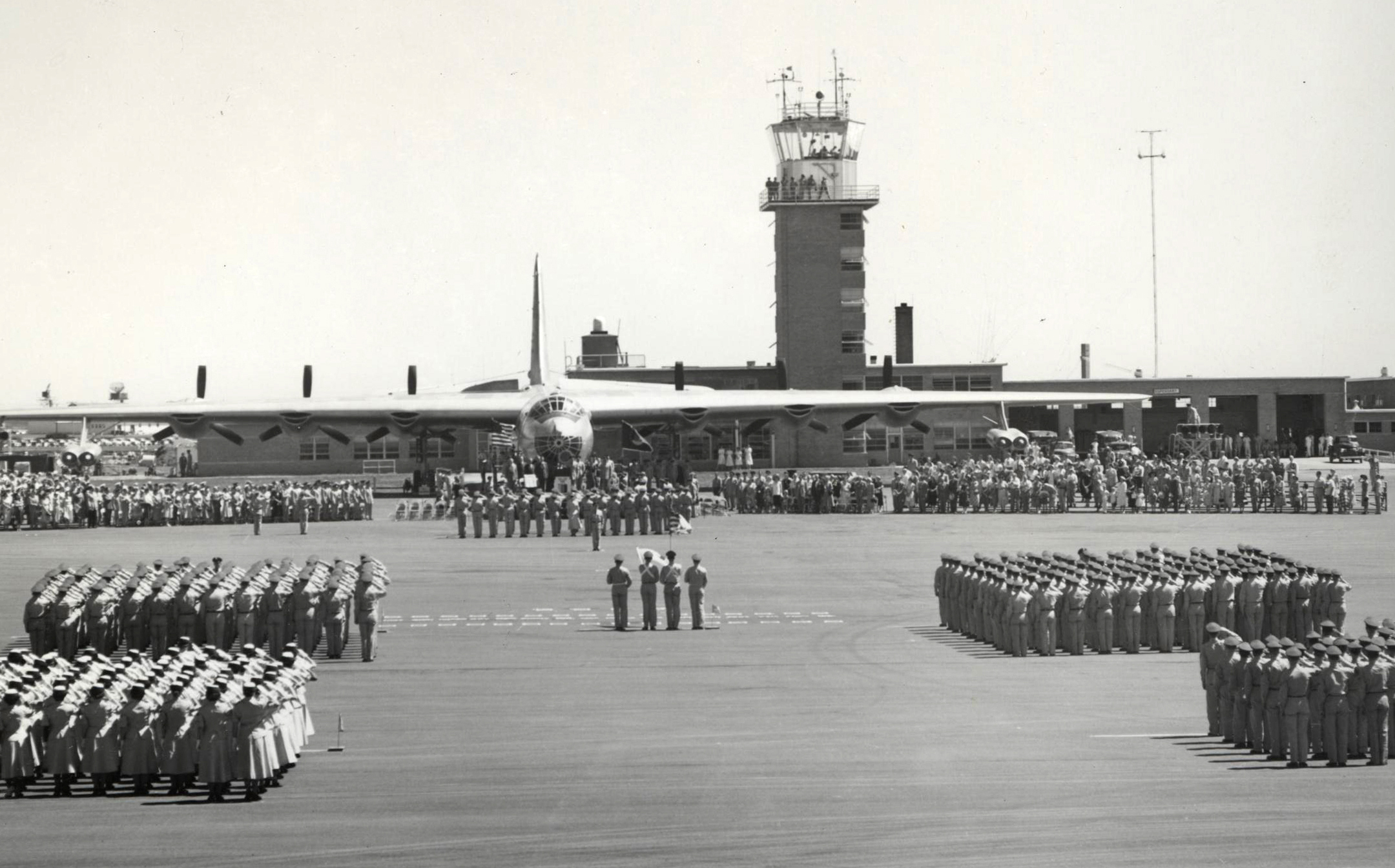
Historic 1953 United States Air Force photograph of Ellsworth Air Force Base, South Dakota
FLAGSHIP RADAR-VISUAL CASE · ELLSWORTH AFB / RAPID CITY · 5 AUGUST 1953

The Ellsworth AFB incidentground radar. two F-84 intercepts. airborne visual contact. a radar gunsight that lit up.

At 8:05 p.m. a Ground Observer Corps post near Black Hawk reported a bright light northeast of Rapid City. Within minutes Ellsworth radar operators, ground personnel and fighter pilots were involved in a night-long sequence that Project Blue Book investigated on site — and ultimately carried as Unsolved.
AUTHENTIC PERIOD CONTEXT · 1953 U.S. AIR FORCE PHOTOGRAPH OF ELLSWORTH AFB. NO AUTHENTIC IMAGE OF THE REPORTED OBJECT SURVIVES: THE RADARSCOPE AND GUN-CAMERA PHOTOGRAPHS TAKEN DURING THE INTERCEPTS WERE REPORTED UNUSABLE AFTER CAMERA MALFUNCTIONS. NOT AI GENERATED.
IMAGE PROVENANCE
U.S. Air Force historical photograph of Ellsworth AFB from 1953, distributed by Air Force Public Affairs. It is genuine period context, not a photograph of the reported object. The failure of the event cameras is part of the evidence record and is not concealed with reconstruction imagery.
5 Aug 195320:05 MST onward
2 F-84sSeparate intercept attempts
4 evidence strandsGround visual · ground radar · air visual · gun-sight radar
Blue BookStatus Report 12 · Unsolved
01 / WHY THIS CASE MATTERS

Ellsworth is valuable because the strongest evidence does not come from one witness remembering a strange light years later. It comes from a contemporaneous military sequence in which several different observation systems overlapped.

At approximately 20:05 MST, a Ground Observer Corps observer at Black Hawk, west of Ellsworth, reported a bright unidentified light to the Rapid City Filter Center. The light was first described as stationary and then moving south toward Rapid City.

The duty controller at Ellsworth began searching the radar picture. Three airmen were sent outside to look visually. The official report says they saw a light or streak moving generally north-to-south, while the radar operator saw targets moving in the same broad area.

Blue Book's file also records a height-finder return at roughly 16,000 feet during the sequence. That figure is important because it is more specific than a generic search-radar blip, but it should still be treated as an operator-reported radar reading rather than a preserved calibrated track.

The sequence escalated because the object or light was repeatedly reported as returning. Two F-84 Thunderjets were sent up on separate intercepts, and the second pilot reported a radar-gunsight indication while maintaining visual contact.

Project Blue Book considered the combination important enough to send an investigator to Rapid City. The case appears in Status Report No. 12, pages 20–23, where the conclusion is simply: Unsolved.

02 / WHY BLUE BOOK TOOK IT SERIOUSLY

Ellsworth did not disappear into the files as just another light in the sky.

Former Project Blue Book chief Edward J. Ruppelt later singled out the Rapid City / Ellsworth incident as one of the stronger cases in the programme's files because visual observations, radar tracking and fighter interceptions all appeared in the same operational sequence.

That later assessment is not additional 1953 evidence, but it matters historically: one of Blue Book's best-known insiders regarded the case as more difficult than routine astronomical or meteor reports.

Major Lawrence J. Tacker later confirmed that gun-camera and radarscope photography had been attempted during the incident. The official case record, however, says the camera systems malfunctioned and no usable images resulted.

That distinction is important: photography was attempted is not the same claim as usable photographic evidence survives.

04 / THE FIRST REPORT

The official file begins with a red or bright light near Black Hawk — and immediately records uncertainty.

The GOC observer reported the light northeast of her post, stationary at first and then moving. Later retellings often give her name as Phyllis Killian, while Edward Ruppelt's 1956 account renders it differently. The spelling discrepancy should not be silently harmonized.

Blue Book's own investigator did not personally re-interview the Black Hawk observers, noting that base personnel had already questioned them and that they were highly excited.

That matters because the GOC observation is central to the chronology but is not the strongest standalone component. One companion reportedly thought the first red light might simply have been a tower light, and the three airmen later sent outside produced descriptions Blue Book considered meteor-like.

Blue Book also noted the twilight setting. Sunset was around 7:20 p.m. MST, with twilight lasting roughly another half hour. By the time the strongest pilot observations developed, the sky was dark enough for bright stars to become relevant candidate explanations.

The case becomes stronger only when the later pilot and radar strands are added.

04 / FIRST F-84 INTERCEPT

A visual target and a ground-radar track moved north.

An airborne F-84 was vectored toward a stationary radar blip roughly fifteen miles northeast of Black Hawk. The pilot made visual contact with a bright light while the controller believed the aircraft had been vectored into the target carried on the scope.

Shortly after the visual contact, the radar target began moving on a heading of about 320° magnetic. The controller obtained four good blips. The final return occurred roughly 70 miles away before the aircraft was recalled.

The strongest defensible wording is operational correlation: visual contact and radar returns occurred in the same intercept sequence. The surviving file does not prove that every radar return and every light seen by the pilot were necessarily the same physical object.

When later interviewed, the first pilot described a silver light varying in intensity, brighter than the brightest star he had seen. He also reported episodes where it faded and reappeared.

Blue Book judged this pilot's contribution relatively limited because his visual observation was brief. That caveat is important: later narrative versions sometimes make the first chase more precise than the official interview supports.

05 / SECOND F-84 INTERCEPT

The second pilot is the strongest individual witness in the official file.

As the first aircraft landed, a second F-84 was launched. The pilot saw a bright light to his right while heading north and initially considered a star or planet. He checked for cockpit reflections and rejected that explanation.

He described the light as considerably brighter than a star, changing intensity and shifting from white toward green. Starting near 15,000 feet, he climbed to roughly 26,000 feet while the light appeared to increase its elevation.

Throughout the chase, the controller was carrying both the F-84 and an unknown radar target. The unknown appeared to remain roughly 5–10 miles ahead as the aircraft continued north until the intercept was broken off around eighty miles from the base.

The pilot stated that the light definitely moved relative to the stars — a key observation because any star explanation must account for perceived relative motion from a fast-moving aircraft.

06 / THE RADAR GUNSIGHT

The lock-on lamp came on. The same equipment later behaved erratically.

When the second pilot turned toward the light he switched on his radar gunsight. The warning/lock indication illuminated. Because the ranging system only began measuring within about 4,000 yards, the absence of a range meant the indication could establish, at most, a return somewhere beyond that threshold.

The light remained indicated during much of the chase.

But the official file records a major limitation: after the intercept, the indicator blinked on and off on the flight home, suggesting a possible malfunction. The gunsight was not checked by maintenance when the aircraft returned and had not been tested by the time of Blue Book's investigation.

So the gun-sight evidence is significant but not clean. It cannot honestly be presented as an independently verified hard radar lock on a craft.

07 / THE FAILED PHOTOGRAPHS

This case should have produced images. The cameras failed at the exact point where the file becomes most interesting.

Blue Book records that photographs were taken of the ground-radar track, but the scope camera malfunctioned and the resulting images were unusable. The second pilot also attempted gun-camera photography during a later visual encounter; those photographs were likewise reported as no good.

This missing-media problem cuts both ways. It prevents the case from having the strongest form of sensor corroboration, and it also prevents later analysts from independently checking what the operators thought they saw on the scopes.

The correct evidence statement is therefore reported radar tracking with failed photographic preservation, not “radar photographs prove the object.”

08 / BLUE BOOK'S OWN DOUBTS

The original investigators did not treat every report that night as equally reliable.

The ground airmen

Blue Book thought their brief visual report resembled a meteor and noted they had been sent outside specifically to look for a light.

The first pilot

His visual contribution was judged too brief to add much, even though he reported an unusually bright silver light.

The radar controller

The investigator accepted that he saw targets on the scope, but worried that the controller seemed invested in proving a UFO and that no usable scope photographs survived to check the exact behaviour.

The second pilot

Blue Book regarded him as realistic and methodical, noting that he actively tried to convince himself the light was a star but remained troubled by its apparent movement relative to the star field.

Blue Book's 1953 conclusion was not “solid craft confirmed.” After stripping away the weaker reports, it still could not close the remaining combination of visual, radar and intercept evidence.
09 / BALLOONS & WEATHER CHECKS

The investigator checked the Rapid City Weather Bureau balloon launched at 20:00. Its track carried it south from the municipal airport, out of the main sighting area.

Blue Book also noted that two upper-air research balloons associated with Lowry had been lost and could have been in the wider region. That possibility was not developed into a positive identification.

Temperature-inversion data were not immediately available to the 1953 investigator because the records had been forwarded elsewhere. That omission became important fifteen years later when the Condon project revisited the night using radiosonde and refractivity data.

10 / THE CONDON REPORT COUNTERCASE

Gordon D. Thayer's 1969 reconstruction is the strongest conventional explanation and deserves to be presented in full.

Thayer treated the incident as a wider Rapid City–Bismarck sequence, not just an Ellsworth local sighting. He reconstructed the night as a mixture of bright stars distorted by atmospheric inversion, at least one meteor, anomalous-propagation radar echoes, possible ghost echoes and a malfunctioning airborne radar gunsight.

His meteorological anchor was real: temperature inversions and radio ducts were present over Rapid City and Bismarck, conditions capable of generating deceptive radar returns. He classified the episode as a strong radar-visual problem — commonly summarized as a Class I-C case — while still arguing that multiple ordinary mechanisms could explain it.

For the first F-84 visual, Thayer proposed Pollux. For the second, he proposed Mirfak. He also cited the second pilot's later statement to Hynek that he felt he may have been chasing a star, even though aspects of the appearance still bothered him.

The gun-sight indication was assigned to malfunction, supported by its later erratic behaviour. The pacing radar target was interpreted as a ghost echo linked geometrically to the aircraft rather than a second physical target.

11 / WHERE THE CONDON CASE STILL HAS FRICTION

Why it is a serious explanation

  • It uses real meteorological inversion data from the night.
  • It identifies candidate stars in the relevant sectors.
  • It explains why ground radar could produce repeated spurious targets.
  • The second pilot's gunsight demonstrably behaved abnormally later in the flight.
  • Some weaker visual reports fit meteors or prompted expectation.

Why it is not a demonstrated identification

  • The actual gunsight was never maintenance-tested after the incident.
  • The failed scope photographs prevent independent reconstruction of the radar tracks.
  • The second pilot reported motion relative to stars, which is the key visual point a star explanation must overcome.
  • Blue Book had already excluded the local weather balloon as the main object.
  • The final explanation requires several ordinary mechanisms operating in the same night rather than one matched object.
12 / A SECOND SKEPTICAL LAYER

The conventional case did not stop with Thayer.

Later skeptical writers, including John Harney in the Magonia tradition, revisited the Ellsworth sequence and argued that the case could be understood through a combination of stars, meteors, radar anomalies and expectation effects without requiring one extraordinary vehicle.

That later work is useful because it shows the conventional interpretation is not dependent on a single Condon-era author.

But the same caution applies in reverse: a sequence assembled from several ordinary mechanisms can be persuasive without becoming a demonstrated historical identification. The value of Ellsworth is precisely that it forces the analyst to distinguish plausible reconstruction from matched cause.

13 / WHY THIS CASE STILL MATTERS IF THAYER WAS RIGHT

Even a fully conventional Ellsworth is still an important UFO case.

If Thayer's broad reconstruction is correct, the incident becomes a textbook demonstration of how a compelling military UFO case can emerge when several ordinary phenomena overlap: stars near the horizon, meteors, atmospheric ducting, radar propagation effects, a malfunctioning gunsight and pilots already tasked with finding an unknown.

That does not make the case trivial. It makes it valuable. Ellsworth shows why multi-sensor does not automatically mean single-object confirmation, and why each evidence strand has to be examined on its own before they are fused into one narrative.

If some part of the sequence remains unmatched after that process, the unresolved remainder becomes more meaningful because the weaker components have already been stripped away.

14 / WHAT IS SECURE

Well supported

  • A GOC report reached Ellsworth at about 20:05 MST on 5 August 1953.
  • Ground radar operators reported unidentified search-radar returns, with a height-finder reading reported around 16,000 feet during the sequence.
  • Two F-84 intercept attempts were made.
  • Both pilots reported unusual lights; the second gave the stronger visual account.
  • The second F-84's radar-gunsight indicator illuminated during the chase.
  • Project Blue Book sent an investigator and concluded the case was Unsolved.
  • The later Condon project produced a detailed conventional reconstruction rather than a simple dismissal.

Not established

  • That every visual and radar report that night referred to one object, or that every radar return was identical with the light seen by the pilots.
  • A usable radar-scope or gun-camera photograph of the target.
  • A maintenance-verified hard lock by the airborne gunsight.
  • A measured physical size or distance for the light.
  • A specific aircraft, balloon or other conventional object matching the entire sequence.
  • An extraterrestrial or otherwise exotic origin.
15 / SOURCE ROOM
PRIMARY BLUE BOOK REPORT
Project Blue Book Status Report No. 12
Official report spine for the 5 August 1953 Rapid City / Ellsworth radar-visual case, including investigator interviews, radar/pilot chronology and Unsolved conclusion.
NATIONAL ARCHIVES
U.S. National Archives — Project BLUE BOOK
Official custody and access information for the declassified Air Force UFO investigation files.
CONDON ANALYSIS
Condon Report — Gordon D. Thayer radar-visual analysis
Primary later skeptical reconstruction using stars, meteors, anomalous propagation, ghost echoes and possible gunsight malfunction.
RUPPELT / CASE HISTORY
Ellsworth / Rapid City historical case reconstruction
Useful for Ruppelt context, height-finder discussion and later Air Force correspondence; cross-check against Blue Book originals.
HARNEY / MAGONIA
John Harney skeptical analysis
Later conventional reconstruction independent of Thayer, useful as a second skeptical layer.
TRANSCRIPTION AID
Blue Book Status Report transcription
Useful navigation/transcription aid cross-checked against the official report reproduction.
COMPETITOR BENCHMARK
UAP Globe — Ellsworth Air Force Base Incident
Strong live competitor synthesis; used to identify information gaps while keeping Blue Book and Condon documents as authority.