Star-like morphology is real
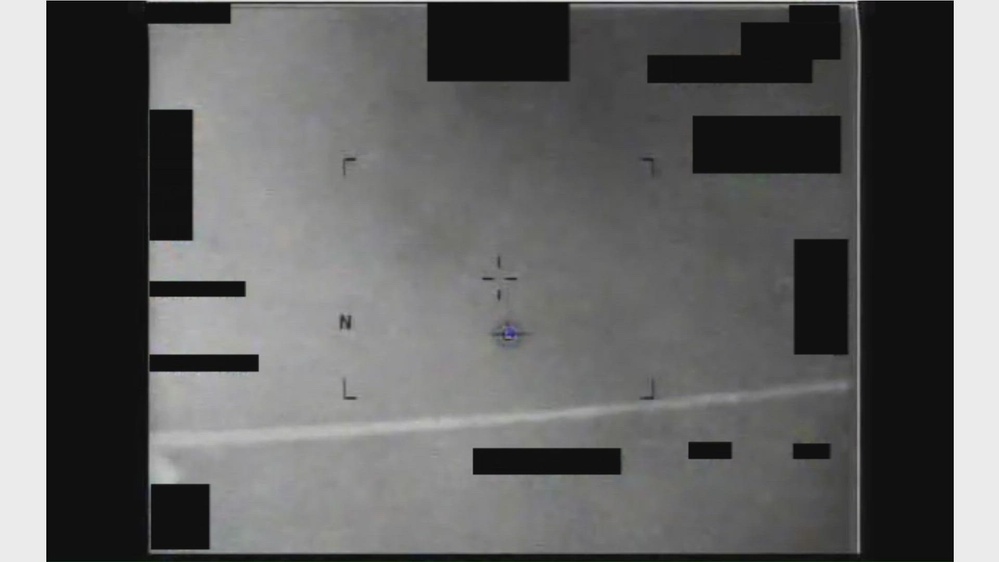
The released IR frame genuinely resembles an eight-pointed star with alternating long and short arms.
CENTCOM · MIDDLE EAST · 2013 · PURSUE RELEASE 01
A dark infrared shape with alternating long and short arms moves across the sensor field with a faint visible trail. AARO says the contrast resembles an eight-pointed star. Online, the clip has been compared with an Ophanim or “biblically accurate angel.” The resemblance is striking; the public record still does not establish that a physical object literally had eight rigid points.
WATCH OFFICIAL PR38 VIDEO ↗THE FAST ANSWER
The released IR frame genuinely resembles an eight-pointed star with alternating long and short arms.
The reporter provided no oral or written observation account, so the shape description comes from the released image and AARO's later wording.
Without range, resolution, raw frames or sensor calibration, the eight arms cannot be promoted into eight confirmed rigid appendages.
THE ACTUAL RELEASED IMAGE
Four longer points appear to alternate with four shorter ones around a central dark body. That is exactly why PR38 attracts attention. But IR systems can turn unresolved sources, glare, focus effects and motion smear into highly structured silhouettes. The picture deserves to be shown clearly — and interpreted carefully.
THE OPHANIM / “BIBLICALLY ACCURATE ANGEL” THEORY
The viral theory is worth covering because readers search for it. It should be framed as cultural interpretation of the image, not evidence about the target's identity.
WHAT THE GOVERNMENT ACTUALLY RELEASED
U.S. Central Command submitted PR38 to AARO. The release says the footage came from an infrared sensor aboard a U.S. military platform in 2013. The reporter provided no oral or written description of the observation.
That means there is no published account of what anyone saw by eye, how far away the target was, how large it appeared, what direction the platform was travelling, whether radar was involved, or what the operator believed the target to be.
DVIDS lists the location as undisclosed. “Middle East” is the release-level regional label; it is not a precise event coordinate.
THE OFFICIAL TIMELINE
The sensor field of view narrows to zoom in on the contrast.
The area of contrast moves within the field of view, followed by a visible trail.
The contrast exits at the bottom-right edge.
Following an apparent edit, the contrast remains generally in view before exiting from the top-left quarter.
The five-second gap and apparent cut mean the public clip should not be treated as one uninterrupted continuous track.
Any claim about continuous motion, acceleration, trajectory or a single uninterrupted trail must stop at this edit point. The later segment may show the same target, but the public file does not prove what happened during the missing interval.
WHY AN IR TARGET CAN LOOK LIKE A STAR
Bright unresolved sources can produce radial spikes or lobes whose spacing reflects the optical system rather than the source's physical outline.
When a source is near or below the sensor's resolving limit, defocus can turn a compact target into a structured multi-lobed shape.
Strong contrast can spill into neighbouring pixels, lengthening some apparent arms and exaggerating symmetry.
Platform motion, line-of-sight change and image processing can add asymmetric extensions or trails around a compact source.
This is the strongest conventional challenge to the “literal eight-pointed object” reading. It does not identify PR38; it explains how a sensor image can look more geometrically specific than the underlying source.
THE VISIBLE TRAIL
AARO explicitly notes a visible trail from 00:11 to 00:29. That makes the feature part of the official description, not an invention by commentators.
But “trail” does not automatically mean exhaust, smoke or unconventional propulsion. In infrared imagery it could represent a thermal wake, atmospheric effect, motion smear, processing artifact, background persistence or a genuine physical emission. The public release does not contain enough sensor metadata to distinguish those possibilities.
WHAT COULD IT HAVE BEEN?
| Candidate | Why it can fit | What is missing |
|---|---|---|
| Aircraft / drone | An unresolved airframe at a compressed aspect can produce a multi-lobed thermal silhouette. | Range, heading, traffic data and resolved structure. |
| Missile / rocket / flare | A bright source with a trail can produce dramatic IR morphology. | Event timing, trajectory, launch records and spectral data. |
| Balloon / suspended payload | Irregular shapes and tether/rigging can collapse into a star-like unresolved image. | Wind, scale, altitude and exact location. |
| Optical / sensor artifact | Spikes, blooming, focus and processing can create alternating arms around a compact source. | Sensor model, raw frames and calibration data. |
No public explanation has demonstrated an identification for PR38. These remain candidate families, not verdicts.
COMPETITOR PASS
UAP Globe correctly foregrounds the authentic frame, the alternating-arm morphology, the visible trail, the lack of witness description and the exact AARO timeline. It also treats the “eight-pointed star” as a description of the image rather than a solved physical structure.
Some other pages go further and call PR38 an eight-pointed-star formation of objects. That is not supported by the official wording, which describes a single area of contrast resembling a star. The UAP Map keeps that distinction explicit, covers the viral Ophanim angle without endorsing it, and gives the apparent cut at 00:35 real evidential weight.
SOURCE ROOM