28 years of military aviation experience
The observer framed the event against a long USAF/USN career and said the flight characteristics were unlike anything previously seen.
U.S. NAVY RANGE FOULER · EASTERN UNITED STATES · 2019
A twenty-second infrared clip would be easy to dismiss as another unresolved blob — except for the debrief attached to it. An observer with 28 years of service across the U.S. Air Force and U.S. Navy described a small phenomenon travelling in a straight line in the opposite direction at high speed and said its flight characteristics were unlike anything seen across that career. That testimony is the heart of PR112. The released pixels still do not provide a measured speed, range or extraordinary-performance solution.
WATCH OFFICIAL PR112 VIDEO ↗THE FAST ANSWER
The observer framed the event against a long USAF/USN career and said the flight characteristics were unlike anything previously seen.
PR112 is not an anonymous internet video. It sits inside an operational reporting chain and is paired with Range Fouler Debrief D090.
The phrase “high speed” comes from the observer account. The public sensor file does not provide enough geometry to reproduce a physical speed.
THE RELEASED EVIDENCE
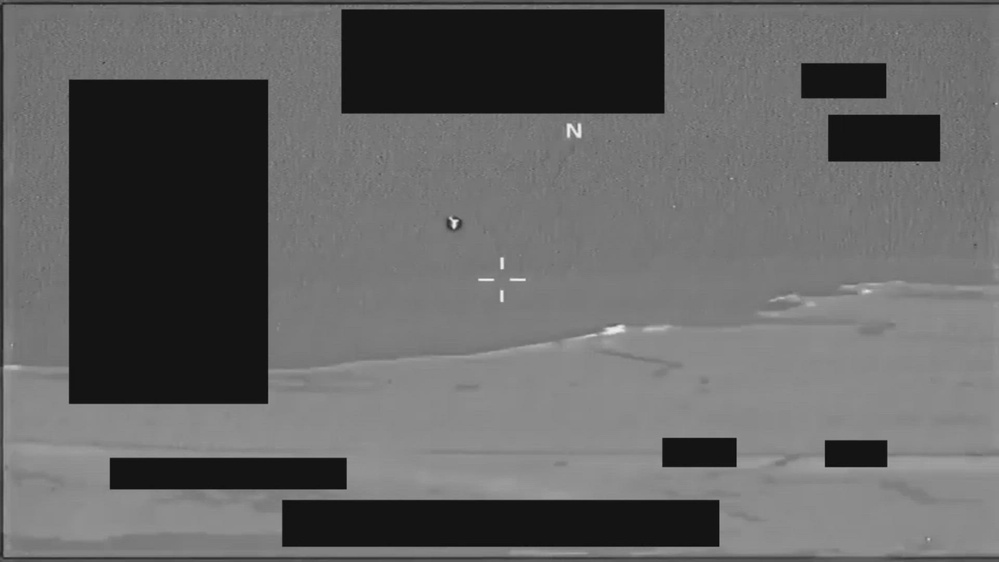
In the public video, the target remains a small unresolved area of contrast near the centre of the display before leaving the field as the sensor changes zoom and display mode. There is no resolved shape, visible propulsion, measured size or published range.
THE LINE EVERYONE QUOTES
“flight characteristics unlike anything [the observer] had seen in 28 years [of service] for the U.S. Air Force and U.S. Navy.”
RANGE FOULER DEBRIEF DOW-UAP-D090 · AS SUMMARISED BY AARO/DVIDSThat sentence deserves to be prominent because it is genuinely unusual context. But it has to remain in the right evidential lane. It is a witness assessment recorded in D090. AARO is releasing the statement; AARO is not independently certifying that the object's performance exceeded known aircraft.
THREE EVIDENCE LANES
A small unresolved area of contrast is visible for roughly eleven seconds before sensor mode/zoom changes and the target leaves frame. The video alone does not establish size or extraordinary performance.
D090 contains the important qualitative claims: small target, opposite direction, high speed, straight-line motion and flight characteristics unlike anything seen in 28 years of service.
AARO publishes and contextualises the material. It does not convert the witness's judgement into an analytical finding that the target exceeded known aircraft performance.
WHAT THE OFFICIAL RECORD SAYS
The U.S. Navy submitted PR112 to AARO with 20 seconds of infrared footage from a sensor aboard a civilian aircraft in 2019. The accompanying Range Fouler Debrief D090 characterises the phenomenon as “small” and “travelling in a straight line [in the] opposite direction at high speed.”
The public release does not give an exact location, range, altitude, angular size, measured velocity, radar correlation, aircraft groundspeed or sensor model. So the most dramatic phrase — “high speed” — remains an experienced observer's characterization rather than a number readers can independently reproduce from the release.
THE 20-SECOND SENSOR TIMELINE
An area of contrast is visible near the centre of the sensor display.
The sensor changes zoom and display mode, flashes white, returns to normal, and the contrast exits left.
The sensor changes settings again, producing another white flash. No target content is visible.
AARO explicitly says this timeline is informational only and must not be read as an analytical judgment or investigative conclusion.
WHY “HIGH SPEED” IS HARD TO MEASURE FROM THE CLIP
The same angular motion can represent modest speed nearby or far greater speed at long range.
The sensor platform is moving. Relative motion and parallax can amplify or reduce apparent target movement.
Zoom and display-mode changes alter how quickly a target appears to move across the screen.
Without bearing history, slant range and platform attitude, the clip cannot be turned into a defensible velocity calculation.
The observer may have had better situational context than the public viewer. That is precisely why the debrief deserves weight — and why it should remain testimony rather than reconstructed physics.
WHAT “RANGE FOULER” MEANS
“Range fouler” is military reporting language for an unexpected or unauthorised object intruding into a training or operating area. The fact that PR112 entered that reporting system matters because it means the observation was treated as an operational event worth documenting.
It does not mean the Navy had already concluded the object displayed non-human technology. The debrief records what the observer reported; identification remains unresolved in the public release.
WHAT COULD IT HAVE BEEN?
| Candidate | Why it can fit | What is missing |
|---|---|---|
| Bird | A nearby bird can cross an IR field rapidly while remaining unresolved, especially against a featureless background. | Range, wingbeat-resolving imagery and flight geometry. |
| Balloon / debris | A small nearby object can appear to move quickly relative to a moving aircraft and sensor line of sight. | Wind, range, aircraft motion and size. |
| Drone | A compact UAS could plausibly create an unauthorized range intrusion and unresolved thermal return. | Exact location, traffic logs, range and resolved structure. |
| Aircraft | A distant aircraft at unusual aspect can collapse to a compact IR contrast source. | Traffic data, distance, aspect and sensor metadata. |
| Parallax / sensor geometry | Own-aircraft motion can exaggerate apparent target speed when distance is unknown. | Platform track, slant range and line-of-sight angles. |
None of these is a demonstrated identification. The point is that the public release does not contain enough geometry to test them decisively.
The original D090 debrief, full flight context, exact civilian-aircraft track, target bearing history, sensor model, slant range, radar correlation and any crew or controller statements beyond the short AARO summary.
COMPETITOR PASS
UAP Globe correctly leads with the 28-year career statement and explains why a professional aviator's reaction matters. It also preserves the Navy range-fouler context and the description of a small target moving in the opposite direction at high speed.
The UAP Map's opportunity is precision and information architecture: D090 is the source of the witness account, not AARO analysis; “high speed” is not a published velocity; the sensor was aboard a civilian aircraft; the witness testimony and sensor clip are separate evidence lanes; and the twenty-second video is too thin to establish extraordinary performance without range. That lets us keep the genuinely interesting testimony without turning it into physics the public record does not contain.
SOURCE ROOM