Long enough to watch behaviour
Unlike many 10–20 second releases, PR105 gives nearly two minutes of repeated target tracking before the target is lost.
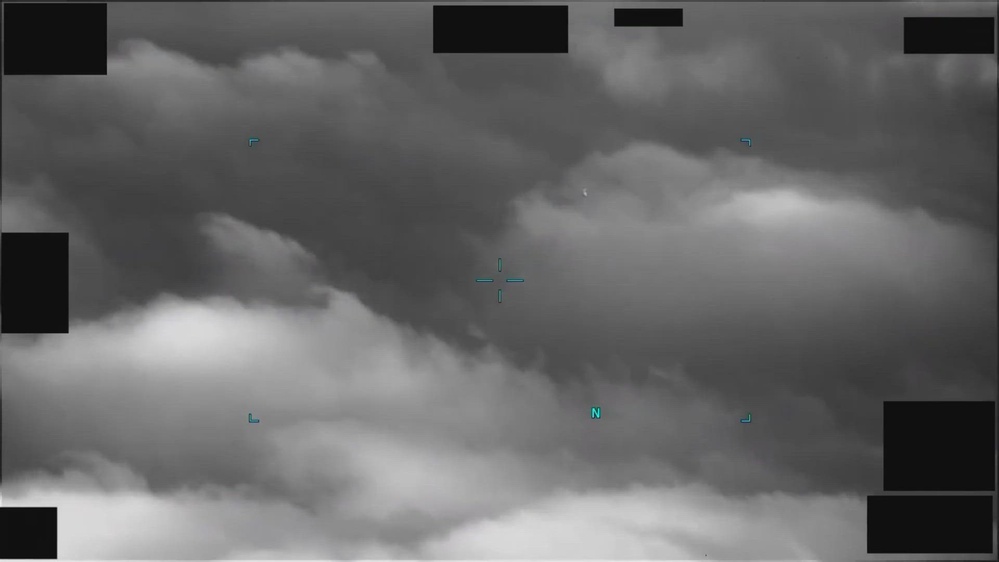
INDOPACOM · EAST CHINA SEA · 2025 · PURSUE PR105
Most government UAP releases last seconds. PR105 runs 4 minutes 59 seconds. For roughly the first two minutes, a U.S. military infrared sensor repeatedly tracks a faint area of contrast as it drifts, fades and sharpens against thermal background. For the remaining three minutes, AARO says there is “No content.” The unusual feature here is not spectacular manoeuvring — it is the unusually long look at something the public release still does not identify.
WATCH OFFICIAL PR105 VIDEO ↗THE FAST ANSWER
Unlike many 10–20 second releases, PR105 gives nearly two minutes of repeated target tracking before the target is lost.
The contrast intermittently loses distinctiveness against the background and repeatedly approaches or exits the right side of frame.
The public clip does not show abrupt reversals or a released speed solution. That makes ordinary explanations harder to exclude, not easier.
WHAT SURVIVES SCRUTINY?
The operator does not merely catch a fleeting flash. The sensor repeatedly follows and reacquires the contrast over a meaningful interval.
Panning, zooming and repeated attempts to keep the contrast in view show sustained interest from the operator, even though the reason for that interest is not released.
The contact looks compatible with conventional explanations, but the government release does not close it as a balloon, aircraft, bird or sensor effect.
That is a stronger and more defensible pro-UAP case than inventing extraordinary manoeuvres the footage does not show.
THE ACTUAL RELEASED IMAGE
PR105 does not present a crisp craft silhouette. The target appears as a small, soft area of contrast that becomes more or less distinct as the sensor tracks it against a changing infrared background. That morphology is central to both the anomalous and conventional readings.
WHAT THE GOVERNMENT ACTUALLY SAYS
The United States Indo-Pacific Command submitted PR105 to AARO as an unidentified anomalous phenomenon report consisting of five minutes of video from an infrared sensor aboard a U.S. military platform in 2025.
The official record never calls the target an orb, craft, balloon or vehicle. It uses the deliberately neutral phrase “area of contrast.”
AARO also states that its description is informational only and must not be read as an analytical judgment, investigative conclusion or factual determination about the event's nature or significance.
THE OFFICIAL 4:59 TIMELINE
The sensor pans to keep an area of contrast generally centred.
Black rectangular overlays briefly appear during an adjustment.
The sensor follows the contrast; portions intermittently lose distinctiveness against the background.
The sensor zooms in and pans right-to-left; the contrast exits the right edge several times.
The sensor zooms and pans against background. AARO explicitly says there is no content.
The five-minute runtime is useful context, but only the first 2:05 contains target-related content according to the official description.
THE 4:59 RUNTIME — VISUALLY
This distinction is important for search accuracy. Calling PR105 a “five-minute tracked UAP” is stronger than AARO's own timeline supports. It is a five-minute file containing roughly two minutes of target-related material.
WHY THE TARGET FADES
AARO notes that portions of the target intermittently lose distinctiveness against the background. In infrared imagery that can happen when the apparent temperature of a distant target approaches the apparent temperature of cloud or background, when cloud partially obscures it, or when sensor gain and viewing geometry change.
That does not prove a balloon. It does mean the fading itself is not evidence of cloaking, disappearance or material transformation.
WHAT COULD IT HAVE BEEN?
| Candidate | Why it can fit | What is missing |
|---|---|---|
| Balloon / payload | A slow, drifting unresolved target that fades against cloud and remains trackable for minutes is consistent with wind-borne material. | Range, wind profile, altitude, size, payload structure and an official attribution. |
| Aircraft | A distant aircraft at favourable aspect can collapse into a soft IR contrast and appear to move slowly. | Traffic data, range, heading and resolved structure. |
| Bird / biological target | Low-resolution IR can turn a small warm target into a soft, variable blob. | Range, wingbeat-resolving frames and scale. |
| Sensor / atmospheric effect | Cloud, gain and contrast can make a weak source appear, fade or smear. | Raw sensor data, calibration and atmospheric context. |
Outside analysts, including Avi Loeb, have argued that the long, slow morphology is compatible with a balloon carrying a suspended payload. That is a useful conventional benchmark, not an AARO determination.
Range, platform track, wind profile, altitude, sensor model, native-resolution imagery, any visible-light view, and traffic or balloon-launch data from the relevant operating area. Without those, “balloon” remains plausible rather than demonstrated.
WHY A PROSAIC OBJECT CAN STILL MATTER
If PR105 was a balloon, drone or other conventional object, a military sensor still tracked an unidentified contact over the East China Sea for nearly two minutes and the public release does not show that it was attributed. In a strategically sensitive maritime theatre, that can matter even without exotic performance.
This is one reason the strongest version of the page should not force a mystery. The genuinely interesting question is why the contact remained unidentified in the released record despite the unusually long observation.
RELATED CASECompare the 2025 PR105 record with the two earlier INDOPACOM infrared releases from the same broad region.
COMPETITOR PASS
UAP Globe correctly emphasises that PR105 is not compelling because of spectacular manoeuvres. It is compelling because the release gives a long, patient look at a faint contact over the East China Sea and because that contact remains officially unresolved.
The UAP Map's advantage is to sharpen the distinction between the 4:59 file length and the ~2:05 period containing target content, surface AARO's “No content” wording explicitly, explain why gradual fading against thermal cloud is compatible with conventional objects, and still preserve the strongest unexplained point: after an unusually long military-sensor observation, the public release does not show a final attribution.
SOURCE ROOM