THE UAP MAP
EVERY CASE HAS A PLACE
DELPHOS · KANSAS · 2 NOVEMBER 1971

The object left.
The ring stayed behind.

Sixteen-year-old Ronald Johnson said a brilliant multi-coloured object hovered low on his family's farm. Minutes later, his parents saw a receding light — and a glowing ring on the ground where Ronald said the object had been.

RONALD JOHNSON · GLOWING GROUND RING · LAW-ENFORCEMENT INSPECTION · SOIL SAMPLES · WATER REPELLENCY · NO BLUE BOOK INVESTIGATION
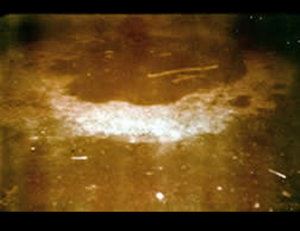
Delphos glowing ring photographed shortly after the 1971 sighting
Genuine Delphos case photograph. The glowing ring photographed roughly ten minutes after the reported encounter. Humanities Kansas identifies the image as sourced from MUFON. Production reuse rights should be confirmed before live deployment.
2 NOV 1971Johnson family farm near Delphos, Ottawa County, Kansas.
1 DIRECT OBJECT WITNESSRonald Johnson was the sole close-range witness to the object.
GLOWING RINGParents later saw the trace and a receding light.
PHYSICAL SAMPLESLaw enforcement and later investigators collected soil for analysis.
WHY DELPHOS MATTERS

The strongest evidence begins after the UFO is gone.

Most UFO reports depend almost entirely on memory. Delphos left something on the ground.

On the evening of 2 November 1971, Ronald “Ronnie” Johnson was working outside on his family's farm near Delphos when he reported hearing a rumbling sound and seeing a luminous object hovering close to the ground among the trees.

He later described the object as bright and multi-coloured, with a strong light beneath it.

After several minutes, Ronald said the object rose and departed.

He called for his parents.

Durel and Erma Johnson did not witness the full close encounter. That distinction is critical. They arrived afterward and reportedly saw a bright light receding in the distance.

Then they saw the ground.

At the reported hover site was a luminous ring.

The strongest part of Delphos is not only what Ronald said he saw. It is what other people saw after the object was gone.

RONALD'S ENCOUNTER

A luminous object low beneath the trees.

Ronald Johnson was sixteen and working near the family sheep pens at about 7 p.m.

He described a bright object close to the ground, with a domed or mushroom-like profile in later investigation records and a strong luminous area beneath it.

The object reportedly hovered for several minutes.

Ronald also described a rumbling sound that changed as the object departed.

Later reports included a temporary visual effect or loss of clear vision as the object brightened and left.

These details are dramatic, but they remain Ronald's testimony.

No photograph of the object itself was taken, no radar track independently fixed its position, and no instrument measured its altitude or dimensions.

The encounter therefore has to be separated from the physical trace that followed.

THE PARENTS ARRIVE

They did not see the hover. They saw the aftermath.

This distinction makes the case stronger, not weaker.

Durel and Erma Johnson were not second witnesses to every part of Ronald's account.

When they came outside, the close object had already departed.

They reportedly saw a bright light moving away in the distance.

More importantly, they saw the luminous ring at the reported hover location.

That means the object sighting and the ground trace can be evaluated as two separate evidential strands.

Ronald supplies the encounter. The family and later investigators supply the trace.
THE RING

Bright, dry and physically different from the surrounding soil.

Early reports describe a ring or doughnut-shaped area of altered soil.

The ring glowed or appeared bright shortly after the event.

The surface was described as cool rather than hot, despite the luminous appearance.

One of the most striking early observations was the contrast with the surrounding ground.

The surrounding soil was damp or muddy. The ring itself was unusually dry.

Later investigators repeatedly described the ring soil as water-repellent or hydrophobic: poured water tended to bead or remain on the surface rather than soak in normally.

The soil is real. The alteration is real. What produced it is still the argument.

THE NIGHT PHOTOGRAPH

The trace was documented before the story had decades to grow.

The Delphos case benefits from something many classic physical-trace cases lack: photographs connected closely to the event.

Humanities Kansas preserves a gallery entry identified as the Delphos ring about ten minutes after the sighting, sourced from MUFON.

Later photographs also document the trace over subsequent months.

These images do not tell us what caused the ring.

They do establish that the mark was not invented decades later as part of UFO folklore.

The provenance of each reproduction still matters. Production should retain the earliest-generation image possible and document the chain from photographer to archive to web copy.

LAW ENFORCEMENT

The sheriff saw the ring — not the UFO.

This is the evidential line that often gets blurred in retellings.

Local law-enforcement personnel inspected the site the following day.

Early sheriff material described a ring-shaped dry area contrasting strongly with wet or muddy soil around it.

Samples were taken.

A Civil Defense radiological monitor was reportedly used, and the soil was reported as non-radioactive.

That negative result matters.

Delphos should not be described as a “radioactive landing site” unless a specific later test is separately sourced.

Law enforcement corroborates the physical ring. It does not independently corroborate Ronald's close-range object description.

TED PHILLIPS

The case moved from police inspection to trace investigation.

Physical-trace researcher Ted Phillips visited Delphos and became one of the most important investigators associated with the case.

His work documented the scene, interviewed the Johnson family and collected ring and control soil.

Phillips also tested the ground's behaviour with water.

The contrast reportedly persisted: surrounding soil darkened and absorbed water, while the ring soil resisted wetting.

That water repellency became one of Delphos's defining physical features.

But sampling controls matter.

Modern readers should ask exactly where each sample was taken, how deep it was, how control soil was selected, how containers were stored and whether later laboratories were analysing identical material.

THE SOIL ANALYSIS

Years of laboratory work produced anomalies — and arguments.

Preserved Delphos soil was examined in later years by multiple researchers.

Published work described differences between ring samples and control soil, including unusual hydrophobic behaviour and chemical or organic constituents proposed as possible causes of the physical coating.

Some analyses explored whether organic compounds could account for the ring's water repellency and apparent luminescence.

Later summaries also reported elemental differences between ring and control samples.

Those findings are interesting because they move the case beyond testimony.

But they do not automatically identify the source of the altered soil.

A laboratory can establish that two samples differ chemically without establishing whether the difference came from an unknown aircraft, fungal activity, animal waste, agricultural contamination or another terrestrial process.

CHAIN OF CUSTODY

The older the sample, the more provenance matters.

Delphos is unusually testable — but only if the material history is clear.

Every preserved soil sample has a chain: who collected it, where it was stored, when it was subdivided, which laboratory received which portion and how contamination was controlled.

Later chemistry cannot be interpreted properly without that chain.

If a sample sat for years in a container, was exposed to handling or was taken from a slightly different part of the ring, its composition may not represent the original surface state exactly.

This does not invalidate the analyses.

It means conclusions must scale with provenance quality.

THE WATER-REPELLENCY QUESTION

Why the ring stayed strange after the glow was gone.

Hydrophobic soil is one of the most persistent Delphos observations.

Water repellency can occur naturally.

Organic coatings from plants, fungi, microbial processes, waxes, oils or other compounds can reduce wetting.

That means “water would not soak in” is not, by itself, evidence of exotic propulsion.

But the timing and localisation matter.

If the soil at one ring-shaped site suddenly behaved differently from adjacent control ground immediately after the reported encounter, the obvious question is what deposited or altered the material there.

This is why Delphos remains stronger than a generic fairy-ring comparison: the physical property was documented in the context of a specific reported event.
FUNGUS, ORGANICS AND NATURAL RINGS

Can biology make a UFO trace?

One conventional family of explanations involves fungal growth or other biological processes capable of producing circular changes in vegetation and soil chemistry.

Fairy rings are real. Microbial and fungal activity can redistribute nutrients, alter vegetation and change water behaviour.

Animal waste, oils or agricultural chemicals can also create localised soil changes.

The challenge is matching those mechanisms to the reported facts: the sudden appearance, the early glow, the strong dry/wet contrast and the precise location Ronald identified after his encounter.

A natural-ring explanation is therefore plausible in mechanism but must still be demonstrated at the actual site.

HOAX

Could the ring have been manufactured?

Any physical-trace case has to consider deliberate fabrication.

A circular mark can be made. Chemicals can be applied. Soil can be dried or coated.

But a hoax theory becomes stronger only when it identifies a practical method that reproduces the observed properties and fits the timeline.

That includes the glowing appearance, reported cool surface, unusual water repellency and later laboratory differences.

It also requires a motive and opportunity consistent with the Johnson family's actions and the rapid involvement of local authorities.

The absence of a demonstrated hoax is not proof of a UFO.

It simply leaves fabrication as one hypothesis among several.

NO PROJECT BLUE BOOK

A common historical mistake.

Project Blue Book had already ended by the time of the Delphos event.

The case therefore should not be presented as a Blue Book investigation.

J. Allen Hynek and civilian UFO organisations became involved through private or research channels, not as part of an active Air Force Blue Book case.

APRO and later MUFON-associated material are civilian UFO research sources.

Keeping those institutional roles accurate matters because “government investigated” carries a different evidential implication from “civilian specialists investigated.”

WHAT DELPHOS ACTUALLY HAS

A rare case where the evidence can be separated into layers.

TESTIMONY

Close object report

Ronald Johnson is the sole direct witness to the close-range object.

CORROBORATION

Receding light

His parents reportedly saw a bright light moving away.

PHYSICAL TRACE

Glowing ring

The family saw the ring and it was photographed soon after.

LAW ENFORCEMENT

Dry soil ring

Officers later inspected and sampled the physical trace.

LAB WORK

Preserved samples

Later researchers compared ring and control soil.

LIMIT

No source identified

No test establishes that an exotic craft created the material.

THE UFO READER'S BEST CASE

Something testable remained after the witness account.

That is what makes Delphos special.

Ronald's object description can be debated forever.

The ring cannot be dismissed as memory alone because other people saw it, it was photographed, law enforcement inspected it and soil was preserved.

The strongest pro-UFO interpretation argues that the coincidence between the reported hover location and the sudden unusual trace is difficult to dismiss as accidental.

The strongest conventional response is that unusual soil chemistry does not identify the process that created it and natural or artificial terrestrial mechanisms remain possible.

Both sides therefore meet at the same place: the sample.

THE IMMEDIATE TIMELINE

Why the first few hours matter so much.

Physical-trace cases become much weaker when the site is first examined days or weeks after publicity begins.

Delphos is stronger because the ring was reportedly noticed immediately after Ronald's encounter, seen by family members, photographed that night and inspected by law enforcement the following day.

That compressed chronology reduces some ordinary contamination possibilities. It does not eliminate them, but it means the physical mark was part of the original event sequence rather than a later discovery retrofitted to the story.

For researchers, the most valuable task is to preserve the exact order: when Ronald called his parents, when the ring was first touched, when the photograph was taken, when outsiders first arrived, when police samples were collected, and when later investigators entered the scene.

Every hour matters because foot traffic, weather and handling can change a trace.

THE NUMBING CLAIM

A memorable physical effect that needs careful sourcing.

Early case material includes reports that touching the ring material produced a numbing sensation in the skin.

Erma Johnson was among those said to have experienced this effect.

It is a striking claim because it suggests the trace was not merely a visual discoloration.

But unlike the ring itself, numbness is subjective and difficult to reconstruct decades later.

No immediate toxicology test identified a compound responsible for the sensation.

The claim should therefore remain part of the original testimony, not be upgraded into proof that the soil contained an exotic anaesthetic or energy residue.

If authenticated preserved material still exists, modern chemical screening could in principle test for compounds capable of causing transient skin effects.

PERSISTENCE

The trace reportedly lasted far longer than the glow.

The luminous appearance faded. The altered ground reportedly persisted.

Later photographs and investigator reports describe the ring as remaining visible months after the event.

Persistence matters because a fleeting optical illusion cannot easily explain a long-lived physical difference in the soil.

But persistence also gives natural processes more time to develop.

Vegetation growth, microbial activity, water movement and seasonal changes can all make an original mark evolve.

This means later photographs are valuable for documenting longevity but are less powerful than the first-night and next-day evidence for establishing the ring's initial state.

The evidential hierarchy should therefore be chronological: earliest photograph first, sheriff observations second, later persistence images third.

CONTROL SOIL

A physical anomaly only means something if the comparison is fair.

Laboratory testing becomes persuasive when ring soil is compared against nearby control soil collected at the same depth, under the same conditions and with the same handling.

If controls come from a different part of the farm, different soil horizon or different storage container, apparent chemical differences can be misleading.

This is especially important for claims involving potassium, manganese, copper, organic coatings or other concentration differences reported in later analyses.

The numbers may be accurate laboratory measurements while still being difficult to interpret environmentally.

A modern reanalysis should therefore treat sample metadata as seriously as the chemistry itself.

“Different from control” is only as strong as the control design.

INDEPENDENT LIGHT REPORTS

Possible corroboration exists — but should not be oversold.

Early investigation literature includes reports from people in the wider Delphos area who said they saw unusual lights around the relevant time.

Such accounts are potentially useful because they could corroborate that something luminous was in the regional sky independently of the Johnson family.

But they need exact timing, direction and first-generation documentation before being tied to Ronald's object.

A light seen miles away at roughly the same hour may be related, or may be completely unrelated.

The correct evidential wording is therefore “possible independent corroboration,” not “multiple witnesses saw the same craft.”

WHY DELPHOS IS DIFFERENT FROM A CROP CIRCLE

The evidential question is chemical and physical, not geometric artistry.

Delphos sometimes gets grouped loosely with landing marks, fairy rings and crop-circle cases.

But its value is not an elaborate pattern.

The mark was simple: a ring.

What attracted investigators was the reported glow, dryness, water repellency, persistence and the ability to preserve soil for testing.

That makes it closer to a forensic contamination question than to a symbolic ground-pattern mystery.

The relevant question is not “who drew the circle?” but “what process changed the soil at that location?”

THE STRONGEST SCEPTICAL CASE

A terrestrial trace can still follow a sincere UFO report.

The conventional case does not require Ronald to be lying.

He could have sincerely misidentified a luminous stimulus while an unrelated natural or chemical soil ring happened to be present nearby.

Alternatively, the trace could have been caused by a terrestrial process that itself produced unusual light, odour or visual effects and influenced his interpretation.

Or the physical mark could have been deliberately created without every family member understanding how.

These possibilities are less dramatic than an exotic landing, but they are scientifically legitimate because the source of the soil alteration has never been uniquely identified.

The burden on any extraordinary interpretation is therefore to show not merely that the ring was unusual, but that ordinary mechanisms fail under controlled comparison.

WHAT WOULD CHANGE THE CASE?

The missing work is archival and laboratory.

  • Secure the earliest-generation ring photographs and full provenance.
  • Recover original sheriff statements and photographs.
  • Reconstruct every surviving soil sample's chain of custody.
  • Identify which laboratory tested which sample and which control.
  • Repeat modern chemical analysis on authenticated material if viable samples survive.
  • Compare ring soil against local fungal, microbial, agricultural and animal-derived controls.
  • Separate findings from the 1971–72 investigation from claims added years later.
  • Recover any independent local witnesses who reported unusual lights before publicity.
WHAT REMAINS

The object left. The evidence did not.

Most UFO reports end when the light disappears.

Delphos did not.

A family saw the aftermath, law enforcement inspected the site, investigators sampled it and laboratories continued to argue over the material years later.

That does not turn Delphos into proof of an exotic craft.

It makes it something rarer: a case in which the extraordinary visual claim and the physical trace can be examined separately.

The soil is real. The alteration is real. What produced it is still the argument.

SOURCE ROOM

Start with the ring, not the legend.