More dramatic than the footage can prove.
CORYDON, INDIANA · 23 AUGUST 1987
The video is stronger than the calculations.
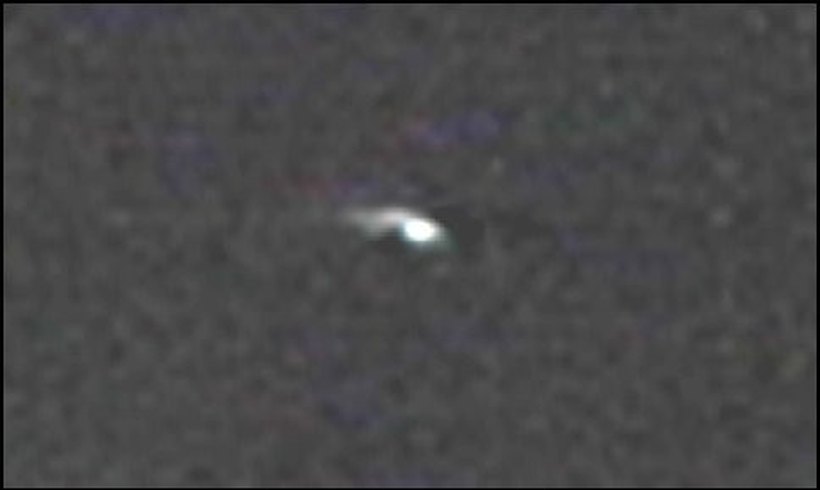
A MUFON team went into the field because Corydon was already producing UFO reports. Then a brilliant light appeared — and Scott Wilkerson's camcorder was running.
WATCH THE CORYDON VIDEO ↗WATCHED BY12–15 reported witnesses
RECORDED≈ 90 seconds
INVESTIGATIONMUFON Indiana
THE STAKEOUT
They were already looking.
On 23 August 1987, MUFON Indiana investigators were in the Corydon area because of an ongoing local sighting flap. This was not a decades-later reconstruction. The team had deliberately deployed, interviewed local witnesses and moved to an area where the strange lights had reportedly been appearing.
Before the unusual event, the investigators filmed a normal aircraft as a control sample. At around 10:20 PM, according to Francis Ridge's detailed report, a brilliant orange light appeared low in the south-southeast. Witnesses described it as headlight-like. It seemed to hover or approach, dropped lower, winked out and returned, then moved slowly across the sky.
BEFORENormal aircraft filmed as a control
≈10:20 PMBrilliant orange light appears
5–10 MINOverall visual event
≈90 SECRecorded by Scott Wilkerson
WHAT THE TAPE HOLDS
A real recording. Very little telemetry.
Wilkerson reportedly filmed at about 6× zoom. The surviving account says the witnesses saw the principal light as brilliant orange, with some binocular observers reporting a much smaller red component. The tape did not preserve those colours faithfully: the main target appears whitish and the smaller light is difficult to resolve.
That matters because a zoomed camcorder can preserve angular movement while badly distorting apparent size. Bloom around a bright point source can make a light look much larger than its true angular diameter.
MEDIA RULE: the footage should be shown as it survives. No artificial orange/red colourisation, no enlargement into a structured craft, and no physical-size claims from the luminous blob.
WHAT A SINGLE CAMERA CAN GIVE
Angular position · motion across the frame · foreground occlusion. Not range, altitude or physical diameter without additional geometry.
THE AIRCRAFT CROSSING
The moment everyone remembers.
During the final portion of the sequence, a conventional aircraft crossed very close to the unidentified light in the camera's line of sight. The visual is striking enough that the original MUFON investigators described an apparent near miss.
But their own report also preserved the crucial limitation: they did not know whether the aircraft and the unknown were at the same distance from the camera.
The tape cannot establish the two targets' true three-dimensional separation because their ranges are unknown.
CAMERA
Same line of sight ≠ same distance.
Two targets can nearly overlap in a frame while remaining widely separated in depth.
THE MISSING DIMENSION
Depth changes everything.
The often-repeated stall-speed argument depends on the same missing information. Investigators reasoned that if the unknown and aircraft were at roughly the same range, and if the aircraft was travelling around 120 knots, the unknown's angular movement suggested perhaps half that speed.
Neither input was independently measured. The unknown's range was not known, and the aircraft's speed was not recovered from flight data.
RESULT: “below stall speed” is a conditional calculation, not a measured performance characteristic.
THE POLE
The least famous detail may be the most useful.
The investigators believed some of the object's repeated “wink-outs” happened because it passed behind telephone or power poles. One such occultation was reportedly verified.
If the original tape, camera position and exact pole can be recovered, that could provide a genuine lower bound on range: anything disappearing behind that pole must have been farther away than the pole.
It still would not establish altitude, full range or physical size. But it would be a real geometric constraint — something the dramatic near-miss calculation does not currently have.
Beyond the pole
A verified occultation could establish a minimum distance if the pole geometry is recovered.
Everything after that
No altitude, full range, craft size or identity follows from a single foreground crossing.
CONVENTIONAL EXPLANATIONS
Aircraft remains in play.
The investigators considered the main target unusual, but the evidence does not let the page honestly declare ordinary explanations scientifically impossible.
Serious candidate
Against it: witnesses thought the lighting and motion were atypical. For it: range and speed are unknown, there is no radar, and a luminous point source can hide aircraft structure.
Raised at the time
An Evansville airport official discussed how distant headlights could look orange through haze or pollution. That does not neatly explain the entire moving sequence, but it belongs in the record.
Less attractive, not magically erased
The investigators rejected these possibilities. Without the original weather record and full geometry, modern copy should avoid claiming every alternative was quantitatively eliminated.
NO RADAR CASE
Experienced observers do not become sensors.
Harold Hartig reportedly had previous experience as a U.S. Air Force radar operator and Ground Observer Corps spotter. That makes his observational background relevant. It does not mean the Corydon object was detected on radar.
The Evansville airport contact was an explanatory follow-up, not sensor corroboration. No airport radar track of the unknown has been established.
CORYDON IS A CIVILIAN MUFON VIDEO CASE. Project Blue Book had ended in 1969. Do not describe this as a federal or Blue Book investigation.
THE ANALYSIS
The later conclusion was deliberately modest.
David Cook later carried out a computer analysis of the footage. The archival dating is inconsistent: one later directory labels a 1994 analysis, while Ridge's report says Cook's work was received and incorporated in August 1990.
The more important point is the conclusion preserved by Ridge:
“Unidentified — borderline significance.”
Not proof of exotic technology. Not proof of a near collision. Not proof of impossible flight. Unidentified.
WHAT SURVIVES
VIDEO
≈ 1.5 minutes
A prepared civilian investigation team recorded an unidentified luminous target.
LIMIT
The third dimension
The missing range is what prevents the most dramatic calculations from becoming measurements.
THE REAL MYSTERY
The tape is enough.
Corydon does not need the claim that a UFO nearly struck an aircraft while flying below stall speed.
A group of investigators was already in the field. Multiple witnesses saw the event. A camcorder captured roughly ninety seconds. A conventional aircraft crossed the same angular region, providing a useful comparison. A foreground-pole transit may eventually offer a genuine range constraint. And the later analysis still left the luminous target unidentified.
The strongest question is therefore simpler: what did Scott Wilkerson's camera record over Corydon that night?
SOURCE ROOM
Follow the record.
Francis Ridge / MUFON Indiana investigation reportPRIMARY / NEAR-PRIMARY CASE RECORD
Scott Wilkerson / MUFON photographic evidence documentationCAMERA / FORM 8 — ORIGINAL STILL A RETRIEVAL TARGET
Corydon videotape — surviving online uploadYOUTUBE LINKED BY NICAP · FIRST-GENERATION MASTER REMAINS THE HIGHEST-VALUE MEDIA TARGET
David Cook computer analysisFULL ORIGINAL VERSION / DATE STILL REQUIRES RECOVERY
Evansville Regional Airport follow-upEXPLANATORY CHECK — NOT RADAR CORROBORATION
NICAP Corydon case directoryARCHIVAL REPRODUCTION OF RIDGE MATERIAL · VIDEO · FRAME-GRAB LINKS