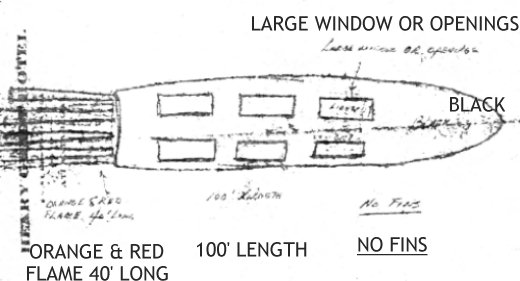
Historical 1950 FLYING magazine reproduction including Captain Clarence Chiles UFO sketch from the 1948 encounter
NEAR MONTGOMERY, ALABAMA · 24 JULY 1948

Two airline pilotssaw it coming head-on.

Clarence Chiles and John Whitted were flying an Eastern Air Lines DC-3 through the early-morning darkness when a luminous, wingless object appeared ahead. They said it passed close to their aircraft in seconds — dark body, bright windows, blue glow beneath and an orange-red trail behind it. Project Sign moved fast.

AUTHENTIC WITNESS-DERIVED CASE MATERIAL · CAPT. CHILES SKETCH · FLYING MAGAZINE 1950
REVIEW HERO · Historical case-related material from the July 1950 issue of FLYING magazine, including Captain Clarence Chiles’s own sketch of the object he reported in 1948. This is witness-derived documentary material, not a reconstruction created for The UAP Map. A 1948 Atlanta Journal photograph of Chiles and Whitted also survives and should be preferred for production if reproduction rights can be cleared.
24 JUL 1948pre-dawn encounter
2 PILOTSChiles + Whitted
1 PASSENGERreported a bright light
PROJECT SIGNmajor early Air Force case
WHY THIS CASE MATTERS

Chiles–Whitted arrived when the Air Force was still deciding what UFOs were.

By July 1948, the United States Air Force had already created Project Sign to study the wave of unusual aerial reports that followed Kenneth Arnold's 1947 sighting. But the phenomenon was still new enough that its institutional meaning had not hardened. Reports were being tested against secret aircraft, Soviet technology, meteors, astronomical objects and — within parts of Sign — the possibility that some incidents might represent something genuinely beyond known aviation.

Then two professional airline pilots reported a close, structured-looking object passing their DC-3 near Montgomery, Alabama. Captain Clarence S. Chiles and First Officer John B. Whitted were not watching the sky for flying saucers. They were operating an overnight Eastern Air Lines flight when both men saw an approaching luminous object at roughly the same time.

The encounter mattered because it was not merely a distant point of light. The pilots described a dark fuselage-like or cigar-shaped body, rows of bright window-like openings, a bluish glow underneath and a long reddish-orange flame or exhaust-like trail. They estimated the object was large and fast. It passed close enough that both men reacted as pilots to potential collision traffic.

The case quickly entered Project Sign. An Air Force intelligence report linked the airliner sighting with another bright-object report from Robins Air Force Base near Macon, Georgia. Eastern Air Lines itself corresponded with Air Materiel Command after Sign personnel requested information. Whatever the object was, the event was serious enough to become part of the Air Force's early attempt to decide whether the new UFO phenomenon represented misidentification, foreign technology or something even harder to classify.

Chiles–Whitted matters because it was not a later UFO legend projected backward onto 1948. It became part of the official UFO problem while that problem was still being invented.
01 / WHO WAS IN THE COCKPIT

Experienced pilots can be wrong. Their experience still matters.

Captain Clarence Shipe Chiles was thirty-one years old and had logged more than 8,500 flying hours. He had wartime U.S. Army Air Forces command experience at Ascension Island and held a lieutenant-colonel commission in the U.S. Air Force Reserve. First Officer John B. Whitted was thirty and had previously flown B-29s in military service.

Those credentials do not make either man immune to a spectacular night-time misperception. They do explain why Project Sign treated their report as an aviation-intelligence problem rather than an anonymous light-in-the-sky story. Both men were accustomed to judging traffic, aircraft geometry and collision risk from a cockpit.

The DC-3 itself was cruising at roughly 150 knots and 5,000 feet, about twenty miles southwest of Montgomery when the encounter occurred. Those figures come from the near-contemporary case record and should outrank the vaguer numbers that appear in later retellings.

CAPTAIN CLARENCE S. CHILES

8,500+ hours

Commercial captain, wartime Army Air Forces command experience, Air Force Reserve lieutenant colonel. His credentials raise the evidential quality of the observation; they do not convert an estimate into telemetry.

FIRST OFFICER JOHN B. WHITTED

Former B-29 pilot

Military heavy-aircraft experience before Eastern Air Lines. A second trained cockpit observer, but not independent triangulation: both men occupied the same aircraft and compared the event immediately afterward.

02 / THE FLIGHT

A routine overnight flight turned into a near-miss.

In the early hours of 24 July 1948, Chiles and Whitted were flying an Eastern Air Lines Douglas DC-3 toward Atlanta. The aircraft was cruising at roughly 150 knots and 5,000 feet, about twenty miles southwest of Montgomery, in generally clear conditions beneath a higher overcast.

Near Montgomery, the pilots saw a light approaching ahead of the aircraft. What happened next lasted seconds. Chiles later said he instinctively pulled the DC-3 to the left because he believed the object was on a collision course. Whitted watched it pass on the opposite side.

The two pilots then compared what they had seen. Their descriptions overlapped strongly on the broad form: a long object with no conventional wings, a dark body, intense illumination and a fiery trail. That immediate two-pilot comparison is one of the case's strengths. It is not the same as two witnesses independently writing sealed statements before speaking, but it is stronger than one pilot recalling an isolated impression years later.

One passenger, Clarence L. McKelvie, was awake and reportedly saw an intense streak or bright light through a window. His account is useful as limited corroboration that something luminous passed near the aircraft, but it does not independently confirm the pilots' detailed structured-object description.

~02:45

Approaching light

The pilots see a luminous object ahead near Montgomery while cruising at about 5,000 feet.

BOTH COCKPIT WITNESSES SEE THE CORE EVENT.
SECONDS

Evasive reaction

Chiles manoeuvres the DC-3 because the object appears to be approaching on a dangerous path.

THE EVENT IS EXPERIENCED AS AIR TRAFFIC, NOT A DISTANT SKY LIGHT.
PASSAGE

Structured description

The pilots report a wingless elongated body with bright window-like areas and a flame/exhaust-like trail.

SHAPE DETAIL IS THE MAIN REASON THE METEOR THEORY BECAME CONTROVERSIAL.
AFTERWARD

The object disappears

Accounts describe the object moving away rapidly and apparently climbing or vanishing into cloud.

THIS DEPARTURE BEHAVIOUR IS TESTIMONY, NOT SENSOR-TRACKED FLIGHT.
03 / WHAT THEY DESCRIBED

Not a disc. Not a point. Something closer to a flying fuselage.

Chiles and Whitted did not describe the classic saucer shape that would dominate 1950s popular culture. Their object was elongated — cigar-like, torpedo-like or fuselage-like — and apparently wingless.

Contemporary summaries record bright openings or “windows” along the side, a brilliant forward or internal glow, a blue or bluish light beneath, and a red-orange flame or exhaust-like trail extending behind. Chiles and Whitted compared the object's bulk to a B-29-size fuselage; later file-based reconstructions commonly give roughly 100 feet in length and 25–30 feet in diameter. Chiles also supplied an estimated closest passage of roughly 700 feet. None of those figures was instrument-measured, so they belong in the record as cockpit estimates, not physical dimensions.

The structured description is the case's central evidential tension. Meteors and bolides can be extraordinarily bright, fast, colourful and apparently close. Fragmentation can create multiple luminous components. A trained observer can still misinterpret a spectacular meteor seen unexpectedly at night. But window-like apertures, a dark body and apparent level flight below cloud are not the features one expects from an ordinary meteor report.

That conflict is why Chiles–Whitted never becomes intellectually interesting if either side deletes half the story. The meteor explanation has genuine physical plausibility. The pilots' structured-object testimony is also genuinely part of the contemporary record.

CAPTAIN

Clarence S. Chiles

Eastern Air Lines pilot who reacted to the approaching object as collision traffic and supplied a detailed structured description.

FIRST OFFICER

John B. Whitted

Second cockpit witness whose account broadly corroborated the elongated luminous object and close passage.

PASSENGER

Clarence L. McKelvie

Awake passenger who reported seeing a bright streak/light. Useful corroboration for luminosity, not for every craft detail.

04 / THE TWO SKETCHES

They drew it within forty-eight hours.

Two days after the encounter, Chiles and Whitted met Project Sign investigators at Atlanta’s Henry Grady Hotel. Each produced a sketch of the object. That matters because these drawings belong to the early documentary record, before decades of UFO illustration and retelling could reshape the visual memory.

The sketches are not identical. They agree on the broad idea — an elongated, wingless body, intense illumination and a trailing flame or exhaust-like feature — while differing in detail. That is exactly what one would expect from two human observers seeing a fast nocturnal event from different cockpit positions.

The right evidential use is therefore not “matching drawings prove a craft.” It is that the structured-object description was present almost immediately and was not invented in later UFO literature.

Captain Clarence Chiles sketch made for Project Sign investigators in July 1948
CAPT. CLARENCE CHILES · 26 JULY 1948 Witness sketch preserved in the Project Sign / later Blue Book record. Authentic witness-derived evidence, not a modern reconstruction.
First Officer John Whitted sketch made for Project Sign investigators in July 1948
FIRST OFFICER JOHN WHITTED · 26 JULY 1948 Separate witness sketch from the same early investigation. Similar broad morphology, not pixel-for-pixel identity.
05 / PROJECT SIGN

The Air Force treated the sighting as an intelligence problem.

Project Sign personnel investigated quickly. The surviving file includes an Air Intelligence Information Report that broke the night into separate incidents and attempted to determine which observations could plausibly refer to the same phenomenon.

The report recorded a bright-object sighting from Robins Air Force Base near Macon, Georgia, earlier in the night and the Chiles–Whitted airliner encounter near Montgomery. Investigators noted a general southerly movement and a flame that varied in colour. At the same time, they canvassed other observations and explicitly separated some reports that appeared more meteor-like rather than forcing every light into one giant cross-state track.

That separation is important. Later retellings sometimes assemble a chain of sightings across several states and present it as one confirmed object. The contemporary Air Force file was more cautious. One Virginia–North Carolina report was treated as probably different because its behaviour looked more like a meteor. The strongest case therefore remains the DC-3 encounter itself plus limited supporting observations, not a perfectly documented multi-state flight path.

The same contemporary intelligence report also recorded that four witnesses were involved in the core file, three were considered trained observers, and investigators found no indication of subversive or ulterior influence. It further noted that the accounts were made quickly enough to reduce the chance that the witnesses had simply absorbed details from radio or newspaper coverage. That is a useful credibility finding — not a finding that their interpretation was physically correct.

Eastern Air Lines also became part of the official paper trail. On 30 July 1948, a company vice president wrote from 10 Rockefeller Plaza to the Commanding General of Air Materiel Command at Wright Field, for the attention of Col. McCoy. The letter says it was sent at the request of Eastern president Captain Eddie Rickenbacker after Project Sign engineer A. C. Loedding visited the airline’s office seeking information about the 24 July encounter. The surviving copy is annotated “Project Sign.” That is unusually direct institutional provenance: witness report, airline management and Air Force intelligence connected in writing within a week.

AIR FORCE RECORD

Incident 144 entered Project Sign's file.

The primary trail includes the two pilot sketches, signed witness material, the Air Intelligence Information Report, a Robins AFB ground report and the 30 July Eastern Air Lines letter prompted by Eddie Rickenbacker after A. C. Loedding requested access to company information. This is the documentary spine of the case.

OPEN PROJECT SIGN ARCHIVE →
DOCUMENTARY CORE · JULY 1948

Airline: Eastern Air Lines.

Aircraft: Douglas DC-3.

Primary witnesses: Clarence Chiles and John Whitted.

Secondary witness: passenger Clarence McKelvie saw a bright light.

Air Force response: Project Sign intelligence investigation and airline correspondence.

Conventional candidate: meteor / bolide, but with acknowledged fit problems.

06 / ROBINS AFB · WALTER MASSEY

A similar report an hour earlier — useful, but not simultaneous corroboration.

At roughly 01:45 on the same morning, about an hour before the DC-3 encounter, ground maintenance crewman Walter Massey at Robins Air Force Base near Macon, Georgia, reported a fast cylindrical or cigar-shaped object with no visible wings, a faint glow underneath and a long stream of fire behind it.

Massey estimated the object as two or three times the size of a B-29. Later Project Sign material treated the Robins report as potentially related to Chiles–Whitted, and Ruppelt would say it seemed to confirm the airline encounter.

But the evidential limit matters. Robins AFB was roughly 150 miles from the DC-3 encounter position, and Massey saw his object about an hour earlier. The file does not contain continuous radar tracking or a measured trajectory proving one object flew from Robins to Montgomery. It is therefore a strong similar supporting report, not simultaneous multi-station confirmation.

WHAT MATCHES

Wingless. Cylindrical. Fire trail.

Broad morphology and luminous-trail details overlap with the cockpit report closely enough that Project Sign treated the sightings as potentially connected.

WHAT DOESN'T CLOSE THE LOOP

One hour. ~150 miles. No continuous track.

The geographic and temporal gap is large enough that a single-object interpretation remains an inference. A meteor/fireball model can also use that separation to argue for observations along a long luminous trajectory.

07 / THE METEOR QUESTION

The conventional explanation is strong enough to take seriously — and weak enough to keep arguing about.

A meteor or bright bolide is the leading conventional explanation for Chiles–Whitted. It naturally explains extreme apparent speed, brilliant luminosity, coloured trail, short duration and the possibility of an apparent climb or disappearance as perspective changes.

The Air Force itself considered that possibility from the beginning. Some personnel and later analysts argued that the pilots had encountered an unusually bright meteor and interpreted fragmentation, wake and glare as structure. J. Allen Hynek later considered an astronomical explanation, but Project Grudge-era material did not rate the Chiles–Whitted meteor solution as a high-probability identification. In the evaluation index, Incident 144 appears under a lower-probability astronomical category rather than the strongest meteor list.

That nuance matters. “The Air Force explained it as a meteor” is too simple. So is “the Air Force proved it was not a meteor.” Hynek’s own evaluation index placed Incident 144 in the astronomical fair or low probability category rather than the high-probability list. Yet by 1959 Project Blue Book formally carried the case as a “fireball-type meteor.” The official label therefore became firmer over time than Hynek’s original probability assessment had been.

The strongest sceptical version of the meteor case goes beyond “they saw a shooting star.” Astronomer Donald Menzel argued that a brilliant fireball seen under unusual geometry could create an extreme impression of nearness, while glare, fragmentation and retinal after-image effects might be interpreted as a structured fuselage and rows of lights. Later sceptical treatments also point to the 1968 Zond IV re-entry, when some witnesses described a cigar-shaped object with windows even though the stimulus was known space debris breaking up in the atmosphere. That is important evidence that intelligent, experienced observers can genuinely perceive structure in a bright fragmented atmospheric event.

But the perception argument has a limit of its own. It explains how “windows” might be generated psychologically; it does not independently reproduce Chiles and Whitted’s reported close-pass geometry, apparent level path or Whitted’s insistence that the object pulled up and entered the cloud deck. Hynek himself ultimately regarded those details as too difficult for his original meteor explanation.

08 / HYNEK CHANGED HIS MIND

The astronomer who proposed the meteor later withdrew it.

J. Allen Hynek is central to the Chiles–Whitted argument because he appears on both sides of its history. In 1948, as Project Sign’s astronomical consultant, Hynek considered an unusually bright meteor or fireball the most likely explanation. The flaming trail and very short duration made that physically plausible, and meteor activity was elevated that night.

But Hynek’s own contemporary treatment was not a high-confidence identification. His later Project Grudge evaluation index placed Incident 144 under astronomical cases of only fair or low probability.

Then, in The UFO Experience in 1972, Hynek explicitly moved away from his earlier meteor explanation and treated Chiles–Whitted as genuinely unidentified. The structural details — especially the two rows of square window-like openings and the reported banking/climbing departure — no longer fit the meteor model well enough for him.

This does not prove the pilots saw an unknown vehicle. Hynek’s later reassessment was still an interpretation of witness testimony, not new physical evidence. But historically it creates an important contradiction: the Air Force’s formal 1959 “fireball-type meteor” classification remained in place after the scientist who had originally supplied the meteor rationale no longer accepted it.

1948

Meteor favoured

Hynek argues that a brilliant fireball could account for the short duration, luminosity and fiery trail, while leaving the “windows” problem to perceptual interpretation.

1959

Blue Book closes it

The Air Force formally lists Chiles–Whitted as a fireball-type meteor. That becomes the enduring official disposition.

1972

Hynek withdraws

Hynek revisits the case and treats it as unidentified because the reported structure and departure behaviour do not sit comfortably with a meteor.

09 / THE ESTIMATE OF THE SITUATION

Did Chiles–Whitted push Project Sign toward the interplanetary hypothesis?

Later Blue Book chief Edward J. Ruppelt wrote that the Chiles–Whitted case was one of the incidents that helped convince some Project Sign personnel that UFOs might be interplanetary. According to Ruppelt, Sign prepared a classified “Estimate of the Situation” arguing that possibility and sent it up the Air Force chain, where Chief of Staff General Hoyt Vandenberg rejected the conclusion as unsupported by sufficient evidence.

The story is famous, but the document itself has not survived publicly in a form that allows its contents to be independently checked. Ruppelt was writing later and had not personally been a member of Project Sign in 1948. His account drew on files and people connected to the programme.

That means the Estimate belongs in the history of Chiles–Whitted, but with a label. It is an important later insider account about institutional thinking, not a publicly available 1948 document we can quote line by line.

Its significance is nevertheless real. Whether or not every detail of the Estimate story can be reconstructed, Chiles–Whitted plainly arrived at a moment when Air Force intelligence was considering the UFO problem at a much higher level than simple public ridicule would later imply.

Chiles–Whitted did not prove an interplanetary craft. It helped create an Air Force argument about whether that possibility could even be excluded.
10 / THE EXPLANATIONS

A bolide, another aircraft, optical effects — or genuinely unknown traffic?

METEOR / BOLIDE

Fireball + perception

Fits the short duration, luminosity, fiery trail and extreme apparent speed. Menzel-style glare/after-image and fragmentation can address the “windows”; Zond IV shows that known re-entry debris can be reported as a windowed cigar. The main challenge remains the pilots’ claimed close-pass geometry and pull-up into cloud.

AIRCRAFT

Misidentified conventional traffic

A real aircraft could explain structure and windows, but the reported speed, lack of wings and flame-like trail make an ordinary aircraft identification difficult without a specific candidate.

OPTICAL / PERCEPTUAL

A bright source given structure

Night vision, glare and rapid approach geometry can make a luminous event appear larger, closer and more structured than it is. This is a serious human-factors possibility even for skilled pilots.

UNIDENTIFIED

Unknown aerial vehicle

If the pilots' shape, proximity and motion estimates were broadly correct, the object resists ordinary 1948 aircraft and meteor explanations. No photograph, radar track or recovered material independently establishes what it was.

11 / WHAT THE RECORD CAN CARRY

The case is stronger than a meteor slogan — and weaker than a spaceship verdict.

What the record supports

  • Two highly experienced Eastern Air Lines pilots — Chiles with 8,500+ hours and Whitted with prior B-29 experience — reported a close, fast luminous object near Montgomery on 24 July 1948.
  • Their descriptions broadly agreed on an elongated, wingless and intensely illuminated object.
  • A passenger reported seeing a bright light, providing limited independent corroboration.
  • Walter Massey at Robins AFB reported a broadly similar wingless, fiery object roughly an hour earlier, though not simultaneously and without continuous tracking between the two locations.
  • The event entered Project Sign's official intelligence investigation within days.
  • Eastern Air Lines corresponded directly with Air Materiel Command about the incident.
  • A meteor/bolide explanation was seriously considered but was not treated uniformly as a high-confidence fit in later Air Force astronomical evaluation.

What it does not establish

  • No photograph exists of the object during the encounter.
  • No radar track independently measured its speed, range or trajectory.
  • The passenger did not confirm the pilots' detailed craft structure.
  • Later multi-state sighting chains should not be treated as one proven object when the contemporary file separated some reports.
  • The alleged Project Sign “Estimate of the Situation” is known mainly through later accounts rather than a publicly available surviving document.
  • No evidence establishes an extraterrestrial origin.
The enduring question is brutally simple: did two experienced airline pilots mistake one of nature's brightest aerial events for a machine — or did they briefly share the sky with something the Air Force could not identify?
12 / SOURCE ROOM

Start with 1948, not the mythology that came after it.

Chiles–Whitted is especially vulnerable to historical compression. Later books fold in other regional sightings, the Project Sign Estimate story and stronger claims about official conclusions. The best source order is the contemporary Sign file and airline correspondence first, Ruppelt's later institutional account second, and modern technical analysis after that.

PRIMARY WITNESS SKETCHES

Chiles + Whitted · 26 July 1948

Separate drawings made at Atlanta’s Henry Grady Hotel for Project Sign investigators within roughly forty-eight hours of the encounter.

VIEW BOTH SKETCHES →
CONTEMPORARY PRESS / WITNESS PHOTO

Atlanta Journal · 25 July 1948

Next-day article and photograph of Chiles and Whitted. The FBI’s UFO files preserve a copy of the clipping, giving the page an authentic witness-photo route for production.

OPEN FBI-PRESERVED CLIPPING →
PROJECT SIGN RECORD

Air Intelligence Information Report — Incident 144

Preserves the Air Force's contemporary reconstruction, supporting observations and the distinction between reports thought related and those judged probably meteor-like.

VIEW TRANSCRIBED / IMAGED FILE →
SCIENTIFIC REASSESSMENT

J. Allen Hynek — 1948 → 1972

Hynek initially favoured a meteor, while his own evaluation rated the astronomical fit only fair/low probability; in 1972 he withdrew the meteor explanation and treated the case as unidentified.

READ DOCUMENTED REASSESSMENT →
AIR FORCE HISTORY

Edward J. Ruppelt — The Report on Unidentified Flying Objects

Later insider history from the former Project Blue Book chief. Valuable for institutional context and the Estimate story, but secondary to the 1948 file.

READ RUPPELT →
STRONGEST CONVENTIONAL COUNTERCASE

Menzel / fireball-perception argument

Best sceptical mechanism: brilliant fireball, unusual viewing geometry, fragmentation and perceptual/after-image effects producing apparent structure. Useful because it explains more than a one-word “meteor” label.

READ FULL COUNTERCASE →
PROJECT BLUE BOOK CASE FILE

National Archives / compiled case record

The case file contains signed witness statements, sketches, Air Force correspondence, Walter Massey material and later analytical addenda. It is the documentary authority above later retellings.

OPEN PROJECT SIGN COLLECTION →
MODERN CASE REVIEW

UAPRAD — Chiles–Whitted

Modern reconstruction distinguishing the pilot testimony, passenger evidence, Project Sign impact and conventional meteor hypothesis.

OPEN MODERN REVIEW →
RELATED ERA

Kenneth Arnold 1947

The case belongs in the early post-Arnold period when the Air Force was still defining the phenomenon that would become the modern UFO question.

OPEN RELATED CASE →
THE QUESTION CHILES–WHITTED LEAVES

What passed the DC-3 in the dark?

The safest answer is not “spaceship,” and it is not simply “meteor.” Two professional pilots produced near-contemporary statements and sketches describing something luminous, elongated and apparently structured at close range. The Air Force investigated, later formally labelled it a fireball-type meteor, and left that ruling in place even after J. Allen Hynek — the astronomer who had originally proposed the meteor — withdrew the explanation in 1972. The contradiction does not solve Chiles–Whitted. Nor do the pilot credentials, the Massey report or the later failure of Hynek's meteor interpretation. What they do is remove the easy version of the case: this was neither a lone anonymous light nor an uncontested meteor identification. It is why the case still matters.