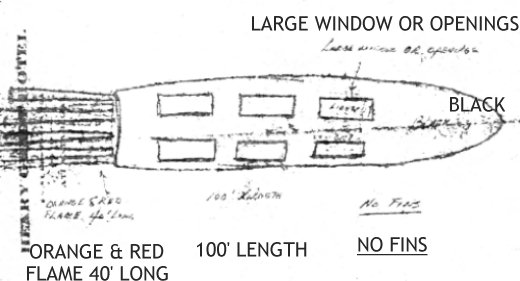
A meteor or bright bolide is the leading conventional explanation for Chiles–Whitted. It naturally explains extreme apparent speed, brilliant luminosity, coloured trail, short duration and the possibility of an apparent climb or disappearance as perspective changes.
The Air Force itself considered that possibility from the beginning. Some personnel and later analysts argued that the pilots had encountered an unusually bright meteor and interpreted fragmentation, wake and glare as structure. J. Allen Hynek later considered an astronomical explanation, but Project Grudge-era material did not rate the Chiles–Whitted meteor solution as a high-probability identification. In the evaluation index, Incident 144 appears under a lower-probability astronomical category rather than the strongest meteor list.
That nuance matters. “The Air Force explained it as a meteor” is too simple. So is “the Air Force proved it was not a meteor.” Hynek’s own evaluation index placed Incident 144 in the astronomical fair or low probability category rather than the high-probability list. Yet by 1959 Project Blue Book formally carried the case as a “fireball-type meteor.” The official label therefore became firmer over time than Hynek’s original probability assessment had been.
The strongest sceptical version of the meteor case goes beyond “they saw a shooting star.” Astronomer Donald Menzel argued that a brilliant fireball seen under unusual geometry could create an extreme impression of nearness, while glare, fragmentation and retinal after-image effects might be interpreted as a structured fuselage and rows of lights. Later sceptical treatments also point to the 1968 Zond IV re-entry, when some witnesses described a cigar-shaped object with windows even though the stimulus was known space debris breaking up in the atmosphere. That is important evidence that intelligent, experienced observers can genuinely perceive structure in a bright fragmented atmospheric event.
But the perception argument has a limit of its own. It explains how “windows” might be generated psychologically; it does not independently reproduce Chiles and Whitted’s reported close-pass geometry, apparent level path or Whitted’s insistence that the object pulled up and entered the cloud deck. Hynek himself ultimately regarded those details as too difficult for his original meteor explanation.