PRIMARY OFFICIAL ARCHIVE
Biblioteca Virtual de Defensa — 760622
The 107-page Spanish Air Force file for 22 June 1976. Declassified in 1994; digital copy distributed under CC BY 4.0.
OPEN OFFICIAL FILE →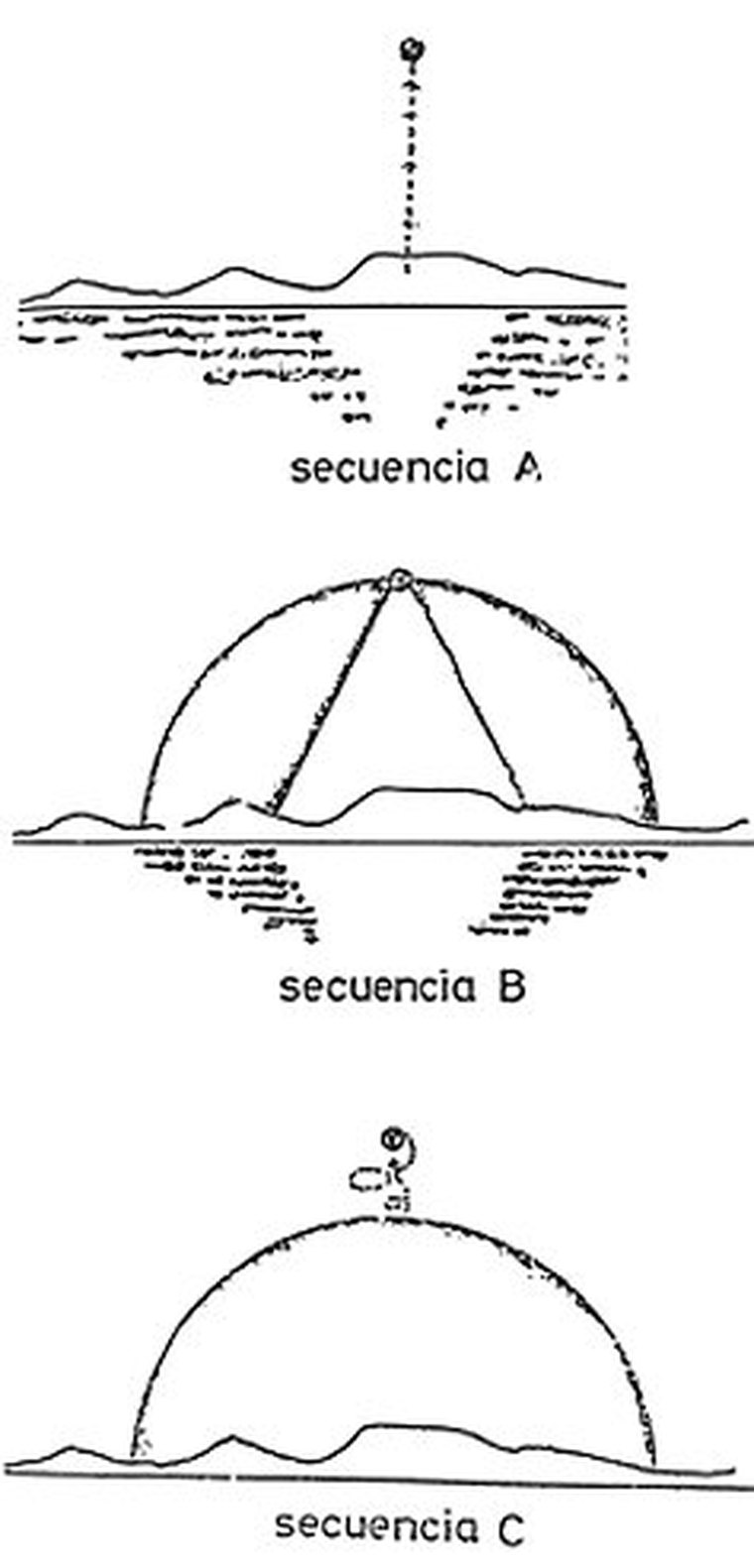
A Spanish Navy corvette watched it bloom over the Atlantic. Civilians across the islands saw the same vast luminous display. Then, on a road in northern Gran Canaria, a doctor and taxi driver said they saw something much stranger: a transparent globe with two enormous figures inside.
The Canary Islands event is valuable because it refuses to stay simple. The broad luminous phenomenon was spectacular, multi-witness, officially investigated and later matched in detail to a real missile test. That identification is strong enough that the mass sighting should no longer be presented as an unexplained craft.
But the most extraordinary testimony in the file is not the broad sky display. It is Dr Francisco Padrón León’s roadside account of a transparent sphere containing two giant red-clad figures, supported in important respects by his taxi driver and echoed by another witness in Gáldar.
The correct page therefore has to do two things at once: allow the missile explanation to close the part it genuinely explains, and refuse to use that success as a shortcut for a separate close-encounter claim.
At 21:27 Z, the Spanish Navy corvette Atrevida was about three nautical miles south of Punta Lantailla off Fuerteventura when its crew observed an intense yellow-blue light moving outward from the island side.
The captain reported that the light climbed to an elevation of roughly fifteen to eighteen degrees, remained almost stationary for about two minutes, then expanded into a huge halo of yellowish and bluish light. The glow persisted for tens of minutes.
The ship’s surface radar recorded no echo. There was no engine noise. The brightness was strong enough that the crew judged the phenomenon to be comparatively nearby.
Within minutes, observers across Gran Canaria and elsewhere in the archipelago were reporting a luminous sphere or globe. The witness pool later taken into the Air Force file included military personnel and civilians from multiple occupations and locations.
Timed, position-fixed naval observation begins off Fuerteventura.
Civilians and professionals across the island report the same broad luminous event.
The phenomenon becomes a large luminous dome/sphere before fading or moving away.
Captain, naval officers and crew provide the cleanest timed military observation.
Doctor, taxi drivers, teacher, police guard, sergeant, farmer and other civilians enter the official file.
Reports place the luminous phenomenon across a much broader regional sky than one roadside encounter.
Dr Francisco Padrón León was travelling by taxi toward Las Rosas to visit a patient. According to his deposition, the car headlights picked out a faintly luminous spherical object near the roadside.
He described it as transparent or crystalline-looking, with the stars visible through it. In the lower part was what looked like a metallic platform with three consoles and a central tube venting bluish material.
Inside stood two very large humanoid figures, around 2.5 to 3 metres tall in his estimate, dressed in red and facing one another.
The taxi-driver evidence is disputed in the later literature. Traditional UFO-source summaries say the driver also confirmed a transparent sphere with two red-clad figures. Critical source reconstructions argue that the driver saw only the large luminous phenomenon and that the detailed occupants belong to Padrón alone. Until the primary A-02 deposition is checked line by line against A-01, the page must preserve that contradiction rather than choose the more dramatic reading.
Padrón said the globe expanded dramatically, took on a bluish spindle-like form and departed toward Tenerife.
The Air Force file contains another account from a woman in Gáldar who described a perfectly round transparent globe through which the stars could be seen, with human-like figures inside.
That matters because it complicates a simple mutual-suggestion explanation confined to Padrón and his taxi driver. But the accounts are not identical, and their exact chronology, exposure to other witnesses and independence should be audited line by line rather than treated as three copies of one description.
Padrón's deposition is unusually specific. Later summaries describe a transparent sphere of enormous apparent scale, sometimes reconstructed at roughly thirty metres in radius, with the stars still visible through its shell.
In the lower portion he described an aluminium- or metallic-looking platform supporting three console-like structures. A central semi-transparent tube appeared to vent bluish material or smoke that remained inside the globe.
The two giant figures were reportedly seen largely in profile, facing one another, dressed in red and wearing headgear. When the luminous globe expanded, Padrón said the outer sphere grew dramatically while the occupants and internal platform did not appear to enlarge with it.
Some retellings also preserve a faint whistling during ascent.
Stars reportedly remained visible through the sphere, giving it a crystalline or transparent appearance.
A lower internal platform or deck supported the occupants and equipment.
Padrón described three console-like elements rather than an empty luminous ball.
A central tube was associated with bluish material or vapour within the globe.
Roughly 2.5–3 m by Padrón's estimate, seen in profile and facing each other.
This reported scaling mismatch is one of the most unusual details in the whole close-encounter account.
The Mando Operativo Aéreo opened a formal investigation within days. The surviving file runs to 107 pages and contains questionnaires, depositions, evaluations, drawings, plans and photographic material.
The file includes fourteen witness depositions and grades witness credibility and observation quality. Its investigating officer accepted that a very strange aerial phenomenon had genuinely occurred, while remaining much more sceptical about the close-encounter interpretation.
On the Padrón account, the investigator explicitly considered the possibility that witnesses facing an unusual sky phenomenon had interpreted it through mutual influence and imagination. That is an official hypothesis, not a demonstrated psychological reconstruction.
The file was formally declassified in 1994 and is now available through Spain’s Biblioteca Virtual de Defensa under a CC BY 4.0 digital-copy licence.
A rare large official European UFO case file with illustrations and witness material.
Military and civilian statements preserved within one investigative framework.
The Air Force investigator lacked access to the later missile-launch reconstruction that would eventually explain the broad glow.
The principal detailed close-encounter deposition: transparent sphere, internal structures and giant red-clad figures.
Critical comparison witness. Production must settle exactly what he independently described rather than rely on secondary summaries.
A separate witness often cited for a transparent globe and human-like figures. Independence and interview chronology require audit.
The cleanest formal military timing and position anchor for the broad luminous event.
Investigating officer associated with the formal Air Force inquiry and evaluation of the witness material.
Every striking detail should be tied to the witness code and page where it first appears.
The Air Force file already shows a broad witness distribution across the archipelago. Later specialist chronologies add potentially useful outer anchors, including the merchant ship Osaka Bay farther south and a foreign tourist said to have photographed the display.
Those outer reports matter mainly for scale and geometry. They strengthen the interpretation of a very large high-altitude luminous phenomenon, but they do not corroborate Padrón's roadside occupants.
Position-fixed, timed observation near Fuerteventura.
Multiple civilian/professional observers across several localities.
Broader reports showing the display was not confined to one local horizon.
Later specialist literature cites a distant ship report; earliest ship log and timing should be recovered before production emphasis.
Reported in later literature. Item-level provenance is required before treating it as visual evidence.
Wide-area witnesses support the mass luminous display, not the close-encounter narrative.
Later Spanish researchers Vicente-Juan Ballester Olmos and Ricardo Campo Pérez identified the 22 June event, along with several other Canary Islands luminous displays of the 1970s, as high-altitude effects from U.S. Navy Poseidon C-3 submarine-launched ballistic missiles.
External launch records show that the USS Von Steuben carried out two Poseidon C-3 operational-test launches on 22 June 1976.
The mechanism fits the broad reports unusually well. After local sunset, a missile hundreds of kilometres west of the islands rises into the upper atmosphere. Staging and vented gases form a large expanding cloud still illuminated by sunlight at altitude. To observers below, the cloud can appear silent, luminous, enormous and strangely stationary, while surface radar sees no solid target.
Critical Spanish reconstructions argue that Padrón may have been looking at the same giant high-altitude missile plume as everyone else but interpreting structure within it at close apparent range.
In that model, reddish luminous elements within the expanding plume become the “figures,” the bright envelope becomes the transparent globe, and internal contrast becomes platforms, tubes and consoles.
This is stronger than merely saying “pareidolia” because it names the real visual stimulus and attempts to connect specific features to specific parts of the plume.
But the model still has to earn the details. It must account for Padrón's reported profiles, headgear, three consoles, central tube, scaling mismatch and roadside apparent proximity. A vague resemblance is not enough.
This is where the case becomes genuinely interesting. The Poseidon reconstruction is a physical identification of the broad display. It names the launch system and aligns with the date, appearance and geometry.
The conventional explanation for the occupied sphere is different. It argues that Padrón and others structured an unfamiliar luminous phenomenon into a nearby transparent craft with figures — essentially a perception and interpretation problem.
That is plausible in principle. Humans do impose structure on ambiguous light. But a good explanation must account for why multiple witnesses described similar close features and must establish how independent those descriptions really were.
Later critical and journalistic accounts describe Padrón as highly agitated after the experience and say he returned to the area repeatedly in subsequent years, hoping to see the phenomenon again.
That behaviour should not be used as proof that the encounter was real, nor as evidence that he was psychologically unreliable. It belongs in the aftermath lane: the experience appears to have had lasting personal significance for him.
Put Padrón, taxi driver and Gáldar witness side by side feature-by-feature.
Establish interview order, media exposure and opportunities for cross-contamination.
Reconstruct each observer’s bearing to the high-altitude missile cloud.
Match every photograph and drawing to date, witness and file page.
Recover launch time/azimuth and reproduce the sky geometry for each vantage point.
Show how the real plume would have appeared from the road, then compare it directly with the earliest descriptions.
The 107-page Spanish Air Force file for 22 June 1976. Declassified in 1994; digital copy distributed under CC BY 4.0.
OPEN OFFICIAL FILE →Records two USS Von Steuben Poseidon C-3 operational-test launches on 22 June 1976.
OPEN LAUNCH RECORD →Spanish-language reconstruction of the missile explanation, including the two-launch chronology, twilight illumination mechanism and Padrón aftermath.
OPEN ANALYSIS →Important for the disputed taxi-driver corroboration and the argument that Padrón's occupants may be perceptual structure imposed on the missile-generated luminous display.
OPEN SOURCE →Preserves translated testimony, official-file diagrams and the investigator’s sceptical comments on the close encounter.
OPEN SOURCE →Strong modern synthesis distinguishing the Poseidon identification from the Padrón occupied-sphere residue.
OPEN SOURCE →The night of 22 June 1976 really did produce an extraordinary luminous display over the Canary Islands. It was seen by trained naval personnel, civilians and professionals, and Spain’s Air Force preserved one of Europe’s richest UFO files around it. Later evidence gives that broad display a powerful conventional identity: Poseidon missile exhaust high above the Atlantic. The unresolved question is narrower and stranger — whether Padrón and the other close witnesses transformed that spectacle into an occupied sphere, or whether something else happened on the road while the sky was already glowing.