BONSALL · DERBYSHIRE · 5 OCTOBER 2000 · VIDEO EVIDENCE

Six and a half minutes.Then the tape disappeared.

At 9:15pm in a tiny Peak District village already buzzing with UFO reports, Sharon Rowlands pointed a new camcorder toward a luminous object over the woods. What she recorded became one of Britain's most talked-about UFO videos — and one of its hardest pieces of evidence to examine properly.

AUTHENTIC CASE FRAME
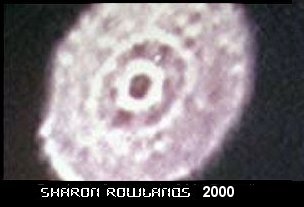
Still from Sharon Rowlands' circulated 5 October 2000 camcorder footage. Not a reconstruction. Production must internalise a lawful highest-generation copy.
Time~9:15 pm
Footage~6½ minutes
WitnessSharon Rowlands
Core evidenceOriginal videotape
01 / THE NIGHT

A quiet village looks up.

Bonsall's story works because it begins with something simple: a woman at home, an unfamiliar sound outside, and a camcorder that had only recently arrived in the household.

On Thursday 5 October 2000, 44-year-old Sharon Rowlands was at home in Slaley, Bonsall, with her husband Hayden when an eerie noise drew her attention outside. Contemporary reporting placed the start of the sighting at about 9:15pm. She had only been given the camcorder days earlier. Rowlands took it outside and filmed toward the woods and fields around the village, estimating the object at roughly two miles away.

Her description was unusually specific. She compared the form to a giant disc with a section missing from the bottom and later called it a segmented disc with a dark centre. She said the object appeared to carry red, yellow, orange and blue lights, to pulse, expand and contract, and at one point to come close enough that she feared it might land in the field. She also described it as looking extraordinarily large through the lens — roughly the size of a detached house in her later recollection.

Rowlands repeatedly stressed that she had not approached the night as a committed UFO believer. Her public position was closer to: she had doubted the subject, then filmed something she could not explain. That matters because it is part of how the case was understood at the time — an ordinary household with a new consumer camcorder suddenly holding an unusually long piece of UFO footage.

The enduring attraction of Bonsall is not just what Rowlands said she saw. It is that she kept the camera running.

The resulting recording was reported as approximately six and a half minutes long. Contemporary descriptions say the object moved across the image, showed red, yellow, orange and blue light, changed appearance and eventually disappeared in a red flash. The publicly circulated excerpts are much less generous: dark sky, a bright defocused form, heavy zoom and only fragments of the sequence that made the original tape famous.

That gap — between the reported full tape and the footage most people can actually inspect — is the central evidential problem of the case.
02 / THE EVIDENCE

The film exists. The full evidence does not.

Unlike many UFO cases, Bonsall produced moving imagery. But the quality of an evidence claim depends on which generation of that imagery is being analysed.

Still from Sharon Rowlands' Bonsall UFO footage, 5 October 2000
ACTUAL CIRCULATED VIDEO FRAME · 5 OCTOBER 2000 — This is a surviving frame from the Rowlands footage as circulated online. Its appearance is important, but a compressed web still is not equivalent to examining the original videotape.
A / PRIMARY

The original tape

Reportedly ~6½ minutes. Contemporary accounts say Rowlands placed it in secure storage. This is the evidential object a serious modern analysis actually needs.

B / COPIES

Broadcast and web excerpts

Short clips and stills survive publicly. They preserve the case visually, but compression, copying, reframing and unknown generation weaken fine optical claims.

C / MISSING TEST

No public full-tape audit

No independently reproducible frame-by-frame analysis of the entire original recording has been located in the surviving public record.

THE MISSING MASTER TAPE

The most important object in the case is not online.

Bonsall is not really a six-minute YouTube clip case. It is a custody problem. The full-length recording is the thing that could make or break the strongest claims.

REPORTED CUSTODY

Vault → solicitor

Contemporary reporting says Rowlands considered the tape valuable enough to lock the original in a Nottingham bank vault before copies were circulated. Later accounts placed the master with her solicitor. That chain is unusual for a household UFO video and deserves to be treated as part of the evidence history.

WHAT SURVIVES PUBLICLY

Fragments, copies and stills

The material available online consists of short, degraded excerpts and still frames. Those are useful for identifying broad optical behaviour, but they are a poor foundation for claims about precise motion, focus, colour, scale or object structure.

PROVENANCE LOCK: Never write that the online clip is “the original footage.” Production should identify the highest-generation lawful copy available and state its generation. The full original cassette remains the target evidence item.
03 / THE BONSALL CLUSTER

One tape inside a much stranger autumn.

The Rowlands event arrived during a run of local reports that transformed Bonsall from a small Derbyshire village into a national UFO story.

BEFORE 5 OCT

The village is already looking up

Local reporting later described a run of sightings in the months around the Rowlands event. Among the recoverable descriptions were a woman reporting a “ball of fire,” another witness describing two large bright lights, and a dog walker reporting a vertically oriented pink glow compared with a shoe box.

5 OCT · ~21:15

Rowlands films the object

The six-and-a-half-minute recording becomes the strongest tangible item in the cluster: not just testimony, but moving imagery that could in principle be reanalysed.

LATER OCTOBER

More reports follow

Later sighting lists and local press continued to record unusual lights and craft descriptions around Bonsall Moor and neighbouring Derbyshire. Similarity is contextual only; these reports do not establish one recurring object.

2001–02

Bonsall becomes a UFO destination

Further reports, national press attention and local UFO walks turned the village itself into part of the story. The often repeated “19 sightings” figure belongs to this wider local cluster, not to 19 independent confirmations of Rowlands’ filmed object.

LOCK: The “19 sightings” are not 19 independent confirmations of Rowlands' object. They are a local reporting cluster with different shapes, witnesses and dates. Use them to reconstruct the atmosphere around Bonsall, not to inflate the video.
04 / CONTEMPORARY CHECKS

The weather office did not explain it away.

One of the few contemporaneous institutional checks was mundane but useful: could unusual weather have created the reported circular light?

Met Office response

Contemporary reporting quoted the Meteorological Office as saying there were no unusual or “freak” weather conditions on 5 October that could account for the circular appearance being reported.

That does not authenticate the object. It simply removes one proposed environmental category from the contemporary discussion.

No formal government UFO investigation

No evidence has been recovered of a dedicated MoD or police investigation into the Rowlands tape comparable with a formal official case file. The Bonsall story moved primarily through local reporting, ufology and television.

05 / HOLLYWOOD

The UFO becomes a media object.

By 2001 the tape had crossed from village mystery into international television — and this is where the source history becomes messy.

The Derby Evening Telegraph reported in May 2001 that California producer Robert Kiviat's company had acquired the tape for more than £20,000 and was considering it for a programme provisionally titled Could It Be True?. Kiviat was quoted praising the footage, ranking it among the strongest UFO films he had encountered and discussing comparison with imagery from NASA's STS-75 tether mission.

But a specialist archive carried a significant correction only days later: according to Santiago Yturria, Kiviat denied that the reported £20,000 transaction had taken place and said an intermediary in Britain had been acting on his behalf. That contradiction is now part of the evidence genealogy. The famous “£20,000 Hollywood sale” must not be presented as settled fact.

The NASA connection needs equally tight wording. Contemporary coverage reported visual similarity to STS-75 imagery and said optical physicist Bruce Maccabee might examine the tape. No published Maccabee analysis of the Rowlands master has been recovered in this research pass. “NASA imagery was compared with it,” “a NASA-associated expert might examine it,” and “NASA authenticated the UFO” are three very different propositions.

That media journey matters because it explains why Bonsall acquired a reputation far beyond Derbyshire. The tape became valuable not only as evidence but as television content — exactly when custody, copy generation and editorial processing became harder to reconstruct.

06 / THE DISPUTE

Street lamp, aircraft — or something genuinely in the sky?

The strongest sceptical case is not “the footage looks bad.” It is optical: an out-of-focus light filmed at heavy zoom can create exactly the disc, rings and colour fringing seen in surviving copies.

WHY THE CASE PULLS YOU IN

The pro-UFO case

  • Rowlands described a structured, changing object rather than merely a point of light.
  • The recording reportedly lasted about six and a half minutes — unusually long for a UFO video.
  • The sighting occurred amid a genuine cluster of other local reports.
  • Rowlands continued to reject the street-lamp explanation years later.
  • No published analysis located so far demonstrates a specific mundane source against the full original tape.
THE STRONGEST COUNTERCASE

Defocus changes everything

  • The surviving imagery is visibly out of focus and heavily zoomed.
  • A point source can become a bright disc with a dark centre or concentric rings when defocused.
  • Consumer optics can add coloured fringes and apparent structure.
  • Camera movement can create apparent drift, expansion and contraction.
  • In 2008, video expert Peter Marriot concluded on Channel 5 that the footage showed a street lamp.
THE UNFINISHED TEST: Marriot's conclusion is important, but no public technical report has been located showing the specific lamp, sightline, camera settings, original frames or a matched recreation. Without the full original tape, the strongest debunk and the strongest UFO interpretation are both working from incomplete evidence.
07 / THE STREET-LAMP TEST

A plausible debunk still has to show its working.

Peter Marriot's 2008 street-lamp identification deserves serious weight. It also deserves a reproducible test rather than a television verdict.

1. Fix the camera position

Recover the exact house, window/garden position, camera height and direction of view. Without this, a claimed lamp cannot be placed against the image.

2. Identify the lamp

Name the actual light source allegedly filmed in 2000. Establish its position, lamp type, height, brightness and whether it existed on the night.

3. Match the optics

Reproduce the disc, dark centre, coloured fringing and concentric-ring behaviour using the same or equivalent camcorder, zoom and focus state.

4. Match the motion

Separate camera shake, zoom and focus breathing from any residual image movement. A fixed lamp explanation must account for apparent drift without hand-waving.

5. Use the full tape

A short broadcast excerpt can make a fixed point source look persuasive. The decisive test must use the complete six-and-a-half-minute sequence or the highest surviving generation.

6. Publish the recreation

The case becomes dramatically stronger or weaker if readers can compare original and matched-control footage side by side.

CURRENT POSITION: Defocus is a real optical mechanism and the street-lamp hypothesis is the strongest named conventional candidate. But no publicly recoverable technical package has yet been found that identifies the specific lamp and reproduces the entire recorded behaviour from the original tape.
08 / WHAT WOULD MOVE THE CASE?

Find the tape. Rebuild the sightline.

Bonsall is unusually testable even now. Its biggest unanswered questions are not philosophical — they are practical.

Recover the highest-generation recording

Original cassette first. Failing that, the earliest direct copy with documented provenance. Every later compression step destroys useful optical information.

Reconstruct the camera position

Exact window/garden position, azimuth, horizon, local lamps, terrain and Middleton Wood geometry could directly test the fixed-light explanation.

Reanalyse frame by frame

Focus breathing, iris changes, zoom, camera shake, motion vectors and apparent size need to be separated from real object motion.

09 / SOURCE ROOM

Follow the evidence generations.

The case is strongest when contemporary reporting, later broadcast analysis and modern retellings are kept in their proper lanes.

Derby Evening Telegraph · 2001

Near-contemporary reporting on Rowlands, the footage, Bonsall's sighting cluster, Omar Fowler and the initial Hollywood/Kiviat claims.

BBC News · 1 June 2001

Contemporary national account of the six-and-a-half-minute footage, Rowlands' description and the growing media interest.

UFO Newsclipping Service archive

Preserves contemporary clippings and a dated local sighting sequence around Bonsall rather than relying only on later summaries.

UFOs at Close Sight · June 2001 update

Important corrective source reporting Kiviat's denial of the widely repeated £20,000 transaction.

Britain's Closest Encounters · Channel 5, 2008

Later television re-examination in which video expert Peter Marriot reportedly identified the source as a street lamp.

Sharon Rowlands later interviews

Later first-person witness layer. Useful for what Rowlands continued to maintain about size, shape and the street-lamp objection, but not a substitute for the 2000–01 record.

UAP Globe · modern case reconstruction

Useful current synthesis for the bank-vault/solicitor custody trail, Met Office response, village-cluster examples and the limits of the 2008 street-lamp identification. Secondary source; underlying contemporary records outrank it where recovered.

EDITORIAL LOCK
Bonsall should feel like the investigation of a lost piece of potentially important UFO footage. Give the reader the extraordinary six-minute claim and the village wave first; then show why optical defocus is a serious challenge. The missing original tape is the hinge. Do not turn a plausible street-lamp explanation into a demonstrated identification unless the geometry and source footage can actually be produced.