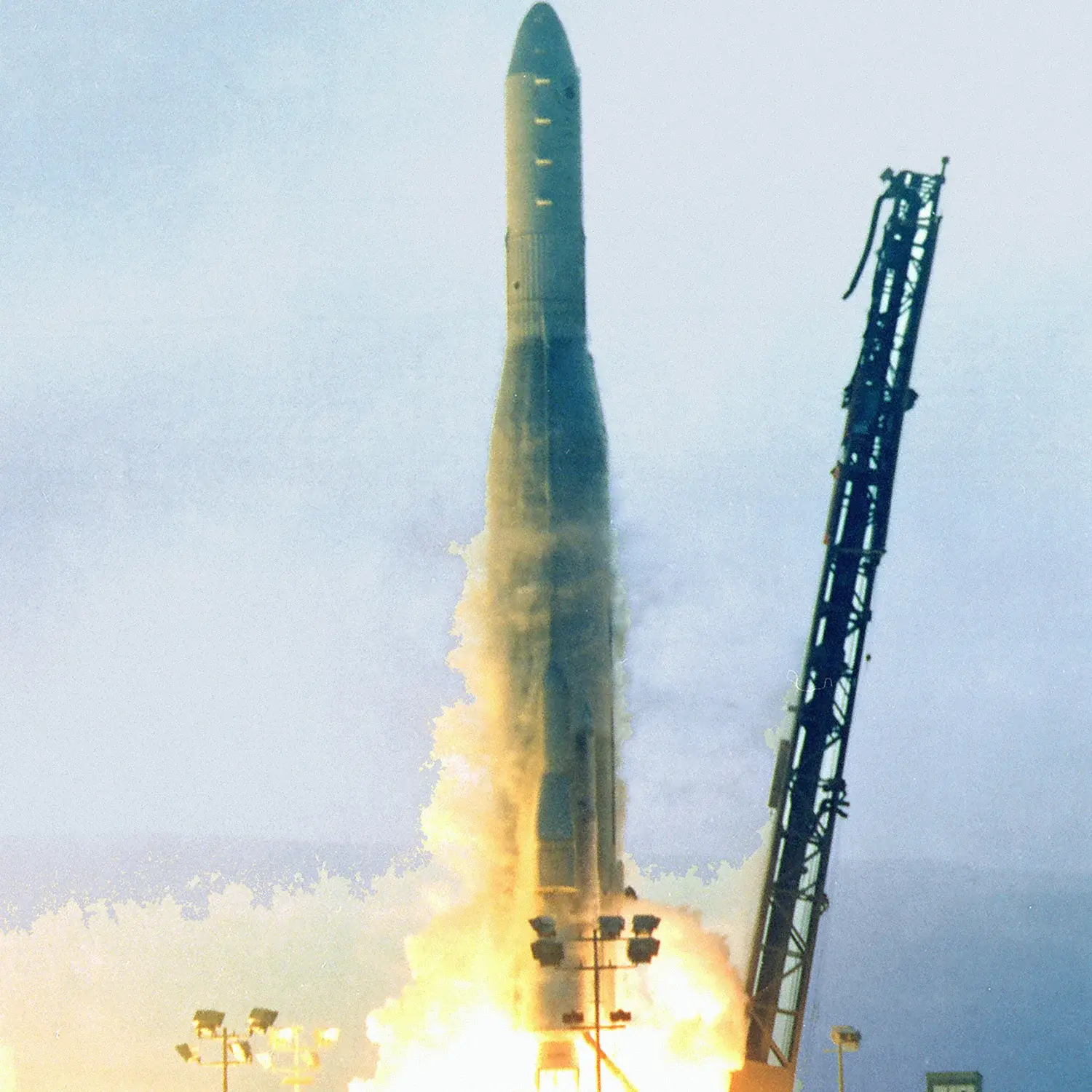
Atlas E/F missile launching from Vandenberg Air Force Base — later mission, used as missile-system context only
THE UAP MAPEVERY CASE HAS A PLACE
BIG SUR · CALIFORNIA · SEPTEMBER 1964

The film is missing.The witnesses disagree about what it showed.

First Lieutenant Robert Jacobs said Air Force tracking film showed a disc-like object manoeuvring around an Atlas dummy warhead and firing four flashes before the re-entry vehicle failed. Project engineer Kingston George said the same episode was classified penetration-aid testing — decoys, chaff and packing debris. The reel that could settle the argument has never surfaced publicly.

AUTHENTIC ATLAS E/F MISSILE-SYSTEM CONTEXT · NOT THE 1964 INCIDENT LAUNCH · PRODUCTION SHOULD REPLACE WITH THE AUTHENTIC 1964 BIG SUR TELESCOPE-CREW PHOTOGRAPH FROM THE KINGSTON GEORGE COLLECTION IF RIGHTS/PROVENANCE ARE SECURED.
NOT INCIDENT PHOTOGRAPHYAtlas E/F launch from Vandenberg, 1977. Mechanically relevant missile-family context only. The authentic 1964 Big Sur crew/telescope photograph exists and is the preferred production hero.
CLAIMDisc + 4 flashesJacobs's later account of the missing film.
COUNTERCASEDecoys + chaffKingston George's insider reconstruction.
CORROBORATORMansmannLater letters support Jacobs's structured-object account.
CORE GAPFilm missingNo independent modern frame analysis is possible.
THE PROJECT WAS REAL

Before the UFO claim, there was an Air Force optics experiment.

In late summer 1964, a U.S. Air Force team deployed a highly sensitive Boston University tracking telescope to the Big Sur coast to obtain side-on photography of Vandenberg missile launches. Kingston George's contemporary October 1964 report says the system covered multiple launches and demonstrated that Big Sur photography could capture useful missile-flight detail.

Jacobs was the field camera officer. George was the project engineer. Major Florenz Mansmann worked in the Vandenberg scientific/photo-analysis chain. Their credentials and involvement are not the main dispute.

The dispute begins with what one particular reel showed — and whether Jacobs and Mansmann were looking at an unknown craft or classified missile countermeasures.

JACOBS'S ACCOUNT

A disc circles the re-entry vehicle.

Jacobs's mature account says he was shown the processed footage after the launch. In slow motion, he said, a structured object entered the frame, moved around the re-entry vehicle and produced four bright flashes from different positions before the warhead package began tumbling or failed.

LAUNCHAtlas rises from VandenbergThe Big Sur telescope team records the flight from more than 100 miles up the coast.
SEPARATIONRe-entry package downrangeJacobs later says the disputed sequence occurred after the missile package separated and coasted.
OBJECTDisc-like form entersLater description: saucer-like form with a raised dome, based on screening-room recollection rather than a surviving public frame.
FOUR FLASHESObject changes positionJacobs interpreted bright events as directed-energy discharges from different relative positions.
AFTERWarhead trajectory failsJacobs connected the sequence causally to the test failure. That causal link is disputed.
MANSMANN'S LATER CORROBORATION

The senior photo analyst did not dismiss Jacobs.

Years later, Mansmann wrote letters that supported key elements of Jacobs's story. He described a “classic disc” with a raised central feature and said the object appeared to turn as though positioning itself to fire. He also wrote that the original film was rapidly sent east and later called Jacobs's account “all true as presented.” citeturn354205search2

Why this matters

Mansmann is the strongest pro-case witness because he was not merely present at the remote site — he says he studied the film itself. But his supporting letters were written decades later, so they remain later corroboration rather than 1964 contemporaneous documentation.

MANSMANN LETTER CHRONOLOGY

His support was repeated, not one vague late memory.

Mansmann's corroboration developed through multiple later letters. That strengthens the consistency of his support for Jacobs, while still leaving every statement decades removed from the 1964 screening itself.

8 MAR 1983

Structured-disc description

Mansmann described the object as a classic disc with a raised central feature and said it appeared to manoeuvre around the warhead. citeturn268652search2turn268652search10

10 MAR 1983

Film rushed east

Later case summaries attribute to Mansmann the claim that the original 35 mm material was quickly sent east after the screening. citeturn268652search2

6 MAY 1987

Directed-energy interpretation

Mansmann continued to endorse an extraordinary interpretation and linked the incident to possible directed-energy interest. citeturn268652search7

15 NOV 1995

Jacobs “all true as presented”

In a later letter, Mansmann again endorsed Jacobs's public account and repeated that government agents removed the film. citeturn268652search8turn268652search10

What this does — and does not — establish

Repeated later corroboration is stronger than a one-off recollection. It still does not replace a dated 1964 memo, screening log or surviving film.

KINGSTON GEORGE'S COUNTERCASE

Classified decoys, chaff and a clearance gap.

George's explanation is unusually strong because it comes from the project engineer himself. He identified a penetration-aid test in which decoy re-entry vehicles and associated material were deployed to confuse missile defences. In his account, the extraordinary-looking sequence was a classified weapons-system problem that Jacobs was not cleared to understand. citeturn184477search0

DECOYS

Multiple objects expected

George says two decoy packages and accompanying packing/debris separated from the missile system, naturally creating several luminous moving targets.

FLASHES

Image-orthicon blooming

Short propulsion/separation events could bloom dramatically on the sensitive television/film system.

SECRECY

Real national-security reason

If the test exposed how easily the decoys could be distinguished from the real RV, classification would protect a genuine strategic vulnerability without requiring a UFO cover-up.

HOW JACOBS'S PUBLIC ACCOUNT DEVELOPED

The event was 1964. The public UFO claim begins in 1982.

Source generation matters here because the vivid mature description was not published contemporaneously. Jacobs first went public in 1982, then expanded and defended the account over the following decades. citeturn268652search30turn268652search3

Editorial rule

Use the 1964 project documents to establish the experiment; use Jacobs to establish what he later says he saw. Do not silently merge those two source generations.

THE DATE PROBLEM

Are both sides even talking about the same launch?

This is the most important unresolved documentary issue in the case. George's explanation is only decisive if his penetration-aid launch is the same launch Jacobs and Mansmann later described.

SourceDate / positionWhy it matters
Jacobs, 1989September 1964; exact date uncertain in his own published reconstructionWeakens confidence in later inherited precision.
Kingston George, 199322 September · “Buzzing Bee”Identifies a specific classified penetration-aid test and supplies the decoy/chaff explanation. citeturn268652search1
Later pro-case literatureOften 15 SeptemberFrequently treated as settled even though the source genealogy is more complicated.
Later Jacobs positionRejects “Buzzing Bee” as the incident he filmedIf correct, George may be explaining a different reel; this needs primary launch-manifest resolution rather than assertion.

Pass 2 priority

Build the September 1964 Vandenberg launch manifest from primary USAF range records, then match every candidate launch to telescope coverage, missile configuration, penetration aids, test objective, anomaly report and film custody.

WHAT THE TELESCOPE COULD RESOLVE

“We saw a saucer” depends on image scale.

George argues that the actual warhead image would have occupied only a few scan lines on the image orthicon and that hard objects were seen primarily as specular glints rather than resolved shapes. That directly challenges later claims of a clearly structured disc at extreme range. citeturn184477search0

Pro-case researchers counter that the Boston University system had unusually long effective focal lengths and could record “minute events” hundreds of nautical miles away. NICAP's own case directory acknowledges the resolution debate rather than treating it as settled. citeturn354205search1

The definitive test

Recover telescope sensor dimensions, focal-length configuration, target range, atmospheric seeing and the claimed object angular size. Then calculate whether a raised dome / disc geometry could actually have been resolved rather than inferred from blooming points.

COULD THE CAMERA REALLY SHOW A DOME?

George's strongest argument is only 2–3 scan lines wide.

George calculated that the warhead image, even viewed side-on, would span less than six-thousandths of an inch on the image-orthicon face — only about two to three scan lines. In his reconstruction, hard objects were detected mainly as specular sunlight glints rather than resolved shapes. citeturn268652search1

George's resolution claim

2–3 scan lines

If correct, a remembered “disc with a dome” cannot be treated as a straightforward resolved image of physical geometry.

Pro-case response

Not settled

NICAP/CUFOS researchers have argued that the Boston University system and projection conditions may have allowed more useful discrimination than George grants. The dispute therefore requires a full optical reconstruction, not slogans. citeturn268652search7

The calculation we need

Sensor active area + scan format + effective focal length + target range + claimed object size + atmospheric seeing. From those inputs we can compute the actual angular/pixel footprint and determine whether “dome” is physically resolvable or memory-level interpretation.

THE BEAM PROBLEM

Four flashes are observations. “Directed energy” is an interpretation.

George's physics objection is specific: a directed-energy beam in vacuum would not normally appear as a luminous line unless it interacted with material, and heating is not the same as physically “knocking” a warhead aside. citeturn184477search0

That does not erase Jacobs's report of four bright events from changing relative positions. It does mean the page should preserve a distinction between:

REPORTED

Four bright flashes/events

Jacobs says the object produced four flashes while changing position around the package.

INFERRED

Energy beams

The interpretation that those flashes were directed beams comes from later reading of the sequence.

INFERRED

Warhead disabled by object

Causation requires the actual film plus missile telemetry/trajectory data linking the flash sequence to the failure.

WHERE DID THE FILM GO?

Three custody stories. No reel.

The disappearance of the film is not one simple claim. Jacobs, Mansmann and George leave different custody narratives, and resolving them may matter as much as resolving the launch date.

SourceCustody storyWhat would verify it
JacobsThe crucial material was removed after the screening; later accounts describe key footage being physically taken out of normal project custody.Projection-room notes, film sign-out sheet, cut-list, courier record, witness to removal.
MansmannThe original 35 mm film was rapidly sent east; later letters say government agents confiscated material and left with it. citeturn268652search8turn268652search9Shipping order, classified courier manifest, receiving office, laboratory accession record.
Kingston GeorgeTop Secret film/material remained a classified penetration-aid record and was later destroyed after its intelligence value expired. citeturn268652search1Retention schedule, destruction certificate, archive transfer log.

The shared fact

Whatever happened administratively, the contested film has not surfaced publicly for independent modern analysis. That keeps both the extraordinary interpretation and the decoy explanation one step short of direct verification against the decisive evidence. citeturn268652search4

WHAT WOULD MOVE THE CASE

Resolve the launch before arguing about aliens.

01

Launch manifest

Identify the exact September mission and test objective from primary range records.

02

Film custody

Trace 35mm original, copies, classification markings, sign-out records and destruction schedules.

03

Optics reconstruction

Calculate whether the claimed disc geometry was resolvable at the actual range/configuration.

SOURCE ROOM

The missing reel sits between two insiders.