But Apollo 17 did not produce one UFO event. The NASA record contains bright nearby fragments, distant rhythmic flashers, retinal light flashes and a separate apparent lunar-surface flash. The first job is not to make them mysterious. It is to stop them being mixed together.
The strongest thing The UAP Map can do here is something most retellings do not: separate every “light” by context before asking what it was.
During spacecraft manoeuvring, Ron Evans described “very bright particles or fragments or something” drifting past. Jack Schmitt's famous “Fourth of July” line belongs inside this fragment field, not inside a formation-of-craft narrative.
Later, Gene Cernan distinguished a bright rhythmic flasher from nearby particles using apparent depth and worked with Houston to describe its location relative to spacecraft axes. This is the more interesting external-observation strand.
Apollo crews had long reported flashes even in darkness or with eyes closed. Apollo 17 carried the ALFMED experiment specifically to study whether energetic particles were producing those sensations.
Schmitt later reported a brief bright flash apparently on or near the lunar surface north of Grimaldi and asked Houston to check seismic data. He himself raised a small impact as a possibility.
Modern UFO retellings often make the phrase sound like an astronaut describing a spectacular fleet. The primary mission context is less dramatic — and more useful.
Evans first identifies “particles or fragments or something” drifting by during manoeuvring. Schmitt then compares the bright material at the window to the Fourth of July.
The crew themselves discuss mundane physical candidates including S-IVB-related material, ice and paint. That does not prove every light was debris. It does mean the famous phrase cannot honestly be used as a stand-alone description of unexplained craft.
Never publish “Fourth of July” without the immediately surrounding fragment context.
Around mission elapsed time 02:18:47, Cernan's report is qualitatively different from the nearby debris field. He describes a bright object flashing rhythmically and uses depth comparison to distinguish it from close particles.
Reconstruct spacecraft attitude, Sun angle, S-IVB and SLA-panel trajectories, line of sight, separation geometry, flash periodicity and any relevant photography. Until that work is done, “likely mission hardware” is a strong hypothesis, not a demonstrated identification.
NASA's Apollo 17 mission report records a dedicated visual-light-flash investigation. During a 64-minute translunar test, crewmen reported 28 events at random intervals; the experiment was designed to study the flashes astronauts had reported on previous lunar missions. NASA's press material explicitly described competing charged-particle mechanisms for flashes seen with closed eyelids.
This evidence is fascinating — but it belongs to space radiation and human vision unless an individual event is independently shown to have been external.
Instrumented experiment context, not a UFO count.
Cosmic-ray / charged-particle interaction with the visual system was a central experimental hypothesis.
Internal phosphenes must never be merged with the external rhythmic flashers.
Apollo 17 material was resurfaced through the modern PURSUE UAP release ecosystem. That makes the records easier to discover; it does not rewrite what NASA recorded in 1972–73.
UAP Globe currently combines drifting particles, Cernan's flashers, retinal-flash material and a later-highlighted image anomaly within one page. It does acknowledge that those strands may have different causes, but it still gives them one case identity. Our version goes further: every strand is classified before interpretation.
Any claimed anomaly frame should be analysed at frame level — exact photograph number, camera, magazine, exposure, mission activity, neighbouring frames and geometry — before it becomes evidence on this page.
The crew saw nearby illuminated material and described it plainly. Mission debris is a strong contemporary explanation.
Cernan's depth distinction and rhythmic flashes merit geometric reconstruction rather than dismissal or inflation.
A brief lunar event with impact as a crew-raised possibility. It should never be used to corroborate the translunar flashers automatically.
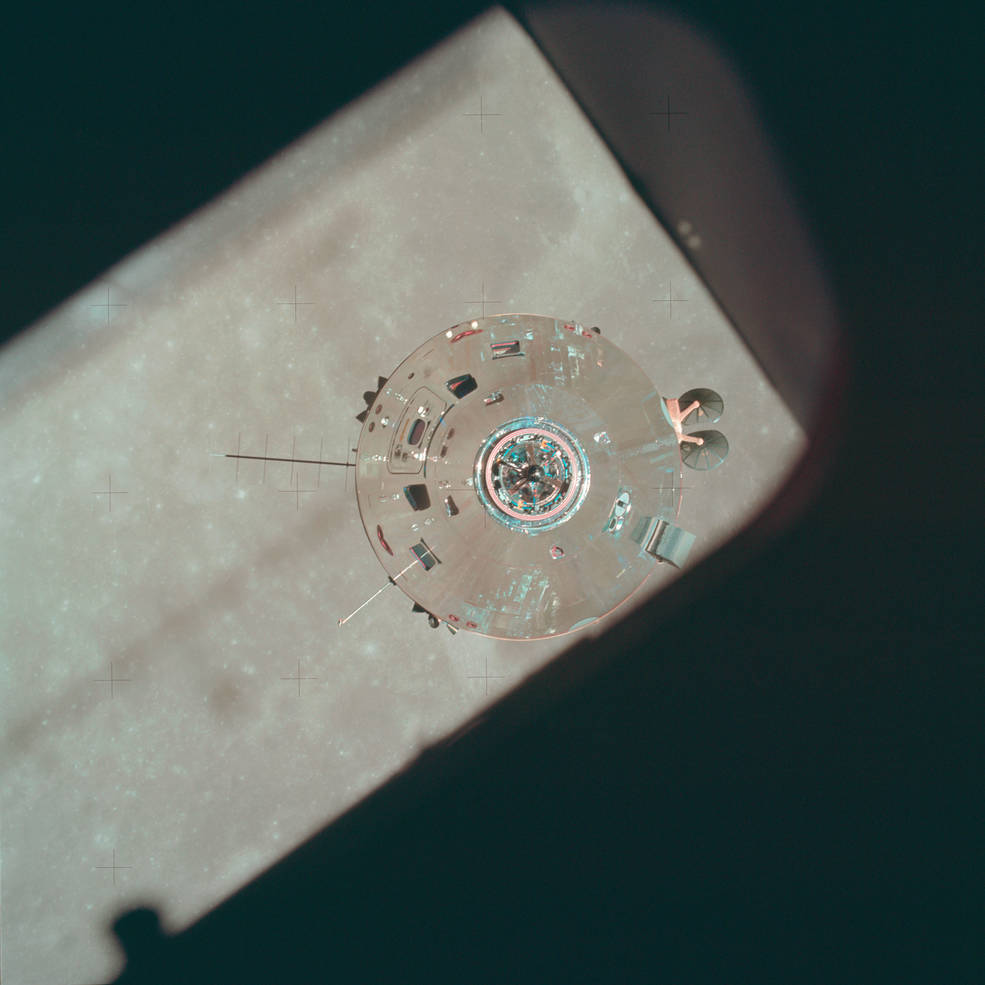
The 2026 PURSUE catalogue isolates a separate Apollo 17 image anomaly: three dots in a triangular formation in the lower-right quadrant of the lunar sky, visible more clearly under magnification.
The official problem statement preserves uncertainty. There is no consensus on the anomaly's nature. Preliminary U.S. government analysis suggests it could represent a physical object in the scene, and the original film has reportedly been obtained for fuller analysis.
That makes VM006 worth following. It does not make it proof of a spacecraft, and it does not justify merging it with every bright fragment, rhythmic flasher, retinal flash and lunar-surface event reported during Apollo 17.
Controls what was actually said and when.
Separates immediate mission recollection from later UFO retelling.
Provide operational and retinal-light-flash context.
A distinct image-analysis problem requiring frame, lens, attitude, Sun angle and neighbouring-frame reconstruction.
Show what the 2026 catalogue actually claims — and what it does not.
Prevents external lights from being conflated with internally generated astronaut visual flashes.