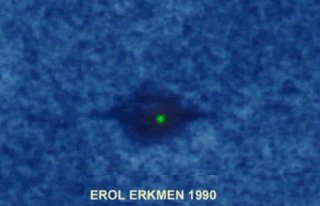
Before the photograph, there was a visual claim.
At about 14:00, Erkmen and a second diver identified only as “Mr Kemal” were reportedly searching for an old wreck in Saros Bay, at roughly 57 metres depth.
Erkmen later told Turkish researcher Sefer Murat Aksoy that he first felt as though the divers were being watched. He then saw a greenish light ahead. It disappeared, then reappeared on his left. Erkmen interpreted the change in position as movement around the divers.
He said he watched it for almost three minutes before using an older underwater Kodak camera to take a photograph. According to the account, the light went out as the shutter was released. With their air running low, the divers then surfaced.
Kemal matters because he was reportedly present. But no independent first-person statement from him is currently available. Until one is recovered, the public evidence record remains Erkmen's account of a two-diver event, not two independently documented witness streams.
Three minutes in the water. Decades of interpretation.
The negative is the hardest problem in the case.
Erkmen's own account says the negative showed nothing obvious, while the printed image contained a green point that became a “disc-shaped object” only after extreme enlargement.
That matters because film records light in the emulsion before a paper print exists. If a feature appears only in a later print or becomes meaningful only after extreme magnification, investigators have to consider print-processing artefacts, dust, grain, dye irregularity, backscatter and enlargement effects before inferring a structured object.
The circulated image is therefore evidentially interesting but weakly constrained. No original negative has been made available for modern independent examination in the current source trail. No laboratory report establishes what the dark oblong area or green point physically represents.
Magnification makes existing information larger. It does not create missing detail.
What enlargement can do
Reveal low-contrast structures already recorded in the film or print, help map tonal boundaries, and make tiny image elements easier to compare.
What enlargement cannot do
Recover physical distance, prove external three-dimensional structure, distinguish grain from geometry without first-generation material, or turn an unresolved patch into measured craft anatomy.
The underwater environment offers several mechanisms — but none has been demonstrated for this frame.
At depth, the physics matters. Red and yellow wavelengths are absorbed rapidly, leaving blue-green light disproportionately visible. Suspended material can also produce halos, flare and backscatter around small sources.
Bioluminescence
Marine organisms can emit blue-green light, sometimes in compact flashes or disturbed patches. Aksoy himself listed a phosphorescent organism as a possible explanation. No sample or species identification ties a specific organism to Erkmen's sighting.
Diver light / glow source
Another torch, marker light or glow source can appear unusually bright against a dark underwater field, especially through suspended sediment. No equipment inventory or geometry reconstruction has shown a diver light occupying the reported positions.
Flash + particulate backscatter
Particles close to the lens can reflect flash light and create bright points, halos or diffuse forms. This is common in underwater photography, but the exact flash/camera configuration and first-generation negative are needed to test whether it fits this exposure.
Print / enlargement artefact
Dust, emulsion irregularities, dye variation, grain clumping or print-processing effects can become visually structured after extreme enlargement. This category becomes especially important because Erkmen said the negative itself showed nothing obvious.
The case became public about a decade after the dive.
1990 · claimed event
Erkmen says the dive and photograph occurred on 15 August 1990. No contemporary official or newspaper record has been recovered in the current research trail.
1999–2000 · Aksoy publication
Sefer Murat Aksoy publishes the detailed surviving narrative in “Turkey USO Sightings.” This is the principal surviving source from which most later accounts descend, making it the controlling benchmark for separating original claims from later story growth.
WaterUFO / Carl Feindt
The case is catalogued as report 642 and Aksoy's account is preserved. This is valuable for survival of the text, but it does not create an independent investigation.
Later web retellings
Claims of video, temperature drops, multiple other divers or other dramatic effects should not be back-projected unless they can be traced to pre-2000 documentation.
The earliest surviving version is much leaner than the later internet legend.
The safest way to read Aegean is to separate what appears in Sefer Murat Aksoy's 1999–2000 account from details that only surface in later web retellings.
Earliest surviving Aksoy layer
Two divers. Saros Bay. Approximately 57 metres depth. A greenish light. Apparent change of position. Roughly three minutes of observation. One Kodak still photograph. A negative that showed nothing obvious. A green point in the print. A disc-like form interpreted after extreme enlargement.
Later additions requiring proof
Claims of a 15-second video, abrupt temperature drop, energy waves/ripples, additional divers or wider multi-witness corroboration do not appear in the core Aksoy narrative currently recovered. They should be treated as later-source additions until an earlier document is produced.
“Kemal” could materially change the case.
The second diver is one of the most important missing pieces because a genuinely independent account could either strengthen or substantially weaken Erkmen's narrative.
The current public source only gives a first name and says the surname was withheld at the witness's request. There is no quoted statement from Kemal describing the green light, its motion, duration, colour, position or disappearance.
Until that statement is recovered, describing the case as “two divers witnessed a USO” goes beyond the surviving public evidence. The safer formulation is: Erkmen reported that a second diver was present during the encounter.
A compelling underwater story attached to a very fragile photograph.
If Erkmen's conscious account is taken at face value, the event is unusual: a green light at depth, apparently changing position around two divers and extinguishing at the instant a photograph was taken.
But the photograph does not independently carry that story. The negative reportedly showed nothing obvious; the famous form emerged only in a print and after extreme enlargement; the second diver has no recovered first-person testimony; and the case entered the surviving public record years later through civilian UFO literature.
The strongest next step is not another enhancement. It is the physical evidence chain: negative, print, camera, film, processing, Aksoy notes and Kemal's statement.